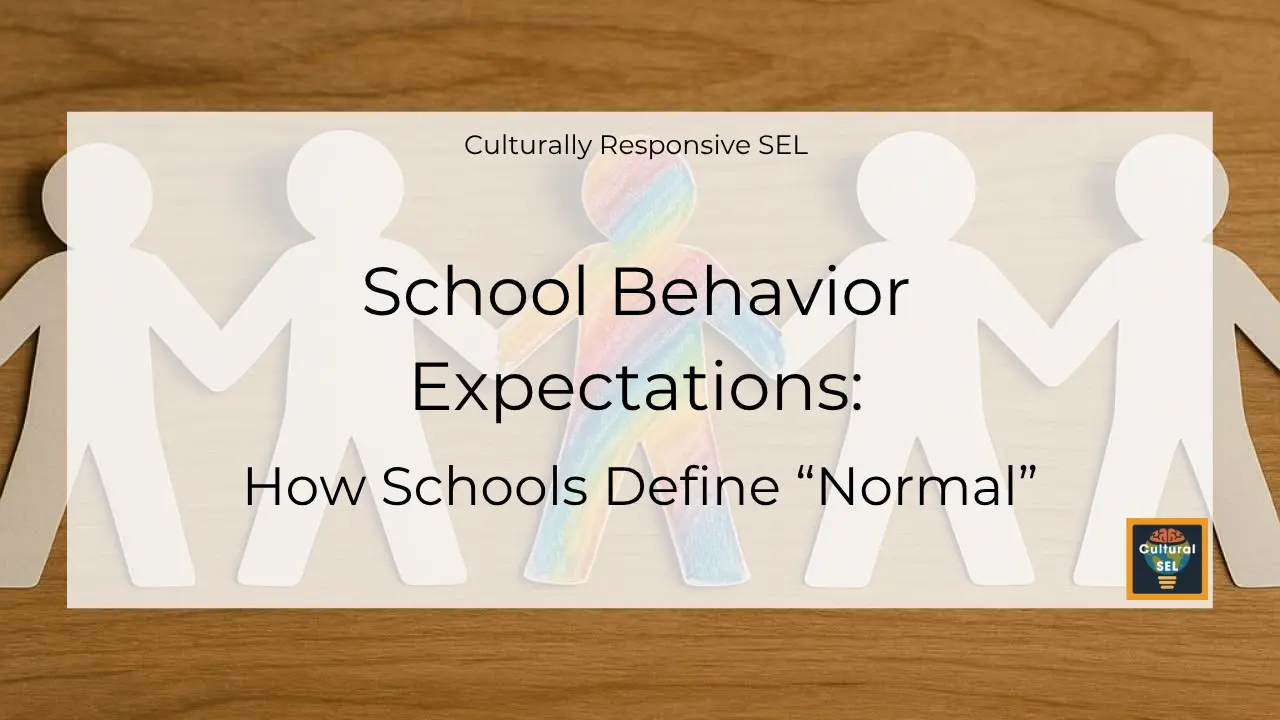
How School Expectations Define Normal Student Behavior
A child can be eager, respectful, and still get corrected all day.
A student answers quickly without raising their hand, looks away when spoken to, or speaks with energy during discussion.
In many classrooms, each of these moments gets corrected, even when the child is engaged and trying to participate.
This happens because schools do more than respond to behavior. They define what counts as “normal” through routines, rules, and repeated judgments. Those rules shape how behavior is seen before it is judged.
When you understand that, school feedback becomes easier to read. It stops feeling random and starts pointing back to the expectations behind it.
This matters for educators, families, counselors, and anyone supporting children through school behavior expectations and social-emotional learning.
FREE DOWNLOAD · REFLECTION GUIDE
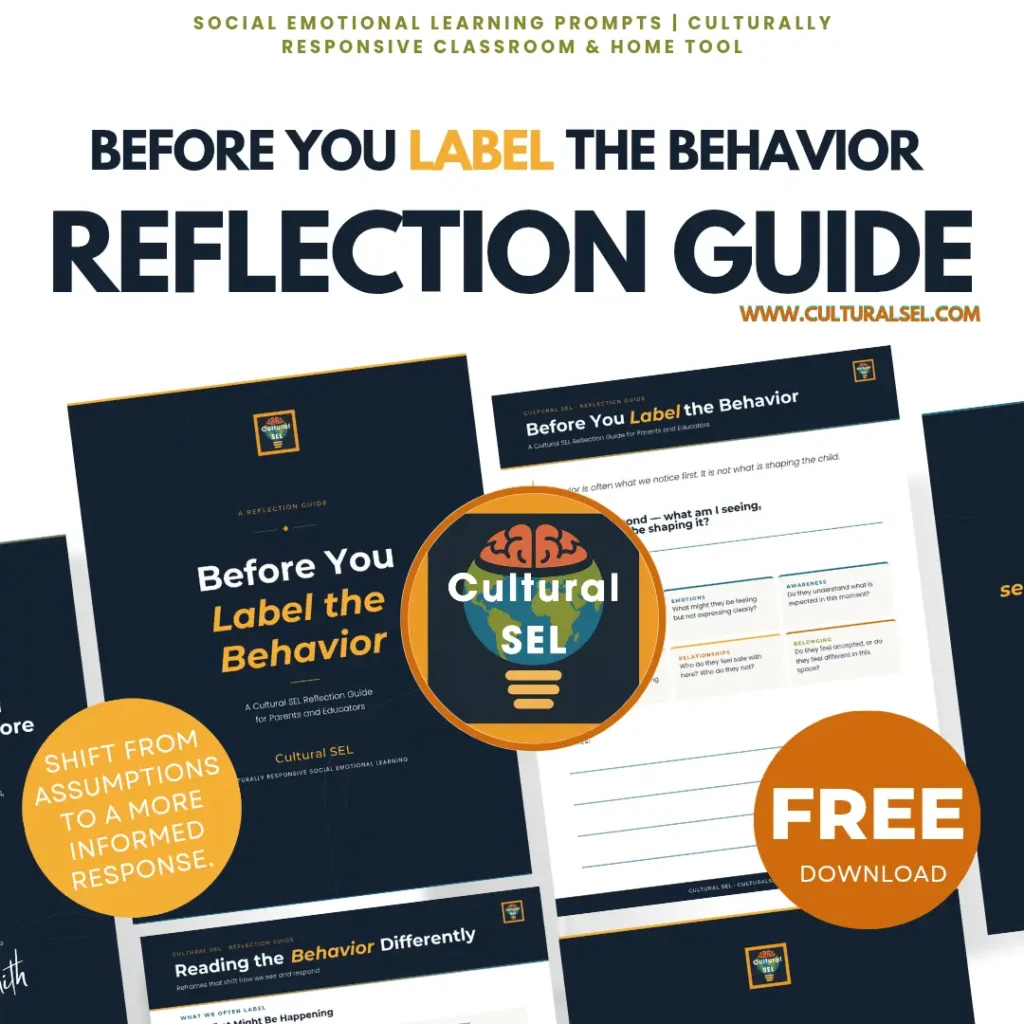
What if the behavior isn’t the whole story?
A free reflection guide that explores what may be influencing a child’s behavior before it is labeled, corrected, or misunderstood.
Schools Define Appropriate Behavior Through Clear Expectations
Schools teach behavior every day, even when no one says, “This is a behavior lesson.”
Students learn to sit still during instruction, raise a hand before speaking, make eye contact when addressed, and wait for a turn to talk. These actions become the standard for what “appropriate” looks like in that setting.
For example, a child may call out an answer because they’re excited and fully engaged. In many classrooms, that child still gets corrected. The message is clear: participation counts only when it follows the classroom format.
Those repeated corrections shape behavior. They also shape belief. Soon, the rule feels natural, even though it came from a specific school routine.
That daily repetition matters. Children learn the content of school, and they also learn the behavior script that school rewards.
Where School Behavior Expectations Come From
These expectations do not appear out of nowhere. Schools build them through systems.
Teacher training programs often stress classroom management, order, and smooth group instruction. School discipline policies reinforce that.
Older classroom models also shaped today’s norms, especially models built for control, compliance, and efficiency.
That structure makes sense in one way. A teacher with 25 students needs predictable routines. Quiet listening and controlled turn-taking help a large group move together.
Still, the need for order can turn one style of behavior into the baseline for everyone. Once that baseline is set, schools treat it as common sense.
A classroom rule may help the room function. At the same time, it can become the measure for what counts as respectful, engaged, or mature.
Research from organizations like OECD shows that classroom structures and behavior expectations are shaped by institutional systems, not universal standards.
Why School Behavior Feels “Normal” Even When It Is Not Universal
School rules can start to feel like the default standard for how behavior should look in school because they are repeated every day.
Students hear the same reminders each day. Raise your hand. Sit still. Wait your turn. After a while, those rules stop sounding like choices and start sounding like facts. Adults can fall into the same pattern.
A good example is eye contact. Many schools read eye contact as a sign of attention and respect.
Yet some children learn at home that direct eye contact with adults is rude or too intense. In school, that child may look away and get read as disengaged.
The behavior did not change. The setting changed, and so did the interpretation.
What feels normal in school is often what school repeats.
That is why behavior can look “obvious” in one space and misunderstood in another. Familiarity often gets mistaken for neutrality.
Classroom Communication Styles Shape How Behavior Is Judged
Classrooms rely on a specific communication style for participation.
Most classrooms favor one speaker at a time, direct answers, short responses, and quiet listening. That style works well for many students. Still, it is not the only way people show interest or respect.
In some homes, overlapping talk shows connection. A child may jump in while someone else is speaking because that is how conversation flows in their family. In school, the same child may get labeled disruptive.
This matters because communication is social. Children do not invent it from scratch when they walk into a classroom. They bring patterns from home, community, language, and culture.
When a school recognizes only one way of participating, other styles can disappear under labels like “rude,” “off task,” or “too talkative.”
The child then gets judged through the classroom’s preferred style, not through the full context of the behavior.
When Home Behavior Norms Do Not Match School Expectations
Children arrive at school with a working set of social rules already in place.
They know how to speak to adults, how to join a conversation, how to show respect, and how to express emotion. Those home norms may line up with school expectations, or they may not.
A child who speaks loudly may sound “too much” at school, even if strong expression is welcomed at home. Another child may wait to be invited into discussion because that is respectful in their family, then get seen as passive in class.
Mismatch creates confusion. Adults may see a behavior problem when the real issue is a gap between environments.
That does not mean every school correction is unfair. It means behavior makes more sense when adults ask where the norm came from and who set it.
Guidance from UNESCO on inclusive education highlights how cultural context affects how behavior is interpreted in learning environments.
How School Systems Shape Behavior Before It Is Labeled
By the time a behavior gets labeled, the school has already chosen the measuring stick.
If the classroom rule is “raise your hand before speaking,” other forms of participation start from a disadvantaged position. A student who blurts out an idea may be thoughtful, eager, and ready to learn. Still, the behavior has already been placed outside the accepted pattern.
That is how labels form. First comes the expectation. Then comes the comparison. After that, adults decide whether the behavior was respectful, disruptive, appropriate, or immature.
This sequence matters. Many adults believe they are judging behavior as it is. In practice, they are judging behavior against a pre-set school standard.
When that standard stays invisible, the label can feel objective. It rarely is.
Parents Can Recognize System Mismatch Early
Parents often hear behavior feedback before they hear the context behind it. Clear questions help.
Watch for patterns like these:
- When does your child get corrected most often at school?
- What exact behavior keeps getting flagged?
- Does that same behavior look different at home?
- Is the concern about the behavior itself, or the way your child expresses it?
A child who is often told they are interrupting may be showing excitement and engagement, especially if fast back-and-forth talk is normal at home. That does not erase the classroom rule. It does help explain the pattern.
I have sat in school meetings where the concern sounded serious at first. Once I asked for specific examples, I saw the issue more clearly. The concern centered on how the behavior showed up in that classroom. That changed how I responded and how I supported my child.
Ask for the exact moment of concern. Specific examples show whether the issue involves safety, learning, or style.
Seeing the mismatch early helps families respond with clarity instead of fear. It also prevents labels from growing larger than the actual concern.
Cultural SEL Starts With Understanding Systems First
Cultural SEL begins with understanding how expectations are set before behavior is judged.
In practice, this means adults pause before reacting and ask what the behavior represents in context. A child speaking out of turn may be showing urgency or engagement. A child who stays quiet may be following a different rule about when it is appropriate to speak.
This shift changes the response. Instead of correcting immediately, adults can first identify whether the issue affects safety, learning, or classroom flow, or whether it reflects a difference in communication style.
That distinction matters. It allows adults to guide behavior without misreading identity.
Systems Define Normal Before Children Ever Enter the Classroom
Children do not walk into a blank social space. The structure is already there.
Before the first student arrives, the classroom has routines, rules, pace, and behavior categories. Some actions will count as respectful. Others will count as distracting. Those judgments have already been mapped out.
As a result, children spend part of school learning how to fit into a pre-set system. That reality shapes behavior from day one.
When adults keep that in view, they read behavior with more care. They can separate true harm from simple difference, and they can guide children without assuming one way is the only way.
Frequently Asked Questions About School Behavior Expectations
Why do schools have strict behavior expectations?
Schools have strict behavior expectations to manage groups of students and protect learning time. Clear routines help teachers lead a classroom, especially with large class sizes. These expectations come from specific models, so they are practical but not universal.
Are school behavior expectations culturally neutral?
No. School behavior expectations are not culturally neutral. Many reflect dominant ideas about respect, attention, and participation, such as quiet listening, direct eye contact, and quick responses.
Why do some children struggle with classroom behavior expectations?
Some children struggle because they follow different social rules at home. When those rules do not match school expectations, adults may misunderstand the behavior. The child is adjusting to a different system, not refusing to behave.
Does this mean school rules are wrong?
No. School rules help classrooms run smoothly. The key point is that they are specific to a setting. Once adults see that, they can hold expectations with more flexibility and fairness.
What is the first step in culturally responsive SEL?
The first step is recognizing that behavior expectations come from systems. When adults see where the rule came from, they can understand behavior in context and respond more accurately.
A child who gets corrected all day may not be failing at behavior. More often, that child is meeting one set of social rules while school applies another.
When adults understand where expectations come from, they stop treating one pattern as the only standard of normal. That shift changes how behavior gets seen, interpreted, and supported.
The next time school feedback sounds serious, ask which expectation shaped the judgment before accepting the label.
CONTINUE EXPLORING CULTURAL SEL
Explore free Cultural SEL guides, culturally responsive SEL tools, and practical resources for understanding how cultural environments, identity, belonging, relationships, and lived experiences connect with children’s social and emotional development.
📌 Save or share this post with someone who is raising, teaching, or guiding children.

Hi, I’m Faith, the creator of Cultural SEL
I create practical tools and resources that support children’s social and emotional development and help parents, caregivers, educators, and community professionals look beyond behavior labels.
My work focuses on how cultural environments, identity, belonging, relationships, and lived experiences shape what children experience and how adults interpret and respond.
Read more about Faith and Cultural SEL: https://culturalsel.com/about
Join the Cultural SEL community: https://culturalsel.com/fb