African, Caribbean, Afro-Latine & Afro-Diasporic SEL Books for Children

THIS POST MAY CONTAIN AFFILIATE LINKS. THIS MEANS WE MAY RECEIVE A COMMISSION FROM QUALIFYING PURCHASES YOU MAKE THROUGH OUR LINKS. KINDLY READ OUR DISCLOSURE NOTICE FOR MORE INFORMATION.
Finding children’s books that support social and emotional learning and reflect culture, identity, and lived experience is often harder than it should be.
This list centers African, Caribbean, Afro-Latine, and Afro-diasporic stories with accuracy and clear cultural context.
These books support emotional growth through family, memory, voice, immigration and everyday life, and they work well as read-alouds in classrooms, counseling spaces, libraries, and at home.
Each group is centered separately, with its own history and context. None is used as a stand-in for the others.
Children across the African diaspora learn who they are through family, community, imagination, and a sense of belonging. That is where social and emotional learning lives.
What if the right book still misses the child in front of you?
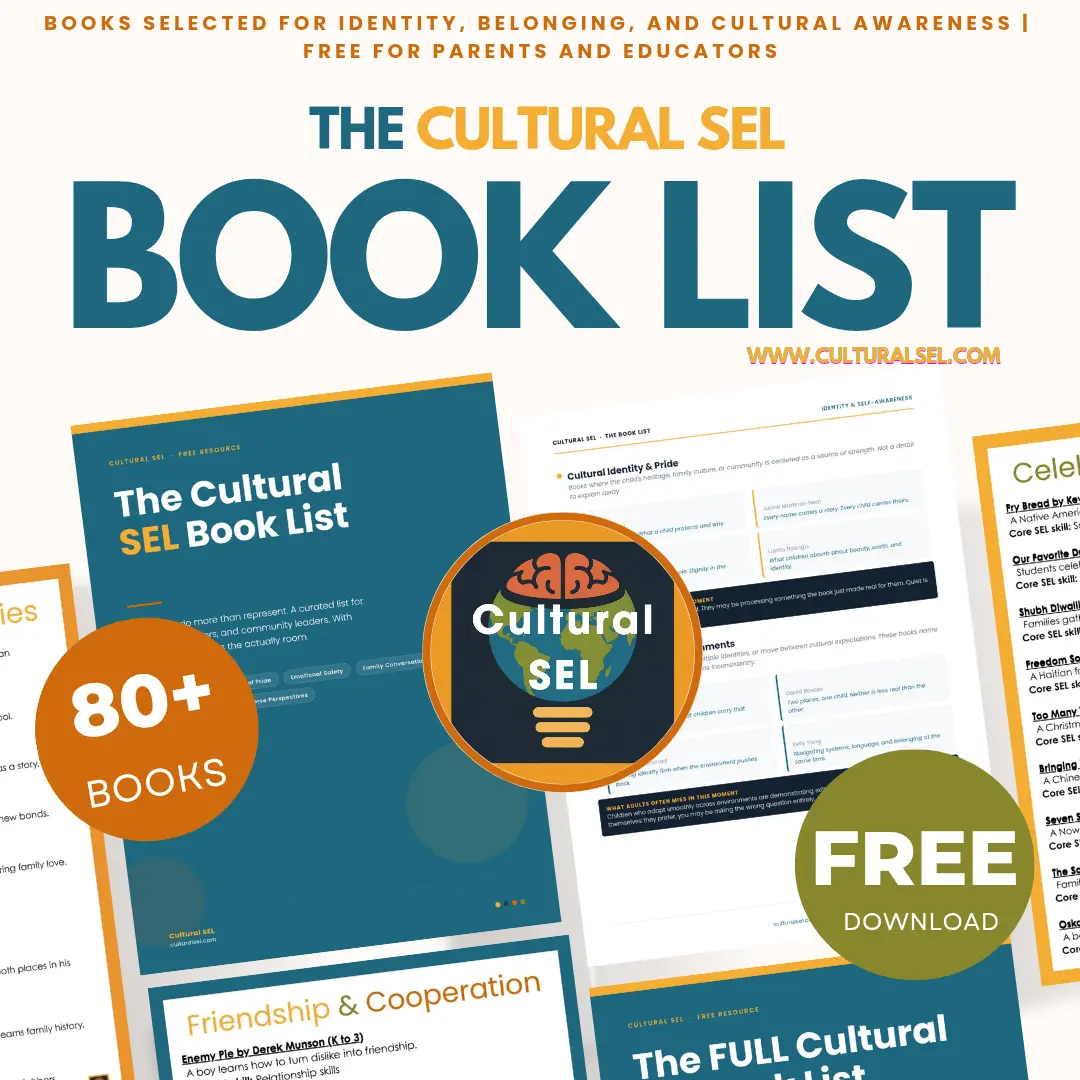
80+ books selected for identity, belonging, and cultural awareness. Each category includes what adults often miss, so you know how to use them, not just which ones to choose.
How This List Is Meant to Be Used
This list is designed for parents, educators, counselors, and caregivers who already value social and emotional learning and want book choices that reflect cultural context alongside emotional development.
It can be used:
- during heritage or cultural learning moments
- as part of classroom or home reading routines
- to support conversations about identity, belonging, and voice
- alongside African American–centered book lists, and not in place of them
There is no required order and no expectation to use every book. Each title stands on its own and can meet different needs at different times.
A Quick Way to Pick the Right Book for Your Group
Use this 3-step filter:
- What SEL support is needed right now?
Calming, empathy, confidence, or coping with change. - Whose experiences should be centered?
African, Caribbean, Afro-Latine, Afro-diasporic, migration, island life, or mixed identities. - What kind of story support helps today?
Gentle tone, humor, fewer conflict scenes, or clear hopeful endings.
You can also check the author or illustrator notes at the end of the book for one short line of context before reading.
Afro-Caribbean and Afro-Latine are not interchangeable terms.
Afro-Caribbean refers to Black communities from Caribbean nations, while Afro-Latine refers to people of African descent from Latin American countries.
Some communities overlap, but their identities are not the same, which is why the books below are intentionally grouped.
African-Rooted Stories
Stories shaped by African cultures, traditions, and family life, whether set in African countries or within African families living in the diaspora.
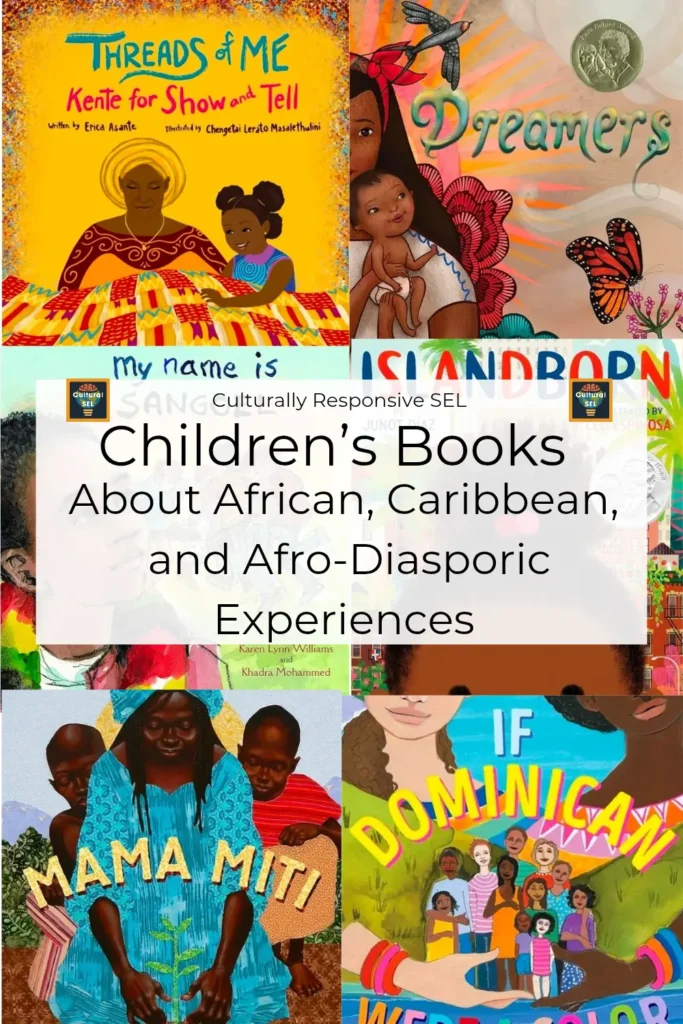
- Threads of Me: Kente for Show and Tell by Erica Asante (Ages 5–8)
A Ghanaian child brings Kente cloth to school and explains its meaning during show-and-tell, learning how to speak about culture when curiosity turns into attention.
SEL focus: identity, confidence, speaking up. - My Name Is Sangoel by Karen Lynn Williams and Khadra Mohammed (Ages 6–9)
A Sudanese child holds onto the meaning of his name while navigating school life and learning how to correct others with confidence.
SEL focus: identity, self-expression. - The Water Princess by Susan Verde, inspired by Georgie Badiel (Ages 6–10)
Inspired by real life in Burkina Faso, this story follows a child’s daily walk for water and the responsibility she carries within her family.
SEL focus: perseverance, empathy. - Mama Miti: Wangari Maathai and the Trees of Kenya by Donna Jo Napoli (Ages 6–10)
A story about caring for land and community, showing leadership through steady, long-term action.
SEL focus: responsibility, care for others. - Handa’s Surprise by Eileen Browne (Ages 4–7)
A walk through a village becomes a story about generosity, observation, and shared joy through food.
SEL focus: awareness of others, kindness. - Ashanti to Zulu: African Traditions by Margaret Musgrove (Ages 7–11)
A visual reference that introduces African cultures through names, traditions, and daily life, offering context rather than a single storyline.
SEL focus: cultural awareness, respect.
Caribbean-Rooted Stories
Stories shaped by Caribbean cultures, traditions, languages, and family life, whether set in Caribbean nations or within Caribbean families living in the diaspora.
- Malaika’s Costume by Nadia L. Hohn (Ages 5–8) Malaika looks forward to wearing her Carnival costume, but an unexpected change brings disappointment and learning how to cope with big feelings with family support.SEL focus: coping with disappointment, emotional regulation, community support.
- Islandborn by Junot Díaz (Ages 6–9)
A child gathers stories from family members to understand the island she left behind.
SEL focus: identity, emotional connection. - Drum Dream Girl by Margarita Engle (Ages 7–10)
Inspired by a Cuban figure, this story follows persistence as a girl challenges expectations around who gets to play the drums.
SEL focus: confidence, speaking up. - The Jumbies by Tracey Baptiste (Ages 9–12)
Rooted in Caribbean folklore, this story explores courage and decision-making while protecting home and community.
SEL focus: courage, boundary setting.
Afro-Latine Stories
Stories shaped by Latin American cultures and languages, centered on people of African descent within those communities, whether set in Latin American countries or within diaspora families.
- When the Spirits Dance Mambo by Marta Moreno Vega (Ages 7–11)
A story rooted in Afro-Caribbean spiritual tradition, where a child learns to understand memory, ancestry, and cultural inheritance through family and ritual.
SEL focus: identity, belonging, emotional awareness. - If Dominican Were a Color by Sili Recio (Ages 4–8)
A child connects Dominican identity to colors, memories, food, and family life, naming Blackness and belonging within a Dominican context.
SEL focus: identity, belonging, pride.
Afro-Diasporic Stories
Stories shaped by Black communities living across countries and regions, often connected through migration, family, and shared community life.
- Thank You, Omu! by Oge Mora (Ages 4–7)
A neighborhood story about generosity and shared care within an immigrant Black community.
SEL focus: empathy, community care. - Julian Is a Mermaid by Jessica Love (Ages 5–8)
A gentle story about self-expression and affirmation within family.
SEL focus: emotional safety, confidence. - Dreamers by Yuyi Morales (Ages 6–10)
A migration story about adjustment and building belonging through imagination and story.
SEL focus: resilience, hope. - My Papi Has a Motorcycle by Isabel Quintero (Ages 7–10)
A reflection on neighborhood change and memory, showing how place and family shape identity.
SEL focus: understanding change, belonging.
Use These Books for a 10-Minute SEL Routine
- Before reading (1 minute)
Name the focus in simple language, such as “Today we’re practicing empathy,” and offer a pass option. - During reading (5 minutes)
Pause once and ask, “What might they be feeling right now?” - After reading (4 minutes)
Choose one action: draw a feeling, role-play a repair sentence, or name one kind next step.
This routine works in classrooms, library storytime, counseling groups, and after-school programs. At home, keep it simple. One page, one feeling, one next step.
Expanding Afro-European Stories
As someone raised as a Black German, I have always looked for children’s books that clearly center the Afro-European experience.
Those stories are far fewer in number, and many are published only in their native European languages rather than widely available in English.
Many of the titles that are available in English also tend to be written for older audiences rather than early childhood.
💡 If you know strong, age-appropriate Afro-European children’s books available in English, including Afro-German, Afro-French, or Afro-Dutch titles, please share them in the comments.
I would love to continue expanding this list with accuracy.
Explore More Titles
If you are building your shelf beyond this list, we share additional culturally responsive SEL books in our Amazon storefront.
If you prefer another retailer, many of these same titles are also available through Books-A-Million
Use the option that works best for your family, classroom, or library.
Frequently Asked Questions
What makes a book an SEL book?
It gives children a safe way to notice feelings, practice choices, and see care and repair in action through a story.
What if a story brings up fear or grief?
Offer a pass, keep questions general, and provide a quiet option such as drawing or sitting nearby.
What ages are these best for?
Most titles work well from early childhood through upper elementary. Adjust prompts by using pointing, choices, or fewer words for younger children.
Can these books be used in classrooms, counseling, or libraries?
Yes. These titles work well for read-alouds, small groups, counseling sessions, library storytime, and family settings. Prompts can be adjusted based on time and group needs.
How is this list different from African American–centered book lists?
African American–centered lists focus on experiences shaped by communities formed through forced displacement and enslavement in the United States. This list centers African, Caribbean, Afro-Latine, and other Afro-diasporic stories shaped by migration and movement across countries and regions. Both support social and emotional learning and are used based on which histories and experiences are being centered.
“Stories are how we make sense of the world.” – Chimamanda Ngozi Adichie
You now have a starter set of African, Caribbean, Afro-Latine, and Afro-diasporic children’s books that support SEL through culture, family, and everyday life.
You also have a short routine you can repeat anytime.
If you want help matching a book to your setting, share your age range and where you plan to use it in the comments.
CONTINUE EXPLORING CULTURAL SEL
Explore free Cultural SEL guides, culturally responsive SEL tools, and practical resources for understanding how cultural environments, identity, belonging, relationships, and lived experiences connect with children’s social and emotional development.
📌 Save or share this post with someone who is raising, teaching, or guiding children.

Hi, I’m Faith, the creator of Cultural SEL
I create practical tools and resources that support children’s social and emotional development and help parents, caregivers, educators, and community professionals look beyond behavior labels.
My work focuses on how cultural environments, identity, belonging, relationships, and lived experiences shape what children experience and how adults interpret and respond.
Read more about Faith and Cultural SEL: https://culturalsel.com/about
Join the Cultural SEL community: https://culturalsel.com/fb