PBIS and Cultural Mismatch in Schools: What Families and Teachers Should Know
PBIS and cultural mismatch in schools shows up when the same behavior is read differently depending on the setting.
Why does a child seem “respectful” in one room and “off task” in another? That question sits at the heart of PBIS and cultural mismatch in schools.
PBIS (Positive Behavioral Interventions and Supports) is a school-wide framework that teaches expected behavior through clear routines, consistent responses, and positive reinforcement to improve student outcomes.
PBIS gives schools a clear behavior system. It can help students feel safe and supported. Still, the system can break down when schools and families attach different meanings to the same behavior.
That gap matters because children notice it every day. Once you see how those mixed signals work, PBIS makes more sense, and so do the students moving through it.
FREE DOWNLOAD · REFLECTION GUIDE
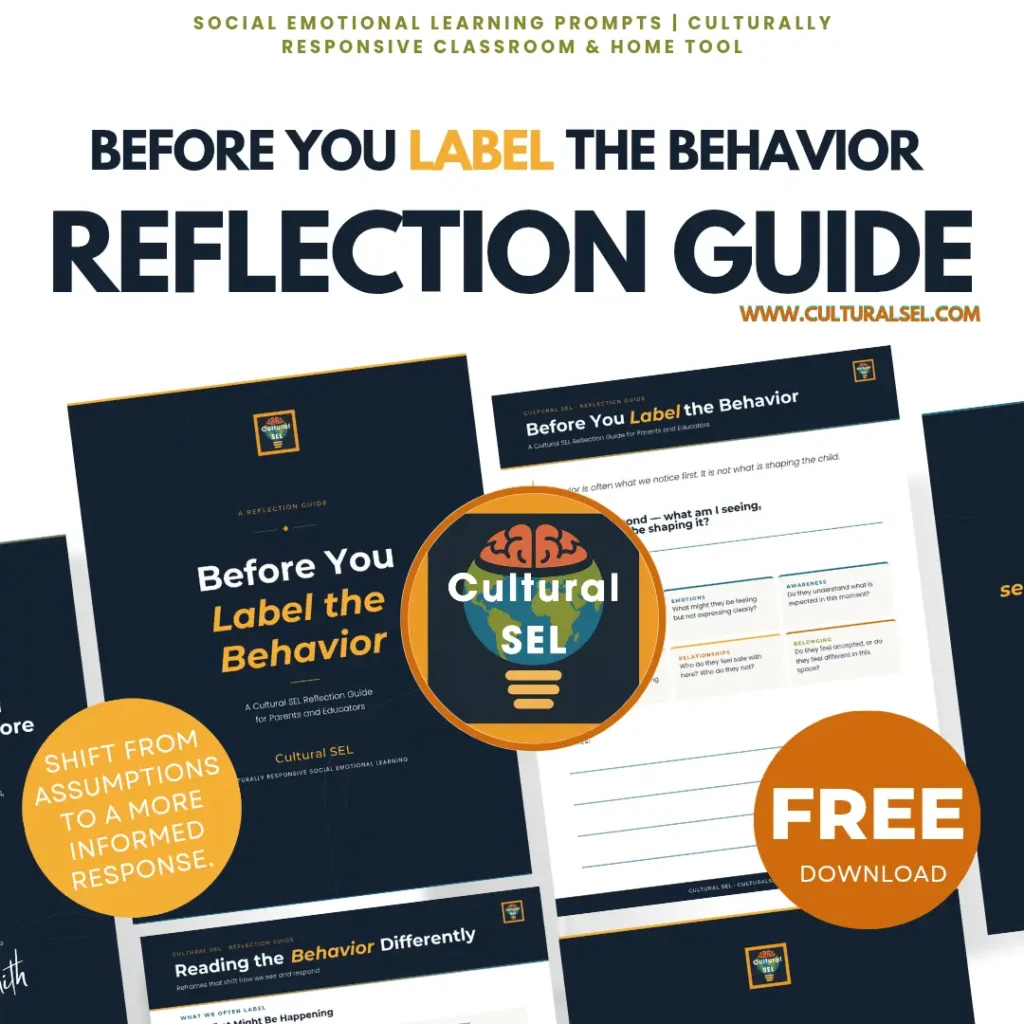
What if the behavior isn’t the whole story?
A free reflection guide that explores what may be influencing a child’s behavior before it is labeled, corrected, or misunderstood.
PBIS Behavior Systems Shape How Schools Define “Good Behavior”
PBIS and similar structured behavior frameworks are used across many school systems globally to create consistent expectations and responses to student behavior.
PBIS teaches behavior the way schools teach routines. Students learn expected actions, hear common language, and receive reminders and rewards. Many schools center values like respect, responsibility, and readiness.
This structure can help. Students know what adults expect, and staff can respond with more consistency. That kind of predictability matters, especially for children who need clear routines.
Still, structure depends on shared meaning. A school may define “respect” as making eye contact, speaking in a calm voice, and answering quickly.
A family may define respect through quiet listening, waiting to be called on, or avoiding direct challenge. Both sets of values make sense within their own setting.
When schools treat their version of behavior as universal, some students look compliant while others look wrong. The system stays organized, but the meaning behind behavior gets lost.
PBIS Expectations Do Not Carry The Same Meaning Across Cultures
Behavior expectations are never neutral. They grow from ideas about communication, authority, self-control, and social rules.
Take eye contact. In many classrooms, teachers read direct eye contact as honesty and attention.
In some homes and cultures, children show respect by lowering their gaze with adults. The same behavior can signal opposite meanings.
The same thing happens with tone, volume, body language, and response time. Some students are taught to speak with energy and overlap in conversation.
Others are taught to wait, listen, and keep their voice low. A teacher may read one style as engaged and the other as passive, even when both students are trying to do well.
Behavior systems work better when adults ask what a behavior means before they label it.
That simple shift can change how schools respond to children.
Students Often Translate Between Home Rules And School Rules
Many students manage two behavior systems at once. They learn one set of cues at home and another at school. Then they switch back and forth all day.
I see this in families trying to support both home expectations and school expectations at the same time. The child is not confused. The child is adjusting.
At school, speaking up may earn praise. At home, interrupting adults may bring correction. A child learns when to volunteer, when to stay quiet, and when to wait. That takes skill.
Adults sometimes call that inconsistency. A better word is adaptation. The student is reading the setting and adjusting behavior to fit the people in front of them.
This daily translation can be tiring. It can also create stress when children do not know which rule carries more weight.
When adults miss that tension, they may punish behavior that already reflects careful effort.
PBIS Reward Systems Motivate Students In Different Ways
PBIS often uses points, public praise, classroom charts, and prizes. Some students love that. They feel seen and want to earn more.
A student earns a reward and the teacher announces it to the class. The student lowers their head and avoids eye contact. The teacher reads that as disinterest. The student feels exposed, not proud.
Others react differently. Public praise can feel exposing, especially for students who value modesty or privacy.
A child may cringe at hearing their name announced, even while the teacher thinks they are offering encouragement.
In some families, effort is expected without outward celebration. In others, praise is more private and tied to the relationship, not the group. A visible reward system does not land the same for every student.
Schools do not need to remove rewards. They do need more than one way to affirm students.
Quiet feedback, private check-ins, and choice in recognition can make behavior support feel more respectful.
Behavior Without Context Leads To Misreading And Family Strain
When PBIS is used without context, adults fill in the blanks with assumptions. Quiet students may get marked as disengaged.
Expressive students may get labeled disruptive. Reserved students may seem unmotivated.
Those labels can follow a child fast. Once that happens, correction increases and trust drops. Teachers may feel frustrated, and students may start to expect negative feedback.
Families notice the fallout. Some children come home quieter than usual. Others say they “got in trouble” but struggle to explain why.
Parents may hear the school rules clearly and still leave meetings unsure how those rules fit their child’s way of being.
In my work with PTA and family engagement, I see this often. Behavior systems are explained clearly, but families still struggle to connect those expectations to how their children were taught to show respect at home.
That confusion does not come from poor communication alone. It comes from expectations being applied without shared meaning.
When that happens, behavior gets judged by appearance instead of understood through experience, and students are corrected for patterns they learned at home.
PBIS Works Better When Schools Build In Cultural Context
PBIS can still be useful. The gap shows up in how schools apply it.
A stronger approach begins with explanation. Instead of posting “Be respectful,” schools can describe several ways students may show respect.
One child may show it through eye contact. Another may show it through listening, waiting, or helping.
Staff training matters too. Teachers need support in reading behavior through a cultural lens, not only through school norms.
Family voice matters for the same reason. Parents can explain what behaviors mean at home, what correction sounds like, and what encouragement feels right for their child.
This keeps the structure of PBIS while making it more accurate and more fair.
Cultural SEL Connects Behavior Support To Real Student Experience
Culturally Responsive SEL adds the missing layer. It helps adults look at identity, belonging, bias, and the meaning behind behavior.
That changes the questions adults ask. Instead of asking only, “Did the student follow the rule?” they can also ask, “What did this behavior communicate?” and “How might this child have learned to show respect, stress, or self-control?”
In school-family conversations, the shift often happens when adults stop treating behavior as a simple compliance issue.
Once context enters the room, students make more sense. So do family concerns. Trust starts to grow because adults respond to the child, not only to the visible action.
Clear School-Home Alignment Lowers Behavior Conflict
When schools and families align, students do less code-switching. Expectations feel clearer, and adult responses become more accurate.
A teacher asks a student to explain their answer out loud. The student stays quiet. The teacher assumes they are unprepared.
At home, the child has been taught not to speak quickly in front of adults without being invited directly.
That does not mean school and home must match in every detail. It means both sides understand what behaviors mean, where those behaviors come from, and how a child can meet expectations without hiding key parts of who they are.
Even small changes help. A school can explain the purpose behind a routine. A family can share how their child shows respect or handles stress.
These conversations reduce unnecessary correction and help children move through both spaces with less strain.
How To Identify PBIS and Cultural Mismatch Signals Early
Mismatch does not always show up as obvious conflict. It often appears in small, repeated patterns that adults overlook.
Mismatch Signals In Students
- A child behaves differently at home and school
- A student follows rules but still gets corrected often
- A child avoids participation even when they understand the material
- A student reacts strongly to public praise or correction
- A child says “I don’t know what I did wrong” after repeated feedback
These patterns often show a student adjusting between different expectations.
Mismatch Signals In Classrooms
- The same behavior is praised in one student and corrected in another
- Teachers describe behavior as “confusing” or “inconsistent”
- Classroom expectations are clear, but some students still struggle to meet them
- Behavior corrections increase without clear improvement
These patterns often show expectations being applied without shared meaning.
Parent and Teacher Alignment Checklist for PBIS
Alignment does not require full agreement. It requires shared understanding.
What Schools Should Clarify
- Have we explained what behaviors mean, not just what they look like?
- Do we allow more than one way for students to show respect or engagement?
- Are we checking how families define key behaviors like respect, effort, and participation?
- Do we offer both public and private ways to recognize students?
What Families Should Share
- Do we understand how the school defines respect, responsibility, and participation?
- Have we explained how our child shows respect or handles stress at home?
- Are there behaviors our child uses at home that may be misunderstood at school?
- Do we feel comfortable asking how behavior expectations are applied in class?
What Both Should Align On
- What does “respect” look like in both settings?
- How does the child respond to correction and encouragement?
- Where does the child seem most comfortable or most stressed?
These conversations reduce confusion before it turns into conflict.
Frequently Asked Questions About PBIS and Cultural Mismatch
What is PBIS in simple terms?
PBIS is a school system that teaches expected behavior through clear routines, reminders, and positive feedback. Its goal is to help students know what to do and feel supported doing it.
Why do PBIS systems not work the same for every student?
They often rely on behavior norms that come from one cultural view of respect, attention, or self-control. When families use different norms, students may get misread.
Is PBIS harmful for multicultural students?
PBIS itself is not harmful. The issue shows up in how it is applied. When schools use one definition of behavior without considering cultural differences, students can be misunderstood even when they are trying to meet expectations.
How can schools improve PBIS for diverse classrooms?
Schools can invite family input, allow more than one way to show expected behavior, and train staff to interpret behavior with context. Culturally Responsive SEL also helps adults connect rules with real student experience.
Behavior systems give structure. Context gives those systems meaning.
When schools hold both at the same time, children do not have to split themselves between home and school.
They can show up more fully, and adults can respond with more care and accuracy. That is where behavior systems start working with students, not against them.
CONTINUE EXPLORING CULTURAL SEL
Explore free Cultural SEL guides, culturally responsive SEL tools, and practical resources for understanding how cultural environments, identity, belonging, relationships, and lived experiences connect with children’s social and emotional development.
📌 Save or share this post with someone who is raising, teaching, or guiding children.

Hi, I’m Faith, the creator of Cultural SEL
I create practical tools and resources that support children’s social and emotional development and help parents, caregivers, educators, and community professionals look beyond behavior labels.
My work focuses on how cultural environments, identity, belonging, relationships, and lived experiences shape what children experience and how adults interpret and respond.
Read more about Faith and Cultural SEL: https://culturalsel.com/about
Join the Cultural SEL community: https://culturalsel.com/fb