When School and Home Expectations Don’t Match: What Families Need to Know
School rules often assume one shared way to show respect: raising hands, making direct eye contact, and waiting turns to speak.
At home, families may teach overlapping conversation, indirect communication, or different signs of respect.
A child can follow expectations at home and still get corrected at school for the same behavior.
That is where the mismatch begins, and that gap can shape how children feel, act, and understand themselves.
A school-home expectation mismatch happens when the rules, communication styles, or behavior norms a child learns at home do not match what is expected at school.
This can affect how a child participates, how their behavior is interpreted, and how they understand themselves across different environments.
FREE DOWNLOAD · REFLECTION GUIDE
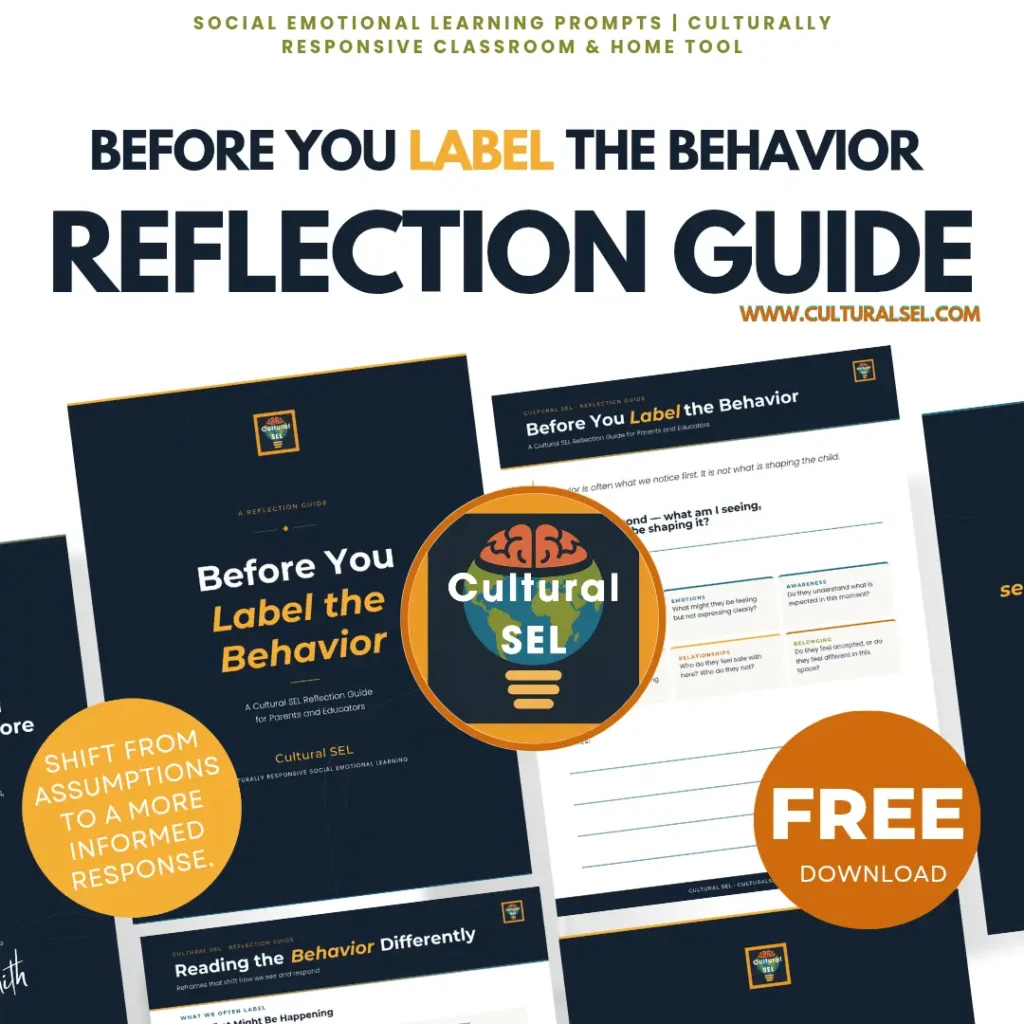
What if the behavior isn’t the whole story?
A free reflection guide that explores what may be influencing a child’s behavior before it is labeled, corrected, or misunderstood.
School And Home Expectations Do Not Always Align
Schools need routines, so many classrooms use the same basic rules for everyone. Those rules help a group run on time. Still, they often reflect one communication style more than others.
At home, children may learn that speaking over someone shows interest, not disrespect. They may hear that looking down shows respect to an adult.
They may also learn to wait for a pause that sounds different from the one a teacher expects. When home and school use different rules, the child is left to sort them out in real time.
These differences often reflect cultural differences in parenting and school expectations, even when no one names it directly.
Children Show Behavior Changes When Expectations Clash
Parents often notice changes first. A talkative child may come home quiet after school. A child who usually shares freely may suddenly hold back. Some children show frustration and cannot explain why.
These changes are rarely random. The child is managing two systems with different rules. For example, a child who speaks freely at home may become silent in class because they are unsure when it is okay to speak.
That silence can look like disengagement, even when the child is working hard to avoid another correction.
This is why some parents search for answers like “why is my child’s behavior different at school than at home” or notice what feels like a home and school rules conflict.
Emotional Tension Builds Between Children And Parents
When expectations clash, children can feel misunderstood. They may wonder which version of themselves is right. That kind of uncertainty can lead to worry, shame, or anger.
Parents feel tension too. A teacher may describe a child as disruptive, rude, or withdrawn, while the family sees a warm, expressive, respectful child at home.
That gap is confusing. It can also strain trust between home and school, because the feedback does not match the child the family knows.
Families Translate School Expectations At Home
Many families step in as interpreters. They explain classroom rules, prepare children for specific moments, and help them shift between settings without feeling wrong.
A child often needs context, not another correction. A simple script can help:
“At school, you may need to wait before speaking. At home, we speak more freely.”
That kind of explanation gives the child a map. It says, “These places work differently,” instead of “Your way is bad.”
Families Decide When To Adjust And When To Push Back
Families do not handle every school expectation the same way. Some rules are clear and useful, so parents may help their child adjust.
For example, waiting for directions during a fire drill or raising a hand during whole-group instruction may make sense.
Other expectations deserve a closer look. A family may question rules that treat one speech pattern, one body language style, or one way of showing respect as the only acceptable option.
That can lead to conversations with teachers, requests for clarity, or firm boundaries. Family values shape those choices.
Cultural Background Influences Family Response
Family response is shaped by experience. Some families adapt out of respect for authority or because past school conflict felt risky.
Others speak up early and ask for change. Some decide the fit is poor and move to a new classroom, school, or learning setting.
These responses come from lived experience, community history, and past contact with schools. They are learned responses, not fixed personality traits.
Two families can face the same issue and respond in very different ways because they carry different stories into the room.
Learning to Navigate Two Systems in Real Life
Many children learn this shifting early. I grew up between home and school expectations that did not always match.
At school, speaking a certain way mattered. At home, expression sounded different, and it carried warmth, humor, and closeness.
Children learn when to adjust, when to hold onto identity, and how to read a room. That can build strong social awareness.
It can also create pressure when adults do not name what is happening. A child should not have to figure out that split alone.
It took time to understand both without feeling like one was wrong. What helped was having language for both spaces instead of feeling like I had to choose between them.
Small Patterns Show Where Misinterpretation Begins
Mismatch rarely starts with a major conflict. It starts with small patterns: the same behavior gets corrected again and again, a child withdraws instead of joining in, or a parent hears feedback that does not match what they see at home.
Those moments build over time. Then behavior gets misread. A child who avoids eye contact may be labeled defiant.
A child who talks with energy may be marked impulsive. Support needs to begin at the pattern stage, before those labels settle in and shape how the child is seen.
Family Support Shapes How Children Understand The Mismatch
With support, children can understand both environments and keep their confidence.
They learn that different places have different rules, and they do not have to erase themselves to move through them.
Without support, confusion grows. Some children withdraw. Others overcorrect and become tense, guarded, or afraid to participate.
The goal is to help the child understand both systems clearly, so they can function at school and still feel at home in themselves.
What Families Can Do When School Expectations Don’t Match
Families can reduce confusion when they respond early and clearly.
Name The Difference Clearly
Tell your child that home and school may expect different things. Keep the message steady and simple. Neither environment needs to be framed as right or wrong for the child to understand the difference.
Give Children Language For Both Environments
Children need words they can use in the moment. You might say, “At school, wait for the teacher to call on you,” and also, “At home, we speak more freely.” Those phrases help children switch without guessing.
Watch For Behavior Shifts After School
Notice withdrawal, frustration, sudden silence, or a sharp change in mood. These shifts are signals. They often show that your child is carrying stress from managing different expectations all day.
Decide When To Support Adjustment And When To Step In
Ask clear questions: “Is this about structure or control?” and “Is my child being misunderstood?” Those questions help families sort out which school rules support learning and which ones may need a response.
Communicate With The School Early
Share how your child communicates at home. Explain what respect looks like in your family and what may be misread. Early context can prevent repeated correction later.
Reinforce Identity At Home
Children need to know they do not have to change who they are to succeed. Support their way of speaking, their way of expressing, and their sense of belonging, even while you help them meet school expectations.
What Schools Can Adjust To Support Families
Schools can lower stress for children when expectations are clear and flexible.
Ask Before Assigning Meaning To Behavior
The same behavior can mean different things in different homes. For example, avoiding eye contact can signal respect in some cultures. Teachers need to pause before attaching intent to a child’s actions.
Make Expectations Explicit
Many classroom rules stay unspoken, and that creates confusion. Schools should explain when to speak, how to participate, and what respect looks like in that classroom. Clear expectations help every child, especially those moving between different norms.
Allow Different Ways To Participate
Participation does not need one format. Structured responses, partner talk, written reflection, hand signals, and other non-verbal options can widen access. Students are more likely to engage when the path to participation fits their communication style.
Work With Families, Not Around Them
Families already read behavior at home every day. Better outcomes happen when schools listen, families share context, and adults agree on how to support the child. That shared understanding reduces mixed messages.
Look At Patterns, Not Isolated Moments
One incident rarely tells the full story. Repeated correction often points to mismatch. Teachers can ask, “Is this behavior being misunderstood?” and “Am I expecting one way of being?” Those questions shift the response from judgment to support.
These questions come up often for families, teachers, and school staff trying to understand what is happening and how to respond.
When School And Home Expectations Do Not Match: Key Questions Answered
Why Does My Child Act Differently At School Than At Home?
Children adjust their behavior based on the rules around them. If school and home expect different things, your child may act like a different person in each setting.
Is My Child Being Disrespectful Or Confused?
Confusion is often the better starting point. Many children are trying to follow different rules at the same time, and their stress can look like poor behavior.
Should I Teach My Child To Follow School Rules Even If They Feel Wrong?
Start with understanding. Once the expectation is clear, decide whether it supports learning or clashes with your child’s identity, communication style, or dignity.
How Can I Support My Child Without Adding Pressure?
Explain both environments clearly. Give your child language for each one, and keep home grounded in acceptance rather than constant correction.
When Should I Talk To The Teacher?
Talk early when patterns repeat, your child starts changing after school, or the feedback does not fit what you know about your child. Early contact can stop a small issue from turning into a fixed label.
What Is Code-Switching In Children And Is It Harmful?
Code-switching is when a child changes how they speak or behave depending on the environment. It is a normal skill, but it can become stressful when a child feels they have to hide parts of themselves to be accepted.
Further Reading and Research
- OECD — Research on student behavior, learning environments, and cultural context in education
- UNESCO — Guidance on cultural diversity and inclusive education
Families carry a hard job between two systems. Schools shape behavior in one environment, while families shape identity across environments.
When expectations do not match, children often adjust in ways adults misread.
The gap usually shows up in small patterns first. A child changes behavior, a parent senses something is off, and a teacher responds to what they see in class.
When both home and school recognize that pattern, the response can shift toward clarity, support, and belonging.
Children do better when they do not have to choose between fitting in at school and feeling at home in who they are.
CONTINUE EXPLORING CULTURAL SEL
Explore free Cultural SEL guides, culturally responsive SEL tools, and practical resources for understanding how cultural environments, identity, belonging, relationships, and lived experiences connect with children’s social and emotional development.
📌 Save or share this post with someone who is raising, teaching, or guiding children.

Hi, I’m Faith, the creator of Cultural SEL
I create practical tools and resources that support children’s social and emotional development and help parents, caregivers, educators, and community professionals look beyond behavior labels.
My work focuses on how cultural environments, identity, belonging, relationships, and lived experiences shape what children experience and how adults interpret and respond.
Read more about Faith and Cultural SEL: https://culturalsel.com/about
Join the Cultural SEL community: https://culturalsel.com/fb