Foundation of Social Emotional Learning: What It Is, Where It Comes From, and Why It Matters

Most people have an opinion about social emotional learning before they have a definition for it.
Parents question whether schools should be teaching it at all. Educators are told to prioritize it without a clear picture of what it actually covers.
Children are being assessed on it while the adults around them are still debating what it is.
The foundation of social emotional learning is a set of five teachable skills: self-awareness, self-management, social awareness, relationship skills, and responsible decision-making.
Children build these through practice, feedback, and time, across classrooms, homes, youth programs, and community settings.
This guide covers what those skills are, how to teach them well, what gets in the way, and how to put them into practice starting this week.
FREE DOWNLOAD · REFLECTION GUIDE
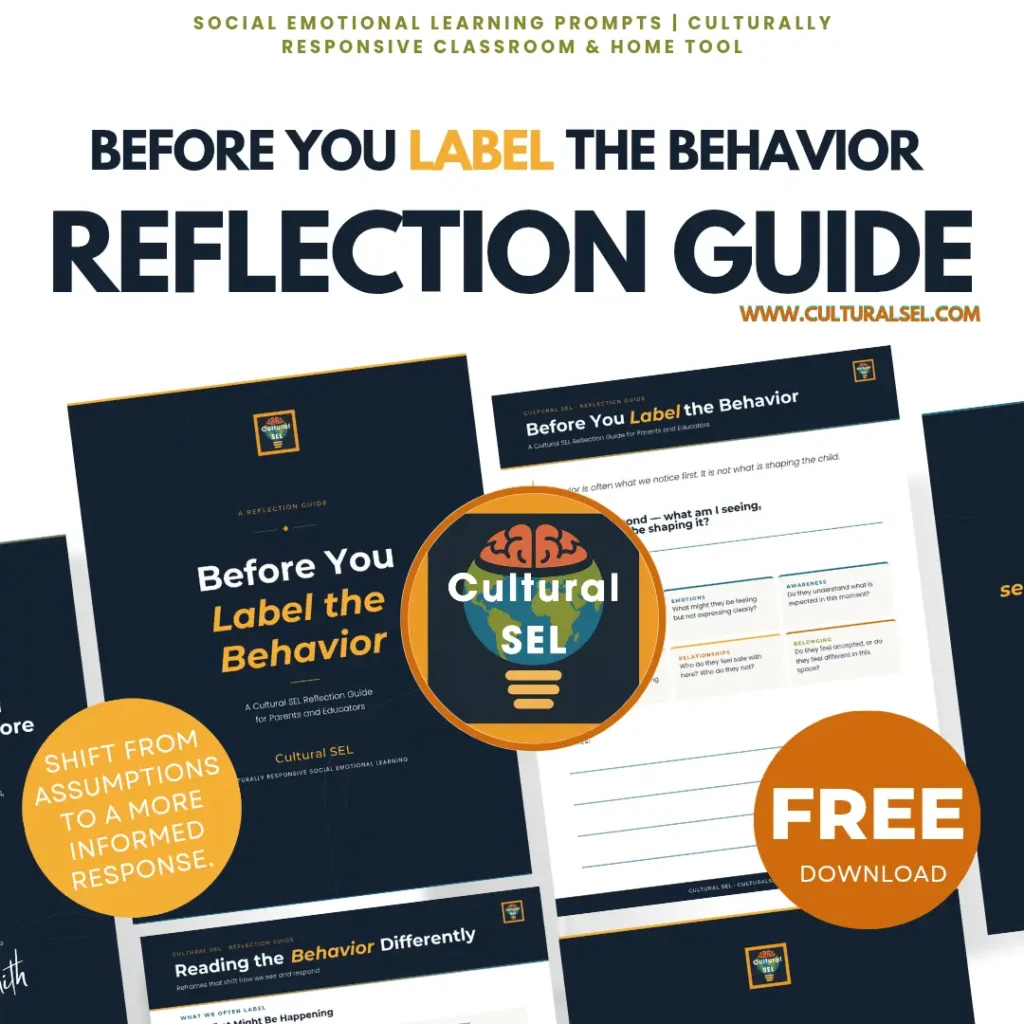
What if the behavior isn’t the whole story?
A free reflection guide that explores what may be influencing a child’s behavior before it is labeled, corrected, or misunderstood.
What Social Emotional Learning Actually Is
Children have always learned how to manage emotions, navigate relationships, resolve conflict, find belonging, and move through social environments through families, cultures, communities, faith spaces, and lived experience.
Researchers did not create these skills. As formal education systems expanded, CASEL organized them into five competencies that schools could teach, measure, and build into curriculum.
That structure is often called the foundation of social emotional learning. It is the framework. The skills themselves came long before it.
As formal education systems expanded, that learning was organized into frameworks.
CASEL, the Collaborative for Academic, Social, and Emotional Learning, became the most widely adopted in U.S. schools and is referenced internationally. Other regions, also draw from WHO and OECD frameworks alongside or instead of CASEL.
CASEL organized social emotional learning into five competencies that schools could teach, measure, and build into curriculum.
That structure gave educators a shared language. It was built around a specific kind of child, in a specific kind of setting.
As it reached more diverse classrooms and communities, what it could not see became visible. Significant research was left out.
Whole communities were not reflected. And the ways many children actually develop emotionally and socially were not part of the picture
SEL skills grow the same way reading and math do: through instruction, practice, feedback, and time.
A child who struggles to manage frustration on a Thursday is not losing a skill they had on Monday.
They are still building it, in a harder context, with less capacity. That distinction matters because how adults interpret the struggle changes what they do next.
They are still building it. A student who managed yesterday and cannot today has not gone backwards.
Something in their day shifted. The adult who sees said shift responds differently than the adult who only sees the behavior.
Research backs the outcomes. A 2011 meta-analysis of school-based SEL programs found an 11 percentile-point gain in academic achievement.
A more recent review of 40 studies (2008 to 2020, over 33,000 students) found SEL programs improved academic achievement by approximately 4.2 percentile points overall.
Programs lasting longer than one semester showed gains closer to 8.4 percentile points.
A student gets a wrong answer in front of the class, feels the shame, and starts to shut down.
A student who has practiced naming that feeling and using a reset strategy can rejoin instruction in minutes. Without that skill practice, the shutdown can last the whole period.

The 5 Core SEL Competencies (CASEL)
CASEL organizes social emotional learning into five competencies. These are the skills children develop when they are taught how to manage emotions, build relationships, and make responsible decisions.
They apply across early childhood through high school, and in many other programs.
| CASEL Competency | What It Means in Practice | Example |
|---|---|---|
| Self-awareness | Notice your own feelings, needs, and strengths | “I’m getting frustrated. I need a minute before I respond.” |
| Self-management | Handle feelings and actions in a way that works for the situation | Kofi, who processes anger physically, uses two slow breaths before speaking in group work. His teacher taught him that strategy explicitly. He did not arrive with it. |
| Social awareness | Read others’ feelings and adjust | Aaliyah notices a classmate went quiet after a hard morning. She gives them room instead of pressing. That is a practiced skill, not a personality trait. |
| Relationship skills | Communicate, listen, and solve problems with others | Mateo and his partner have a real disagreement about their project. They use “I” statements because that is the language the class has rehearsed together. |
| Responsible decision-making | Choose actions that are safe, fair, and thoughtful | Samira pauses before posting a message online and asks permission first, applying a framework her class used to work through digital situations. |
These five competencies are a shared starting point, not a fixed script. What each skill looks like in practice depends on the child, the setting, and the adults who are teaching and modeling it consistently.
I have watched our own children learn some of these skills at home, and absorb others from the environment around them, and the difference is visible.
The ones that were taught, named, and practiced stuck. The ones that were assumed or expected were nowhere to be found when a moment of conflict, frustration, or pressure arrived.
That is what the research confirms, and it is what I have seen play out across three kids at different ages and in different school settings.
SEL skills do not develop because a child is ready. They develop because someone taught them.

SEL Is Not Only About What Goes Wrong
Most SEL conversations center on behavior problems, regulation failures, and conflict.
Those things are often true and they deserve attention.
But social emotional learning was never only about what goes wrong. Joy, pride, and belonging are part of it.
A child who knows exactly who they are when they walk into a room, who can name what they love and what matters to them, has been taught to see themselves that way by the people and environments around them.
The same competency that shows up when a student names frustration also shows up when a student knows their strengths, their values, and where they belong.
Belonging and pride are not extras layered on top of emotional development. They are part of how children understand themselves and connect with others.
When SEL teaching makes room for celebration and joy alongside coping and conflict resolution, students have a fuller picture of what these skills are actually for.
Self-awareness includes knowing what you love, not only what overwhelms you. Social awareness includes recognizing another child’s pride, not only their pain.
Relationship skills include knowing how to celebrate together, not only how to repair after conflict.
The five CASEL competencies cover all of this. The question is whether the teaching does.
Trauma-Aware SEL: What It Means and Why It Matters
Trauma-aware SEL is not a separate program. It is a set of conditions that need to be in place before skill instruction lands: safety, predictability, and enough relational trust that a student can stay regulated enough to learn.
Stress and trauma change how students pay attention, remember directions, and respond to adult correction.
A child can practice a coping strategy on a calm Tuesday and be unable to access it on a Thursday when they are overwhelmed, hungry, or afraid. That is not inconsistency. That is how the stressed brain works.
Trauma-aware SEL does not require students to share their history or disclose anything personal.
It requires that adults reduce the conditions that make learning inaccessible: shame, unpredictability, power struggles, and environments where students do not know what comes next or whether adults can be trusted.
The goal is not to fix trauma. The goal is to make the space safe enough that the skills being taught can actually be used.
FAQ: Foundation of Social Emotional Learning
What is the foundation of social emotional learning?
The foundation of social emotional learning is the human practice of teaching children how to manage emotions, build relationships, resolve conflict, and make responsible decisions. Families and communities have always done this work. CASEL organized it into five competencies that could be taught and measured in formal educational settings. The foundation came first. The framework came later.
What are the 5 CASEL competencies?
The five CASEL competencies are self-awareness, self-management, social awareness, relationship skills, and responsible decision-making. CASEL defines these as the core skill areas of social emotional learning. They apply from early childhood through adulthood, across school, home, and community settings.
Does SEL take time away from academics?
Short, consistent SEL routines support academic engagement by improving attention, cooperation, and recovery after stress. Research reviews link SEL programs to measurable gains in academic achievement, particularly in programs that run longer than one semester.
Can SEL work in libraries, sports programs, and community settings?
The same skills appear in group projects, games, book discussions, and community events. Keep lessons brief, practice with scenarios that fit the real context, and use the same language each time a skill comes up. The setting does not limit the skill. The consistency of the adults does.
Is SEL only about managing difficult behavior?
No. The five core SEL competencies cover the full range of how children understand themselves and connect with others, including joy, pride, cultural identity, and belonging. A child who knows who they are, where they come from, and what they value is building self-awareness. SEL teaching that only addresses regulation and conflict is covering part of the framework, not all of it.
What is trauma-aware SEL?
Trauma-aware SEL means creating the conditions of safety, predictability, and relational trust that allow students to access and use SEL skills. It does not require students to disclose personal history. It requires adults to reduce shame, unpredictability, and power struggles so that skill instruction can actually land.

The Foundation Holds When the Teaching Does
The five CASEL competencies are a starting point that children have been living before anyone gave them names.
Self-awareness, self-management, social awareness, relationship skills, and responsible decision-making show up in how families raise children, how communities hold conflict, how cultures pass down belonging and pride from one generation to the next.
Formalizing those skills into a teachable framework gave schools something to work with.
What schools do with that framework determines whether children actually build the skills or simply learn to perform them for adults who are watching.
SEL works when the teaching is consistent, the language is shared across the adults in a child’s life, and the framework is wide enough to see the whole child: the frustration and the joy, the conflict and the pride, the hard moments and the ones where a child is exactly, visibly, fully themselves.
That is what the foundation is for. The framework did not create the skills. It named them. What happens next depends on the adults in the room.
Shop Our Culturally Responsive SEL Resources
Digital Cultural SEL resources for parents, caregivers, educators, community professionals, and children.
Explore practical tools, guides, reflection resources, and activities focused on social and emotional development, cultural environments, identity, belonging, relationships, lived experiences, and behavior.
CONTINUE EXPLORING CULTURAL SEL
Explore free Cultural SEL guides, culturally responsive SEL tools, and practical resources for understanding how cultural environments, identity, belonging, relationships, and lived experiences connect with children’s social and emotional development.
📌 Save or share this post with someone who is raising, teaching, or guiding children.

Hi, I’m Faith, the creator of Cultural SEL
I create practical tools and resources that support children’s social and emotional development and help parents, caregivers, educators, and community professionals look beyond behavior labels.
My work focuses on how cultural environments, identity, belonging, relationships, and lived experiences shape what children experience and how adults interpret and respond.
Read more about Faith and Cultural SEL: https://culturalsel.com/about
Join the Cultural SEL community: https://culturalsel.com/fb