What “Being Social” Means Depends on the Environment
One child talks through dinner, freezes at school, and opens up again with cousins. Adults often read those shifts as inconsistency, but they usually reflect context.
People use the word “social” as if it had a single fixed meaning. In daily life, the word can mean outgoing behavior, group participation, relationship-building, or meeting local social rules.
That matters in classrooms, homes, libraries, faith groups, and counseling spaces.
A quiet child may have strong relationships and still get labeled “not social” because the setting rewards speed, volume, or visible confidence.
Cultural SEL helps adults slow down and read behavior through culture, emotional familiarity, communication norms, group expectations, and environment.
FREE DOWNLOAD · REFLECTION GUIDE
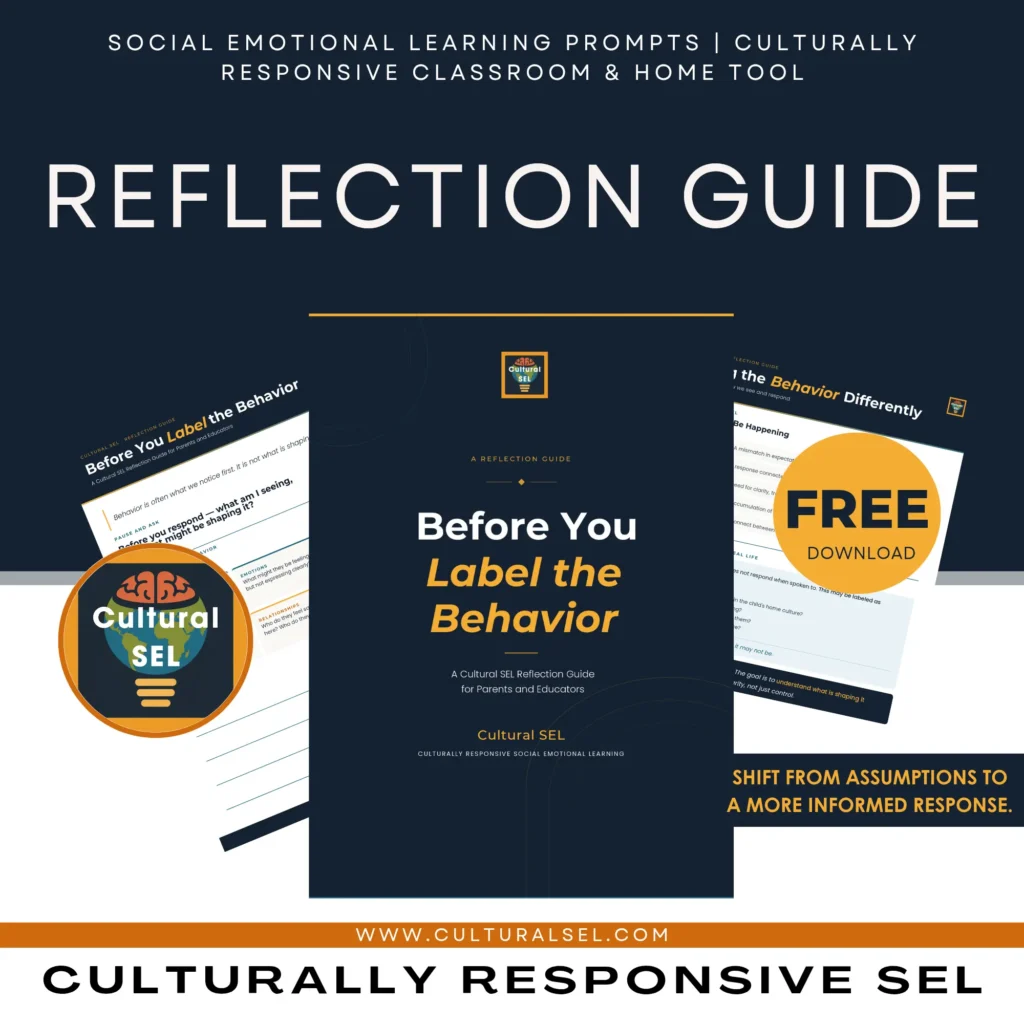
Before You Label the Behavior
A two-page guide helping parents and educators move past their default lens and interpret children through identity, culture, relationships, social dynamics, and emotional safety.
Why People Define “Being Social” Differently
Different Environments Reward Different Social Behaviors
A classroom may praise hand-raising and quick discussion. A homeschool group may value long conversations across ages.
Sports teams often notice energy, teamwork, and sideline talk. Family gatherings may notice who greets elders, helps younger kids, or stays close to relatives.
Online spaces often reward fast replies and visible presence.
Because each setting notices different behaviors, the same child can look highly social in one place and reserved in another.
Social Behavior Is Often Interpreted Through Adult Expectations
Adults often judge social behavior through what feels familiar to them. They may look for eye contact, a cheerful tone, quick verbal responses, public confidence, or easy group interaction.
Those signs can matter, but they do not tell the whole story. A child may listen well, remember details, and build trust over time, yet adults may miss those signs because they are less visible.
How Social Behavior Is Interpreted Differently Across Home, School, and Community
Being Around People Is Not the Same as Building Relationships
Social exposure and social connection are different. A child can sit in a full classroom, join clubs, and attend every event, yet still feel unknown.
Another child may speak to only a few people and still have strong trust, friendship, and real emotional comfort.
Presence shows access to people. Relationship-building shows a connection between people.
Some Environments Reward Fast Participation
Many settings reward the child who answers first, joins quickly, and speaks with ease in front of others. That kind of participation is easy to notice, so adults may treat it as proof of social strength.
Yet some children connect at a slower pace. They may build strong ties with one lab partner, one reading buddy, or one teammate, even when they never lead the room.
Quiet Children Are Often Misread as Unsocial
Observation Is a Social Behavior Too
Some children watch before they join. They may need time to read the tone of the group, learn the rules, or decide whether the space feels safe. That is social awareness, not social failure.
Observation is common in new classrooms, unfamiliar programs, and mixed-age groups.
A child who pauses may be processing the setting before stepping in. Adults who mistake that pause for disinterest are reading the surface, not the behavior behind it.
Quiet Does Not Automatically Mean Disconnected
Quiet children often build connections in smaller circles. They may prefer one-on-one friendship, selective conversation, or predictable routines with people they trust.
In practice, that can look like a child who says little in a group but talks freely with one close friend, a sibling, or a trusted adult. The connection is real, even when it stays out of the spotlight.
Why Conformity Gets Confused With Being Social
Compliance and Social Connection Are Not Identical
A child can follow the group without feeling connected to it. Some children copy the tone, laugh at the right time, or join activities to avoid standing out.
That kind of masking can look like confidence or social ease. In reality, it may come from fear, people-pleasing, or a strong wish to stay safe.
Children Often Adapt to Fit the Environment Around Them
Social dynamics, how groups influence behavior, belonging, and interaction, shape every environment a child moves through.
School rules, peer pressure, belonging needs, and fear of exclusion all play a role.
A student may speak louder with classmates, be calmer with adults, and be more formal in a faith community. Those changes tell us as much about the environment as they do about the child.
How Culture Shapes Social Expectations and Communication
Communication Styles Differ Across Cultures
Different communities teach different ways to show respect and connection. In some homes, children speak freely with adults.
In others, they wait, listen, and speak when invited. Some groups accept overlap and interruption in conversation. Others value silence, pacing, and turn-taking.
Emotional expression also varies. A child who speaks softly or avoids long eye contact may be showing respect, not discomfort.
Relationship-Building Looks Different Across Communities
Some communities value observation first, listening before speaking, group harmony, and strong family ties. Other settings reward verbal confidence, public self-expression, independence, and fast participation.
That difference matters in schools and youth programs. If a space praises only one style, children whose social habits come from another community get misread. For more on how communication patterns shape what adults see in the classroom, see Cultural Communication Styles and Classroom Participation.
How Online Spaces Changed the Way Adults Interpret Social Behavior in Children
Visibility Online Is Now Treated Like Social Confidence in Person
Online spaces reward fast replies, frequent posting, and public interaction. Adults who spend time in those spaces sometimes carry that same metric into how they read children.
The child who comments, shares, and responds quickly looks engaged. The child who stays quiet online and in person can look socially absent, even when neither reflects the full picture.
The confusion happens because visibility and connection are not the same thing. A child can be seen by many people and known by none of them. A child can post nothing and have steady, trusted relationships outside of any screen.
Digital Pressure Affects How Children Navigate Social Expectations in Real Spaces
When children observe that online participation earns approval, that pressure does not stay contained to screens.
It moves into classrooms, hallways, and group settings. Children who are quieter or slower to engage start to read their own behavior as a social failure before any adult says a word.
That is the misread worth naming. The behavior has not changed. The standard being applied to it has.
Adults who understand that shift are less likely to interpret a child’s reserved presence as a social problem and more likely to ask what the child is actually doing in relation to others.
Social Emotional Learning Includes More Than Outgoing Behavior
Social Emotional Skills Are Broader Than Public Participation
Social emotional skills include empathy, listening, emotional awareness, perspective-taking, relationship repair, and handling conflict. A child can show those skills without being the first to speak.
The student who notices a peer is upset and checks in later may show stronger social skills than the child who dominates every group conversation.
What gets seen and what is actually happening are often two different things. For a fuller look at how SEL skills show up across different environments and cultures, see Skill vs. Style in Social Emotional Learning.
Children Connect and Communicate Differently
Some children connect best in pairs. Others need small groups, familiar routines, or time to observe before they speak.
Cultural habits also shape how children ask questions, show care, and join conversations.
When adults make room for different styles, more children can participate in ways that fit them.
How Cultural SEL Reads Social Behavior Differently
Cultural SEL Asks What Is Shaping the Interaction
Cultural SEL asks better questions before making judgments. What does this setting reward? Does the child feel safe here? What communication norms are in play? How do identity, relationships, and past experience shape this moment?
Those questions move adults away from quick labels and toward real understanding.
Adults Also Define “Social” Through Their Own Lived Experience
I noticed this growing up between Ghanaian and German environments, and I see it again now as we raise children in the United States.
Different spaces rewarded different kinds of social behavior. In some settings, respectful listening mattered more. In others, quick participation and visible confidence were treated as social strength.
Watching children move between those expectations makes it easier to see how often adults mistake familiarity for social ability.
That is not a character flaw. It is what happens when adults have never been asked to examine the standard they are applying.
Social Behavior Is Interpreted Through Relationships, Identity, and Environment
Social behavior does not follow one universal standard. The meaning shifts with the environment, the relationships within that space, the cultural rules people bring, and the emotional safety the child experiences there.
Labels like “social” or “not social” skip over most of that. A fuller read looks at how a child connects, not just how loudly or how often.
Common Questions About Social Behavior
What Does Being Social Actually Mean?
Being social means more than outgoing behavior. It includes communication, relationship-building, group participation, and the ability to connect in ways that fit the setting.
Can Quiet Children Still Have Strong Social Skills?
Yes. Quiet children may show strong social skills through listening, observing, selective communication, empathy, and steady one-on-one relationships.
Why Do Children Act Differently in Different Environments?
Children respond to emotional safety, trust, expectations, identity, and cultural norms. A setting that feels safe often brings out more visible participation.
How Does Culture Affect Social Behavior?
Culture shapes how people use silence, eye contact, directness, emotional expression, and respect. It also shapes what kinds of social behavior adults notice and praise.
Is Being Outgoing the Same as Having Social Skills?
No. Outgoing behavior is one style. Social skills also include listening, empathy, problem-solving, perspective-taking, and repairing relationships after conflict.
Why Do Adults Define Social Behavior Differently?
Adults rely on their own lived experience. Personal history, community norms, and familiar communication styles all shape what they see as social.
CONTINUE EXPLORING CULTURAL SEL
Explore free guides, practical tools, and resources designed to help adults understand how culture shapes children’s social and emotional experiences.
📌 Save or share this post with someone who is raising, teaching, or guiding children.

Hi, I’m Faith, the creator behind Cultural SEL.
I create tools and resources that help adults understand how culture shapes children’s social and emotional experiences and how identity, relationships, environment, and lived experience influence how children are interpreted and supported.
Read more here: https://culturalsel.com/about
Join our community: https://culturalsel.com/fb