Racial Identity Development: When an Ism Becomes a Child’s Whole Story
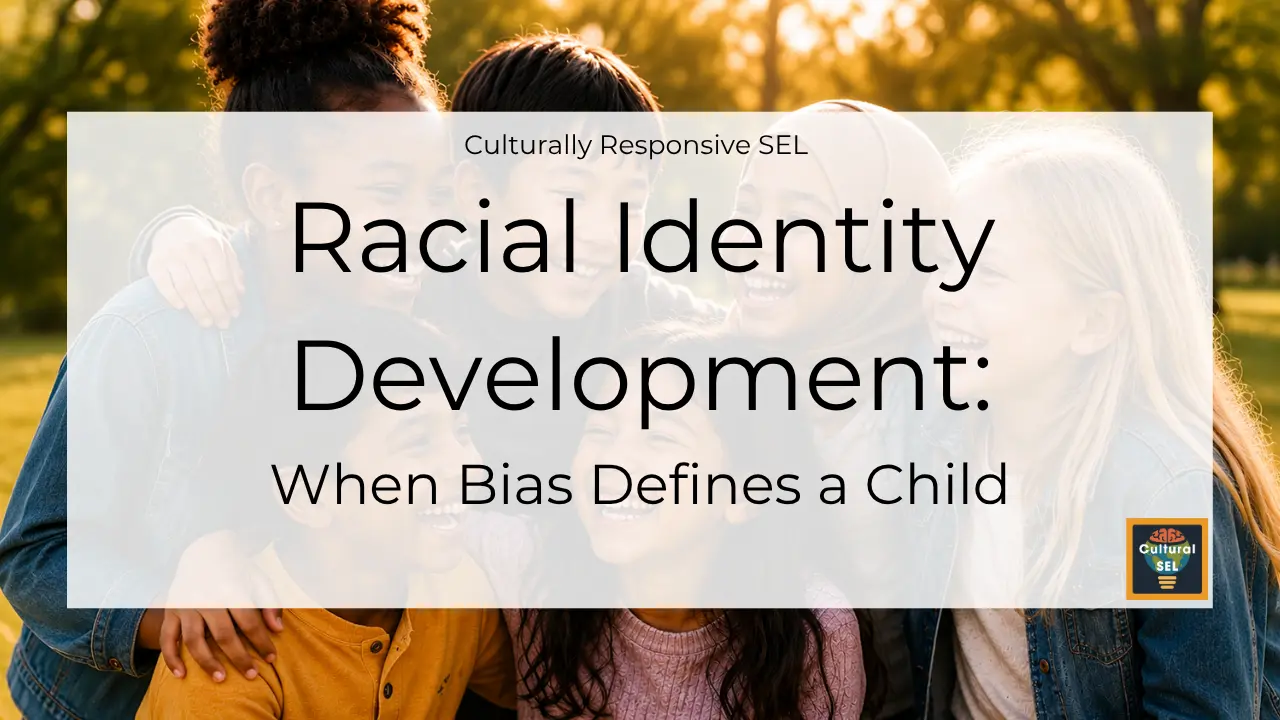
A child gets asked “where are you really from” one too many times and starts introducing themselves with the answer before anyone asks the question.
A dark-skinned child hears one comment about their skin too many times and starts describing themselves by their skin before they describe anything else about who they are.
A child with a disability gets underestimated by one more adult and starts talking about their diagnosis before they mention what they are actually good at.
Racial identity development, and the wider identity development that happens alongside it, is shaped by exactly these moments.
A child does not wake up one day and decide that race, skin tone, gender, ability, class, age, nationality, or ethnicity will be the lens through which they explain themselves.
That lens gets built, moment by moment, out of what other people decided about them first.
FREE DOWNLOAD · REFLECTION GUIDE
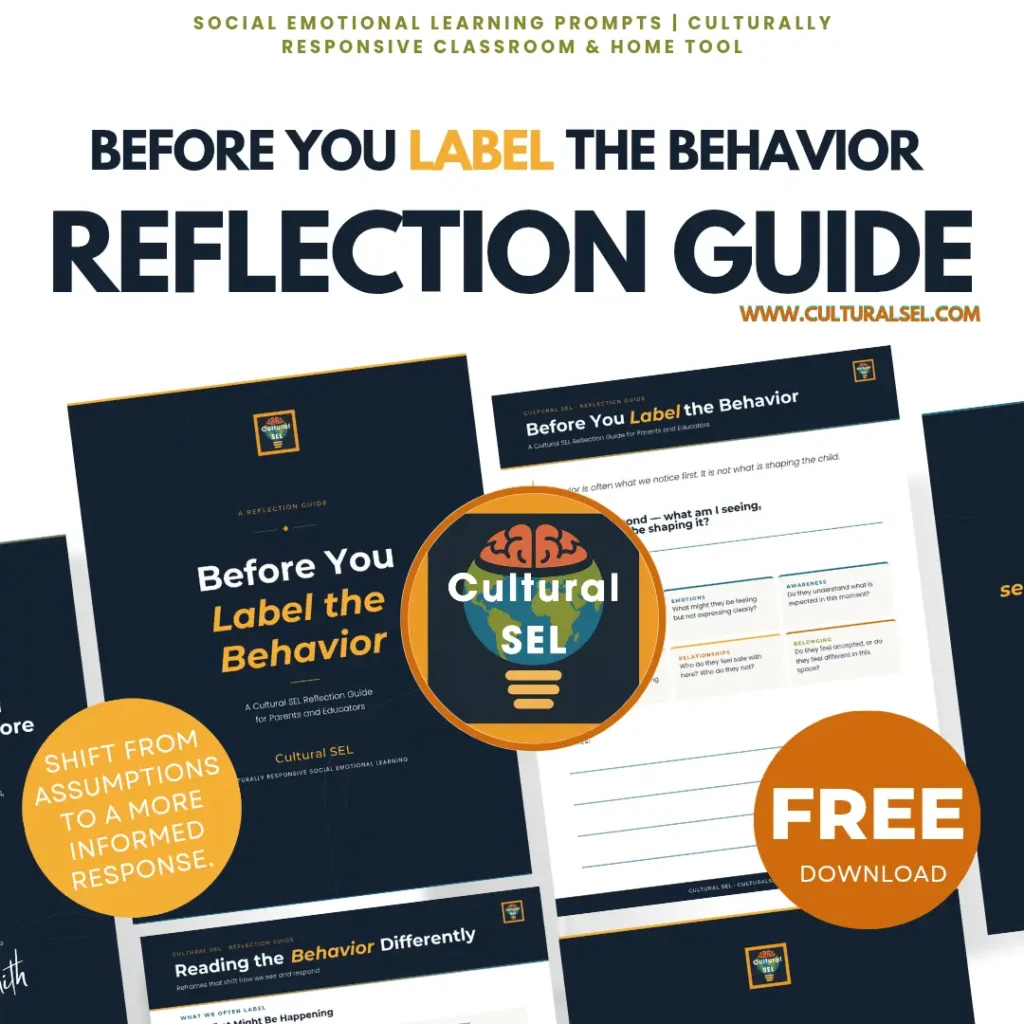
What if the behavior isn’t the whole story?
A free reflection guide that explores what may be influencing a child’s behavior before it is labeled, corrected, or misunderstood.
What Racial Identity Development Actually Looks Like in Children
Racial identity development is the process through which children come to understand their race, and their racial and ethnic group, as part of who they are.
Psychologists have studied this for decades. Children as young as four begin to notice racial categories, and by nine or ten, many children have a clear sense of how their group is seen and treated by the wider world.
That process does not stay isolated to race. The same pattern shows up around skin tone, gender, disability, class, age, nationality, and ethnicity.
In each case, a child starts to notice that one part of who they are draws more attention, more assumption, and bigger consequences than the rest.
The question adults need to ask is not whether this shapes a child. It does. The question is whether it becomes the only thing a child believes is true about themselves.
The Difference Between What Happened to a Child and Who a Child Is
A child who has been on the receiving end of racism, colorism, sexism, ableism, classism, ageism, nationalism, or ethnocentrism has real information about the world. Something happened. It was not imagined, and it should never be minimized.
What adults sometimes miss is a second, separate question: what has this experience become for the child?
Some children hold it as one memory among many. Other children start explaining everything through it. A bad grade, a lost friendship, a missed opportunity, all get traced back to the same one thing.
Those are two different things. A child can know that racism exists, that it happened to them, and still hold a full and separate sense of who they are underneath it.
A child can also start to explain every choice, every relationship, and every setback through one experience, until that experience quietly becomes the whole identity. No single experience was ever built to carry that job.
Adults raising, teaching, or guiding children play a direct role in which of those two paths a child ends up on.
How Racism and Colorism Shape a Child Before They Can Name It
- Racism is bias against someone because of their race.
- Colorism is bias based on skin tone, and it shows up both across racial groups and within them.
I grew up the Black girl in an all-white environment in Germany. I was also one of the darker-skinned children in most rooms I was in. People decided things about me before they knew anything else about me.
Some of it came dressed as a compliment. Some of it came as a question about where I was really from, as if the answer I gave the first time could not possibly be the whole answer.
That happened repeatedly, not once. It followed me later into corporate spaces in Germany, where I watched the same sorting happen before a real conversation had even started.
What that showed me was specific. Race and skin tone kept becoming the first thing, and sometimes the only thing, other people decided about me before they knew anything else. That was a fact. It happened enough times that I could not call it a misunderstanding.
What I now help other adults recognize is the line underneath that pattern. What happened to me was never the same thing as it defining me.
I could name the racism, name the colorism, name that both were very real, without handing either one ownership of who I actually was.
I did not reach that distinction automatically. It took noticing the gap between what people decided about me and what I actually knew to be true about myself, and choosing to trust the second one.
Children living through cultural identity confusion often need that same distinction handed to them directly, because they are rarely told it exists.
Adults working from a culturally responsive lens on race and representation will recognize the same gap between what is visible about a child and what is actually known about them.
Shop Our Culturally Responsive SEL Resources
Digital Cultural SEL resources for parents, caregivers, educators, community professionals, and children.
Explore practical tools, guides, reflection resources, and activities focused on social and emotional development, cultural environments, identity, belonging, relationships, lived experiences, and behavior.
How Sexism Narrows What a Child Believes They Are Allowed to Be
Sexism is bias based on gender. It shapes children through a different mechanism than race does. It rarely looks like an insult. Instead, it shows up as expectation.
A girl who is repeatedly told to be quieter, softer, or more agreeable starts to believe those qualities are the requirement for being liked, not a preference some adults happen to hold.
A boy who is corrected every time he cries starts to believe emotion itself is the problem, not the specific moment he was in.
As this repeats, children stop testing whether the expectation is fair. They start building their sense of self around meeting it.
A child’s capability, their interests, their willingness to lead or to soften, can get quietly narrowed by expectations that were never actually about that child.
The adult’s job is not to remove expectation entirely. Children need structure. The job is to notice when an expectation has stopped being about behavior and started being about identity, and to separate the two out loud.
How Ableism Shapes What Adults Assume About a Child’s Capability
Ableism is bias against people with disabilities. We have family with a disability, and the stigma they have faced is not subtle. Adults underestimate her before they have spent five minutes with her.
Assumptions get made about what she can handle, what she can understand, and what she should be excused from, often before anyone has actually asked her.
Ableism works by treating a diagnosis as a ceiling instead of a piece of context. A child hears, directly or indirectly, that their disability is the explanation for everything they do, including the things it has nothing to do with.
Eventually, some children start explaining themselves the same way, leading with the diagnosis before anyone asks, because that is the order they have learned to use.
A disability tells you something true about how a child experiences the world.
It does not summarize who they are. Adults who keep those two things separate, out loud and consistently, give a child room to know the difference for themselves. Disability-specific SEL practices cover this in more depth.
Classism, Ageism, Nationalism, and Ethnocentrism Follow the Same Pattern
Classism, ageism, nationalism, and ethnocentrism do not always get named in the same breath as racism or sexism, but they operate the same way.
- Classism is bias tied to economic or social class.
- Ageism is bias tied to age.
- Nationalism, in this context, is treating one’s own nation or national identity as the standard for who really belongs.
- Ethnocentrism is judging other cultures against your own, as if your own were the neutral default rather than one culture among many.
A child from a lower-income family can start to believe their family’s circumstances say something permanent about their worth or their future, instead of understanding it as one part of their current situation.
A younger child can be dismissed as incapable of an opinion simply because of their age, until they stop offering one.
A child raised across two countries can be told by one side that they are not really from there, and by the other side that they are not really from here either, until they stop claiming either place with confidence.
A child whose family’s customs sit outside the dominant culture in a room can be treated as strange or lesser by adults who never examined why their own culture felt like the neutral default.
In every case, the pattern is the same one already described for race, gender, and disability.
A single trait gets treated as if it explains the whole child. Researchers who study SEL (social-emotional learning) through the lens of race and equity have found that naming identity, agency, and belonging directly, rather than avoiding them, is part of what helps children move through exactly this kind of narrowing (Jagers et al., as discussed in research on culturally responsive SEL for Black youth).
What the Research Says About Identity Protecting Against Harm
Preparing children for the reality of bias has a real, measurable effect on how they cope with it.
Research on racial socialization, the process of talking with children directly about race and the barriers tied to it, has found that some preparation protects a child’s self-esteem when they encounter discrimination.
That same body of research found something adults often miss. The relationship is not as straight forward.
Research on discrimination and self-esteem in youth suggests that an overemphasis on racial barriers, without an equal emphasis on identity, pride, and capability, can weaken a child’s sense of their own competence and worth.
In other words, naming harm protects a child. Naming only harm, without also building the rest of who they are, can start to work against them.
What This Looks Like in Practice at Home, School, and Community
Adults do not always need a script to apply this. They need a habit of separating two questions whenever a child brings up an experience tied to race, gender, disability, class, age, nationality, or culture.
The first question is whether something really happened. Most of the time, it did, and it deserves to be named clearly and taken seriously.
The second question is whether the child is starting to explain everything else about themselves through that one experience.
If they are, the adult’s job is to reintroduce the rest of the picture: their interests, their relationships, their skills, their sense of humor, and the parts of them that existed before the harmful moment and are still fully intact underneath it.
This applies at home, in classrooms, in faith spaces, and in community settings. A parent can name what happened at school.
A teacher can notice when a student has started speaking about themselves only through one label.
A youth leader can make room for a child to talk about more than the thing that hurt them. All of it is the same practice, applied in different rooms.
Common Questions About Racial Identity Development and Isms in Children
At what age does racial identity development begin?
Children start noticing racial categories as early as age four. By nine or ten, many children have a clear sense of how their racial or ethnic group is viewed and treated by the wider world. Awareness around gender, disability, class, and nationality can develop on a similar or even earlier timeline, depending on the child’s environment.
Is it harmful to talk with children about racism, sexism, or ableism?
No. Research on racial socialization shows that talking directly with children about bias and identity protects their self-esteem when they encounter discrimination. The risk comes from naming harm alone, without pairing it with an equally clear picture of the rest of who the child is.
How can adults tell if an experience has become a child’s whole identity?
Watch for a child who begins explaining unrelated choices, relationships, or setbacks through one experience or label, even when that label has nothing to do with the situation. That pattern is a signal to reintroduce the fuller picture of who the child is, not to dismiss what happened to them.
Does this apply outside of race?
Yes. The same pattern shows up with colorism, sexism, ableism, classism, ageism, nationalism, and ethnocentrism. In each case, one trait can start to override every other part of how a child understands themselves, unless adults actively keep the fuller picture visible.
Naming What Happened Without Letting It Define Who a Child Is
A child who has lived through racism, colorism, sexism, ableism, classism, ageism, nationalism, or ethnocentrism has been through something real.
None of that should be minimized, explained away, or rushed past.
What can change is whether that experience becomes the definition of the entire child.
Adults who name the harm clearly, and then keep naming everything else that is also true about that child, give them something that is genuinely theirs to keep, not something handed to them by whoever decided to look at one part of them first.
This lens, explained in full here, keeps bias from deciding who a child believes they are.
CONTINUE EXPLORING CULTURAL SEL
Explore free Cultural SEL guides, culturally responsive SEL tools, and practical resources for understanding how cultural environments, identity, belonging, relationships, and lived experiences connect with children’s social and emotional development.
📌 Save or share this post with someone who is raising, teaching, or guiding children.

Hi, I’m Faith, the creator of Cultural SEL
I create practical tools and resources that support children’s social and emotional development and help parents, caregivers, educators, and community professionals look beyond behavior labels.
My work focuses on how cultural environments, identity, belonging, relationships, and lived experiences shape what children experience and how adults interpret and respond.
Read more about Faith and Cultural SEL: https://culturalsel.com/about
Join the Cultural SEL community: https://culturalsel.com/fb