What Is Cultural SEL? Children’s Development and Adult Awareness
THIS POST MAY CONTAIN AFFILIATE LINKS. THIS MEANS WE MAY RECEIVE A COMMISSION FROM QUALIFYING PURCHASES YOU MAKE THROUGH OUR LINKS. KINDLY READ OUR DISCLOSURE NOTICE FOR MORE INFORMATION.
A child who is expressive at home may become quiet in another setting.
A teenager who feels confident with friends may suddenly shut down around certain adults.
A person who easily moves between languages, cultures, expectations, and environments may get labeled inconsistent instead of adaptable.
Most adults notice these shifts. Fewer adults stop to examine how they are interpreting them.
Cultural SEL is a brand and framework for children’s social, emotional, and cultural development. It centers the Cultural SEL Lens, which helps adults who are raising, teaching, or guiding children pause before they label a child’s behavior.
The Lens asks adults to notice, consider, interpret, and respond, seeing both the struggle and the strength in what a child is experiencing. The child’s experience is the focus. The adult’s awareness is the work.
Inside Cultural SEL, adults examine the lens they bring into interactions with children, families, communities, and each other.
We have always learned to handle emotions, relationships, belonging, communication, conflict, and social expectations through the spaces we move through.
Long before frameworks existed, people learned these skills inside families, communities, faith spaces, neighborhoods, friendships, and everyday relationships.
Social emotional learning did not begin when institutions gave it formal language.
Cultural SEL starts there. It recognizes that children are not moving through neutral environments, and adults are not interpreting children from neutral positions either.
That changes how we understand children’s social, emotional, and cultural development.
It is about each child’s social, emotional, and cultural experience, not just the behavior adults see.
Children grow up in environments shaped by adults willing to look more carefully. And that work benefits the child and the adult
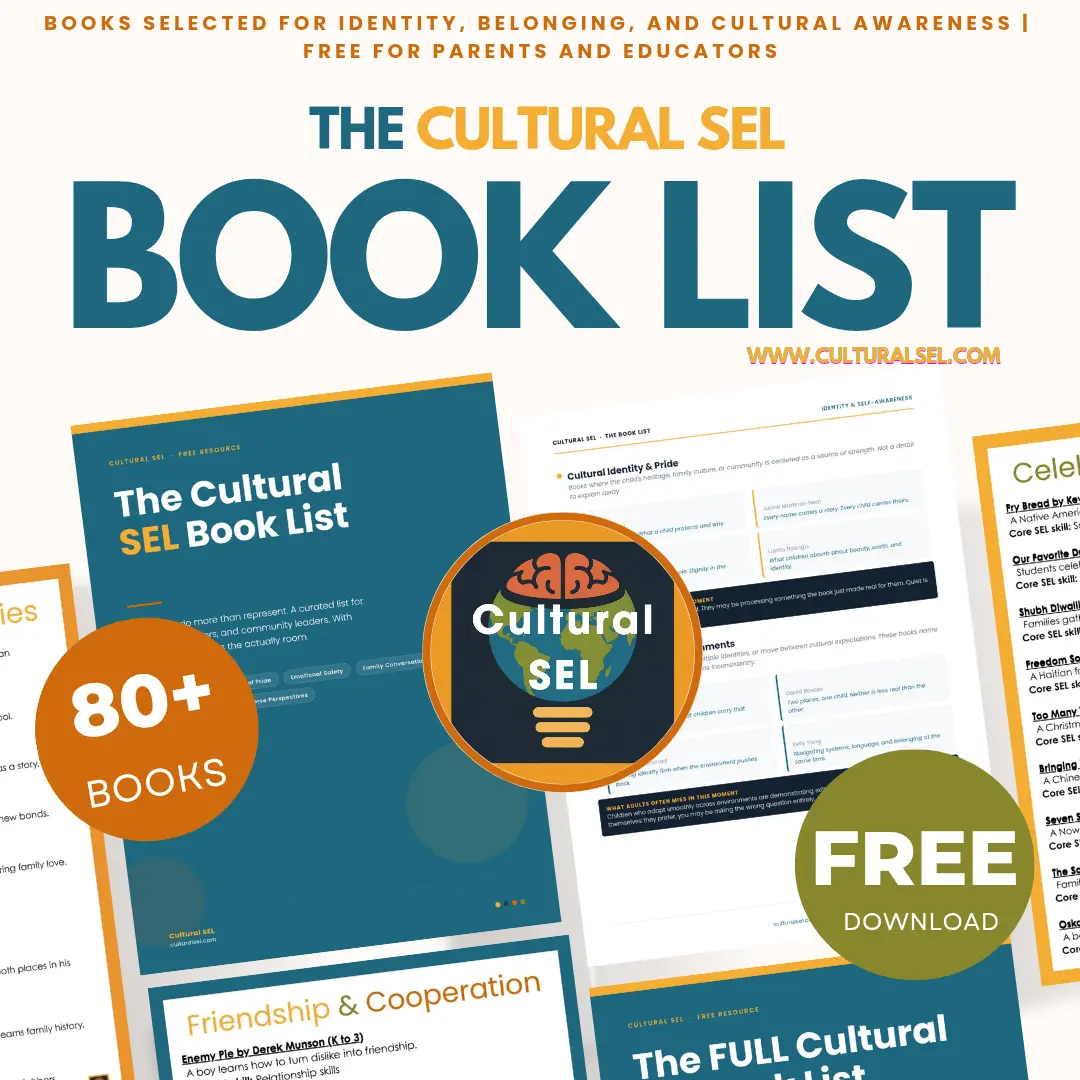
What if the right book still misses the child in front of you?
80+ books selected for identity, belonging, and cultural awareness. Each category includes what adults often miss, so you know how to use them, not just which ones to choose.
Cultural SEL as a Lens for Children’s Development
Cultural SEL looks at children’s social, emotional, and cultural development across the environments they move through.
Home, school, family, community, faith, peer, and online spaces can each communicate different expectations around emotion, behavior, communication, identity, relationships, and belonging.
Inside this work, children experience environments where adults have slowed their automatic assumptions.
Adults learn to notice the lens they bring into interactions and consider how their own upbringing, cultural expectations, emotional conditioning, relationships, and experiences shape what they interpret as respectful, disruptive, appropriate, concerning, or unfamiliar.
That shift changes what children experience on the receiving end.
That shift changes how children are understood and responded to across different settings and relationships.
Adults are part of this, too. Adults are also managing their own emotional conditioning, cultural expectations, inherited communication patterns, relationship dynamics, regulation, social pressure, and learned responses.
Adults will not interpret every interaction perfectly. This work asks them to slow automatic assumptions long enough to examine what may be happening beneath the surface of an interaction.
Behavior matters. But behavior alone is not the whole story.
The Cultural SEL lens widens the picture surrounding behavior by helping adults account for identity, emotional safety, environment, relationships, communication patterns, lived experience, expectations, and adaptation across settings.
The first question is: What may be present here?
From there, the Lens asks adults to notice, consider, interpret, and respond. Notice what is happening before adding a label.
Consider what may be shaping it. Interpret what the child may be communicating or managing. Then respond in a way that supports the child without losing sight of context.
That wider understanding changes interpretation. And interpretation shapes response.
How Social Emotional Learning Became Formalized
Social emotional learning did not begin with a framework.
We have always learned social and emotional skills through relationships, environments, expectations, and everyday interactions with other people.
Children and adults alike are shaped by relationships, communication, conflict, belonging, emotional norms, family systems, cultural expectations, and community experiences.
Researchers and institutions later organized parts of that learning into formal frameworks.
The most widely referenced is CASEL, the Collaborative for Academic, Social, and Emotional Learning, which organizes social emotional learning around five competency areas:
- self-awareness
- self-management
- social awareness
- relationship skills
- responsible decision-making
That framework helped schools and institutions create a common language around social emotional development.
It also reflected cultural assumptions and reference points that did not fully account for every child, family, or environment.
The frameworks helped organize important parts of social-emotional learning, but they did not capture the full range of how people experience relationships, identity, belonging, emotional safety, communication, and adaptation across settings.
How Culturally Responsive Social Emotional Learning Expanded SEL
Culturally responsive social emotional learning expanded the conversation by recognizing that emotions, relationships, communication, conflict, belonging, and emotional expression are shaped by culture, environment, identity, family systems, and lived experiences.
Traditional SEL frameworks helped organize important social-emotional skills and gave schools a shared language around development, relationships, and emotional well-being.
But children do not experience social emotional life outside of culture and environment.
Every child has culture. Every adult has culture. Culture includes the values, beliefs, languages, communication styles, family practices, expectations, identities, traditions, and experiences that shape what feels normal or familiar to us.
The way emotions are expressed, respect is communicated, conflict is handled, vulnerability is shown, and belonging is experienced can look different across families, communities, cultures, and environments.
Culturally responsive social-emotional learning widened the lens by recognizing that those differences matter.
Self-awareness became more than naming emotions. It also included understanding how identity, culture, language, community expectations, migration experiences, family dynamics, and lived experiences shape emotional expression and interpretation.
Social awareness became more than recognizing emotions in others. It also included understanding how environment, bias, culture, relationships, and social expectations shape the way people are perceived and responded to across different settings.
This wider understanding also recognized that children often adapt across environments.
A child may communicate one way at home and another way at school. A teenager may feel emotionally safe in one environment and emotionally guarded in another.
Those shifts are not automatically inconsistency or defiance. Very often, they are adaptations.
Culturally responsive social emotional learning widened the conversation beyond behavior alone and toward the environments, relationships, identities, and experiences shaping what adults are observing.
How Cultural SEL Builds From SEL and Culturally Responsive Social Emotional Learning
Cultural SEL builds on both social-emotional learning and culturally responsive social-emotional learning, while widening the lens further to encompass interpretation, emotional safety, relationships, communication, identity, and environments.
Broader global research also supports this wider understanding of social emotional experiences across settings.
The OECD (Organization for Economic Co-operation and Development) contributed research on social and emotional skills across countries and educational systems.
UNESCO (United Nations Educational, Scientific and Cultural Organization) explored identity, belonging, and inclusive education.
The World Health Organization (WHO) examined how stress, environment, relationships, and community conditions affect development and emotional well-being.
UNICEF (United Nations Children’s Fund) has produced extensive research and guidance on child wellbeing, protection, education, and development across global contexts, including the role of culture, family systems, and community in children’s social and emotional development.
Inside Cultural SEL, the focus includes the child’s social, emotional, and cultural development, the environments shaping that development, and the lens adults bring when they interpret and respond to what children experience.
The Cultural SEL lens helps adults account for identity, emotional safety, relationships, communication patterns, lived experiences, cultural expectations, and environmental context when interpreting children’s social emotional experiences across settings.
Adults do not interpret children from neutral positions. Their own upbringing, emotional conditioning, school experiences, cultural expectations, and relationship history shape what feels respectful, disruptive, appropriate, rude, engaged, concerning, or emotionally safe.
Those experiences and expectations shape interpretation long before many adults consciously recognize it.
A child moving between multiple languages, environments, communication styles, or cultural expectations is demonstrating awareness and adaptation.
Adults who recognize adaptation often respond differently from those who interpret those shifts as attitude problems, inconsistency, or disengagement.
Culture can shape misunderstanding and conflict, but it can also provide pride, connection, joy, belonging, emotional support, and resilience.
The Cultural SEL lens helps adults recognize both.
What Adults Bring Into Interactions With Children
Every adult who works with or raises children brings a lens into those interactions.
Adults are part of the environments children are developing within. Their expectations, reactions, rules, communication, and interpretations become part of what the child experiences repeatedly.
That lens was shaped by upbringing, family systems, emotional norms, cultural expectations, school experiences, community dynamics, relationship history, and personal experiences.
That does not make adults bad. It means adults are shaped by their own experiences, too.
The problem begins when the lens operates automatically and without reflection.
A quiet child gets interpreted as disengaged. An expressive child gets interpreted as disruptive.
A child who communicates differently from the room’s emotional norm is interpreted as disrespectful. A child who changes across settings gets interpreted as inconsistent.
Each interpretation shapes the response the child experiences next. Repeated experiences across home, school, family, community, and other spaces shape what children learn to expect about themselves, relationships, emotion, authority, vulnerability, communication, belonging, and the adults around them.
Growing up between a Ghanaian household and a German school system, I learned early that people are often interpreted before they are fully understood.
Now raising three multicultural children in American schools, I notice how quickly assumptions can shape the way children are treated across environments.
Inside Cultural SEL, adults are encouraged to slow that interpretation process long enough to ask:
- What assumptions am I bringing into this interaction?
- What might this environment feel like for this child?
- What expectations are shaping my reaction?
- What else could be true here?
Behavior is not the whole story. The environment, emotional safety, relationships, identity, communication patterns, and expectations surrounding the child are part of the story too.
What Cultural SEL Recognizes: Strength, Skill, and Pride
A child who moves between two languages is not confused. That child is skilled.
A child who shows up differently at home than at school is not inconsistent. That child is adapting.
A child who wears their culture openly, the jewelry, the food, the name, the faith, is not asking for trouble. That child lives within their identity with pride.
Standard SEL was built to address what goes wrong. Cultural SEL was built to see the full picture: the struggle and the strength, the misread and the thing the child is actually good at.
Joy, pride, and belonging count as much as the moments that need correcting. Cultural identity is a resource, not a complication.
Children also need language for their own identity, emotions, relationships, belonging, and cultural experiences, and opportunities to extend awareness and respect toward others.
Adjustment across environments as a skill, not a problem. Both are true. Cultural SEL recognizes both.
How Cultural SEL Works Across Home, School, Faith, and Community
Cultural SEL does not choose between school-facing and home-facing. It lives wherever children are.
And whoever is reading, an educator, a parent, a faith leader, a homeschooling family, will find themselves in it because the work speaks to the environments they already occupy.
The child moves across all of those spaces. Cultural SEL was built to move with them.
Why Interpretation Changes Across Environments
People do not move through every environment in the same way.
Children and adults move across homes, schools, workplaces, peer groups, faith communities, sports teams, online spaces, neighborhoods, family systems, and community environments, each with different expectations around communication, emotional expression, vulnerability, respect, participation, conflict, and belonging.
As a result, people often adjust how they communicate, express emotion, seek support, or protect themselves depending on the environment.
A child who feels emotionally safe in one setting may become more guarded in another.
A teenager who communicates openly with friends may become quiet around certain authority figures. Those shifts are not automatically inconsistent, disrespectful, or disengaged.
Very often, they reflect adaptation to the environment.
The Cultural SEL lens helps adults examine not only the child’s behavior, but also the expectations, relationships, emotional safety, communication patterns, and environmental pressures surrounding the interaction.
When adults cannot recognize what children are adapting to, they often misread those adaptations.
That matters across every environment children move through.
- Parents may wonder why a child behaves differently at home and at school.
- Educators may misread emotional withdrawal as disengagement.
- Coaches may interpret hesitation as an attitude.
- Faith leaders may unintentionally apply one cultural expectation to every family they support.
Every adult brings experiences, assumptions, emotional conditioning, and cultural expectations into interactions with children.
Those experiences shape interpretation, and interpretation shapes response.
Shop Our Culturally Responsive SEL Resources
Digital Cultural SEL resources for parents, caregivers, educators, community professionals, and children.
Explore practical tools, guides, reflection resources, and activities focused on social and emotional development, cultural environments, identity, belonging, relationships, lived experiences, and behavior.
What the Cultural SEL Lens Looks Like in Daily Life
The Cultural SEL lens often becomes visible in the questions adults ask before reacting.
A parent notices their child speaks their home language comfortably with grandparents but avoids speaking it around peers.
Instead of asking what is wrong with the child, the parent asks what the environment may have taught the child about their language.
An educator notices a child is quiet during group discussions but expressive one-on-one. Instead of labeling the child shy or disengaged, the educator examines what the group setting may be producing for that child.
A faith leader realizes that the emotional expectations built into their community come from a single cultural frame, and that not every family expresses grief, vulnerability, celebration, or support in the same way.
A coach notices a child responds differently depending on who delivers correction and how it is delivered. Instead of assuming an attitude, the coach considers how relationships, communication styles, emotional safety, and cultural expectations shape what the child can receive.
None of those adults needed a scripted program in that moment.
They needed a wider lens and a different first question.
Questions People Ask About Cultural SEL
Is Cultural SEL the same as social emotional learning?
No. Social emotional learning is the broader field. Cultural SEL is a brand and framework focused on children’s social, emotional, and cultural development. It brings identity, culture, relationships, environment, lived experience, and adult interpretation into how children are understood and supported.
Is Cultural SEL a curriculum?
No. Cultural SEL is not a curriculum, behavior system, or step-by-step program. It is a framework and body of work for understanding how identity, culture, relationships, environments, communication, expectations, and lived experience shape children’s social, emotional, and cultural development.
Inside Cultural SEL, adults learn to examine the lens they bring into interactions with children, families, and communities so they can respond with greater awareness and understanding.
Is this only relevant for multicultural or diverse environments?
No. Every child has culture, and every adult has culture. Cultural experiences, family expectations, communication styles, relationships, environments, and lived experiences shape how children develop and how adults interpret them.
The work explored within Cultural SEL applies wherever adults interpret children and relationships shape emotional experiences.
Is Cultural SEL the same as culturally responsive teaching?
Related, but not the same. Culturally responsive teaching focuses primarily on instructional practice and curriculum design.
The work explored through Cultural SEL focuses on how adults interpret and respond to social and emotional experiences across environments.
Do adults need to have this fully figured out before engaging with this work?
No. This work is ongoing. Cultural SEL was built for adults who are still learning, unlearning, regulating, noticing their own assumptions as they happen, and trying to respond more thoughtfully than they did before.
What Cultural SEL Builds Toward
Cultural SEL works toward environments where children can develop with their identity, relationships, emotions, culture, and lived experiences understood as part of the picture. Adults play a role in creating those environments through what they notice, expect, interpret, allow, correct, and respond to.
Children growing up inside those environments develop stronger language for identity, belonging, emotional experience, relationships, communication, and adaptation across settings.
Cultural SEL also works toward communities where culture is understood as a source of pride, joy, connection, belonging, and strength alongside the challenges children may experience across different environments.
Adults will make mistakes. The work asks them to keep looking at the children in front of them, the environments they help create, and the assumptions they bring into those interactions.
That is the kind of awareness Cultural SEL encourages and works toward.
The child’s experience stays at the center of that work. The adult’s awareness is what makes it possible to see it.
CONTINUE EXPLORING CULTURAL SEL
Explore free Cultural SEL guides, culturally responsive SEL tools, and practical resources for understanding how cultural environments, identity, belonging, relationships, and lived experiences connect with children’s social and emotional development.
📌 Save or share this post with someone who is raising, teaching, or guiding children.

Hi, I’m Faith, the creator of Cultural SEL
I create practical tools and resources that support children’s social and emotional development and help parents, caregivers, educators, and community professionals look beyond behavior labels.
My work focuses on how cultural environments, identity, belonging, relationships, and lived experiences shape what children experience and how adults interpret and respond.
Read more about Faith and Cultural SEL: https://culturalsel.com/about
Join the Cultural SEL community: https://culturalsel.com/fb