Culturally Responsive Social Emotional Learning: What It Is and Why It Matters
Most adults who misread a child are not trying to. They are working from a framework that felt complete, because no one told them what it was missing.
SEL gets taught. Children get assessed. Behaviors get flagged. And the adults doing all of that are often genuinely trying to help.
The problem is not intention. The problem is that the framework most of them were handed was built around one kind of child, in one kind of setting, expressing emotions and relationships in one culturally specific way.
Every child who does not match that picture gets interpreted through a lens that was never built to see them accurately.
A child sits quietly through a group discussion. The adult reads that as disengaged. That same child goes home and talks through everything at the dinner table, in two languages, without missing a beat.
The behavior did not change. The environment did. And the adult in that first room never had enough context to know the difference.
That gap is what culturally responsive social emotional learning is built to close.
Culturally responsive social emotional learning is the practice of teaching social and emotional skills in ways that account for a child’s cultural identity, home language, family values, and lived experience.
The goals of SEL stay the same: children learn to recognize feelings, manage stress, build relationships, solve problems, and make responsible decisions.
What changes is how those skills are interpreted, taught, and assessed, so children are not corrected for following norms they learned at home.
FREE DOWNLOAD · REFLECTION GUIDE
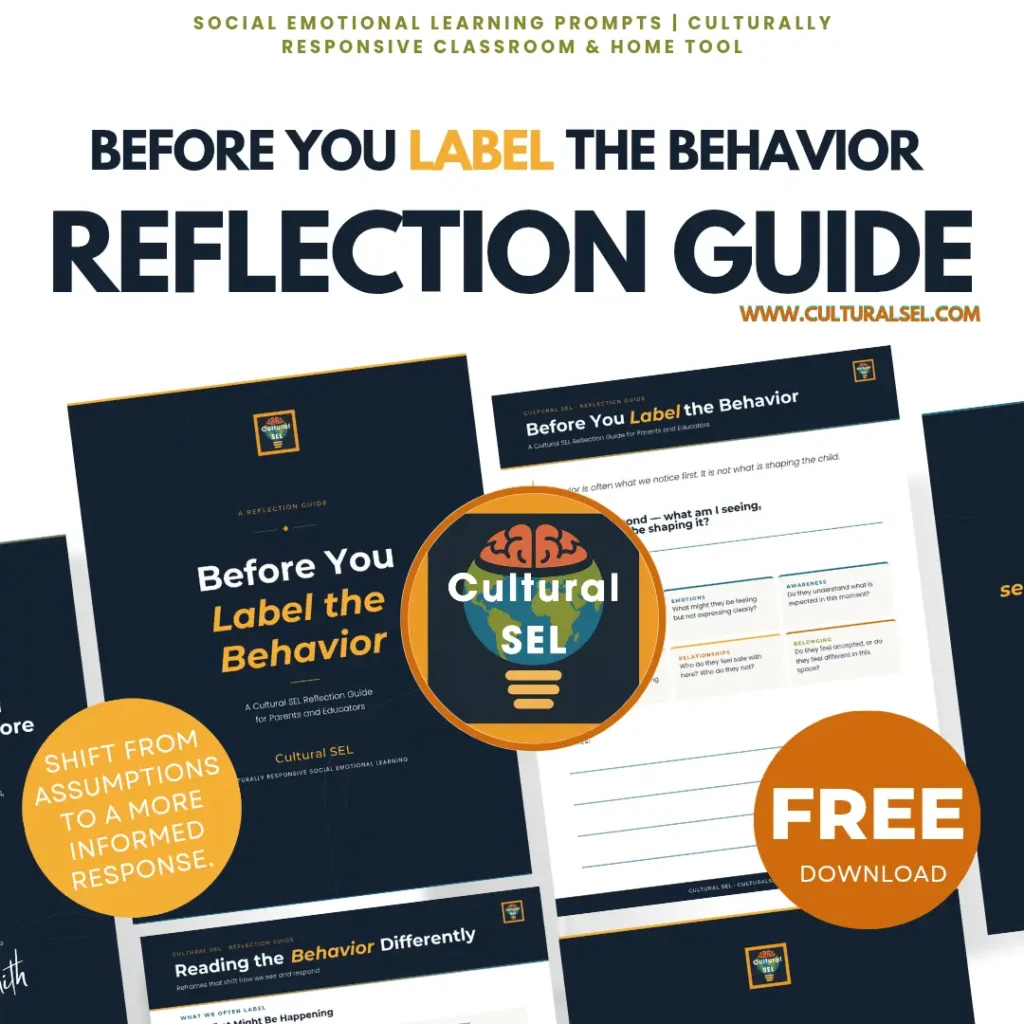
What if the behavior isn’t the whole story?
A free reflection guide that explores what may be influencing a child’s behavior before it is labeled, corrected, or misunderstood.
What Culturally Responsive Social Emotional Learning Actually Means
Standard SEL frameworks were not built with cultural diversity, global community norms, or multilingual families at the center.
When SEL is taught without a cultural lens, what gets measured is often one set of behaviors, the ones that map onto one kind of family, one kind of communication, and one kind of child.
Eye contact becomes a sign of respect instead of a cultural expression of it.
Directness becomes a communication skill instead of a single style among many. Quiet students get flagged. Loud students get corrected.
Children who do not match that norm learn to mask. They do not learn the skill. They learn what adults in that building consider acceptable performance of the skill. Those are not the same thing.
Culturally responsive SEL builds on the CASEL framework (the Collaborative for Academic, Social, and Emotional Learning), which organizes SEL around five core competencies: self-awareness, self-management, social awareness, relationship skills, and responsible decision-making.
CASEL gave schools a shared language for this work. Where it falls short is in its assumptions about whose emotional expression, whose communication style, and whose relational behavior counts as the standard.
Culturally responsive SEL, grounded in the work of researchers like Gloria Ladson-Billings and Geneva Gay, asks what each of those competencies looks like across different cultural contexts.
It asks adults to focus on the skill being developed rather than reacting to the style in which it appears. When adults can do that, children are supported instead of corrected for differences.
How Culture Actually Shapes Behavior in SEL Spaces
Culture in SEL conversations is often reduced to visible markers: food, holidays, music, and language.
Those things matter. They help children feel represented. But they rarely explain what is happening when a child goes quiet under pressure, refuses to make eye contact with an adult, or handles conflict in a way that reads as disrespectful to one person and completely normal to another.
A more useful way to think about culture in SEL spaces is in terms of three layers.
- Surface culture includes the visible markers: language, food, celebrations, clothing, and customs. Adults often stop here. This layer helps children feel seen, but it does not explain behavior during a conflict or why a child shuts down in a group discussion.
- Social norms are the everyday rules people follow without thinking about them. How close to stand when speaking? Whether children wait to be addressed or speak up directly. What tone sounds respectful? How disagreement gets handled in front of others. These norms are learned inside families and communities long before a child enters a classroom. They shape what adults read as attention, self-control, and respect.
- Core values include beliefs about family roles, independence, community responsibility, and how authority works. These values shape what a behavior means to a child and to the adult interpreting it.
When adults work only at the surface, they miss the social norms and core values that are actually driving what they see. Culturally responsive SEL asks adults to understand all three layers before drawing a conclusion.
Why Culturally Responsive SEL Is Not Optional
I grew up in a Ghanaian household in Germany. Showing respect at home meant listening without interrupting, deferring to adults, and reading the room before speaking.
When I stepped outside those walls, that same behavior read as withdrawn, uncertain, or disengaged.
No one told me I was being interpreted through someone else’s lens. I figured it out the way most children do: by watching what got rewarded and what got corrected.
Now I raise my own children in the United States and watch them navigate the same gap. I understand exactly what they are managing that the adults in the room cannot see, because I lived a version of it first.
That experience is part of why I write about this, build tools around it, and sit at tables where these interpretation calls are being made in real time.
I have sat in PTA meetings and on DEI and family engagement committees where a child’s behavior was being discussed.
The interpretation was almost always about the behavior itself, not about what was underneath it.
The child’s home language, their family’s relationship with authority, the way they had been taught to show deference or to speak up for themselves: none of it was in the room.
What was in the room was the behavior, and an adult making a call based on a framework that was never built to see that child accurately.
What I do in those spaces is bring the context that changes the interpretation before it becomes a label.
Three misreads happen repeatedly when SEL is taught without a cultural context.
Communication style is judged by one norm
In many settings, good communication means eye contact, a calm tone, and quick verbal responses. These are learned behaviors, not universal ones.
Some children show they are paying attention by listening quietly. Others were taught that looking an adult directly in the eye is disrespectful.
When only one style is accepted, capable children get read as defiant or checked out.
Emotional expression treated as performance
SEL skills are about coping, safety, and connection. Some children express feelings openly. Others keep emotions close and share them only with people they trust.
Staying calm and quiet can be a form of regulation, not a sign that a child is shut down. Pushing children to express emotions in a single approved way adds stress instead of building the skill.
Maturity defined by one model
In many communities, maturity looks like stepping up and taking responsibility. Children who care for siblings, translate school documents for a parent, or support elders are showing empathy, planning, and follow-through.
Those skills often go unrecognized at school because they do not fit the individualist model most SEL frameworks reflect. When only one version of maturity counts, capable children get overlooked.
How the CASEL Competencies Look Through a Cultural Lens
Culturally responsive SEL does not replace the CASEL competencies. It asks what each competency looks like across different cultural contexts, so adults stop reading cultural difference as skill deficit.
| CASEL Competency | What Standard SEL Often Measures | What Culturally Responsive SEL Asks Instead |
|---|---|---|
| Self-Awareness | Can the child name their feelings using English emotion words? | Does the child understand their emotions, including through their home language and cultural frame? |
| Self-Management | Does the child stay calm and quiet when stressed? | Does the child regulate in ways that fit their cultural and family context, including by seeking community support? |
| Social Awareness | Does the child show empathy through verbal affirmation? | Does the child recognize others’ experiences through listening, action, or presence — not only through words? |
| Relationship Skills | Does the child resolve conflict through direct verbal negotiation? | Does the child repair relationships in ways their community recognizes, including through time, action, or a trusted person? |
| Responsible Decision-Making | Does the child make independent choices that reflect classroom rules? | Does the child make decisions that account for their responsibilities to family, community, and self? |
Each row is a place where a child can be fully competent and still be marked as deficient because the measurement was built for a different child.
What Culturally Responsive SEL Looks Like in Practice
Culturally responsive SEL does not require a new curriculum. It requires a shift in how adults use the one they already have.
In the classroom, it starts with learning what families want adults to know about their child. Not just what is in the file.
What the family knows that no assessment captures: how their child shows they are listening, what their child does when they are overwhelmed, what their home language gives them that English does not.
That conversation changes the interpretation before anything else does.
When emotion words come up in a lesson, the culturally responsive approach teaches them in students’ home languages alongside English.
A student who has a word in Twi, Spanish, or Haitian Creole for something they feel, with no direct English equivalent, is not emotionally limited.
They are linguistically resourced. The goal is a connection between languages, not the replacement of one with another.
When a class builds shared norms, students decide together how they show respect: through eye contact, quiet listening, asking questions, and taking notes.
Multiple expressions of the same value can exist at the same time. The norm becomes real because students built it, not because it was handed to them.
In community and group settings, perspective-taking includes a wide range of perspectives: disability experiences, immigration stories, rural and urban contexts, different family structures, and varied communication styles.
No child is expected to represent their whole community. Adults use “some people might…” framing so students can engage with ideas without being required to self-disclose.
Scenarios for conflict resolution are built around contexts students actually navigate: living in two households, translating for a parent, caring for a younger sibling, and working after school.
When the scenario reflects a child’s real life, the skill connects to something they can actually use.
When a stereotype or cultural misunderstanding surfaces, the response is immediate and calm. Name what happened. Clarify the concept. Return to the skill. That correction is not a detour from the lesson. It is the lesson.
For families, the daily routines, expectations, and conversations already happening inside a home are teaching children how to manage feelings, build relationships, and handle conflict.
Culturally responsive SEL asks families to recognize that what they are already doing has value, and to use their own language and values as the foundation, not something to set aside.
I learned that from living the gap myself. When my children come home having been interpreted in ways that missed them, I know exactly what they are carrying.
And I know the difference between a child who lacks the skill and a child who has it but expresses it in a way the room was not built to recognize.
Home is not the problem. The interpretation gap is. What I help families see is that their language, their norms, and their values are not working against SEL. They are where it already lives.
For families, three things make a real difference.
Use your home language to talk about feelings. If your child has a word in your language for what they are experiencing, use it.
Connect it to the English word when that is useful, but do not treat your language as a barrier.
Children who can name their emotions in more than one language are more equipped, not more confused.
Talk openly about different expectations in different spaces. Help your child understand that the way they show respect at home is not wrong just because it looks different at school.
Give them language for the difference. Children who have that framing do not have to choose between their identity and their environment.
When school communication feels disconnected from your family’s experience, translate it into terms that make sense at home.
The skill being described is almost always something your family already teaches. The terminology is the barrier, not the concept.
Shop Our Culturally Responsive SEL Resources
Digital Cultural SEL resources for parents, caregivers, educators, community professionals, and children.
Explore practical tools, guides, reflection resources, and activities focused on social and emotional development, cultural environments, identity, belonging, relationships, lived experiences, and behavior.
Frequently Asked Questions About Culturally Responsive Social Emotional Learning
What is culturally responsive social-emotional learning?
Culturally responsive social emotional learning is the practice of teaching social and emotional skills in ways that account for a child’s cultural identity, home language, family values, and lived experience. It builds on the CASEL framework and asks adults to examine whether one cultural norm is being treated as the standard for all children.
How is culturally responsive SEL different from standard SEL?
Standard SEL teaches skills: recognizing emotions, managing stress, building relationships, and making decisions. Culturally responsive SEL asks what those skills look like across different cultural contexts, so children are not marked as deficient for demonstrating competence in ways that do not match a single cultural norm.
Does culturally responsive SEL lower expectations?
No. Expectations stay clear. What changes is the accuracy of how those expectations are assessed. There is more than one appropriate way to show respect, attention, self-control, or empathy. Culturally responsive SEL makes the measurement more accurate, not more lenient.
Can families practice culturally responsive SEL at home without a program?
Yes. Families support these skills through daily routines, home language, and conversations that reflect their own values. The home is not a barrier to SEL. For most children, it is where the foundation was already built.
What do adults need to get started?
A willingness to examine which behaviors they are treating as universal and which are actually cultural. From there, learn how the families you serve define the skills you are teaching. Ask what they want you to know about their child. Use that information before drawing conclusions from behavior alone.
How does culturally responsive SEL connect to CASEL?
CASEL provides the framework. Culturally responsive SEL builds on it by asking what each competency looks like across different cultural contexts, so the skill gets measured accurately rather than through a single cultural filter.
“Children don’t learn the skill. They learn what adults consider acceptable performance of the skill. Those are not the same thing.”
The gap between what a child is doing and what an adult thinks it means is where culturally responsive social-emotional learning does its work.
The goal is not to lower the bar. The goal is to broaden the interpretation so that what was invisible becomes part of the picture, and every child is read accurately before they are corrected.
CONTINUE EXPLORING CULTURAL SEL
Explore free Cultural SEL guides, culturally responsive SEL tools, and practical resources for understanding how cultural environments, identity, belonging, relationships, and lived experiences connect with children’s social and emotional development.
📌 Save or share this post with someone who is raising, teaching, or guiding children.

Hi, I’m Faith, the creator of Cultural SEL
I create practical tools and resources that support children’s social and emotional development and help parents, caregivers, educators, and community professionals look beyond behavior labels.
My work focuses on how cultural environments, identity, belonging, relationships, and lived experiences shape what children experience and how adults interpret and respond.
Read more about Faith and Cultural SEL: https://culturalsel.com/about
Join the Cultural SEL community: https://culturalsel.com/fb