How to Add Culturally Responsive SEL to a Program You Already Run
You have the morning check-ins running. You have conflict-resolution steps taped to the wall.
Some students still aren’t reached by any of it.
That gap means the program was built around one version of a student, and the room in front of you has more than one kind.
Culturally responsive SEL is an adjustment to the SEL (Social and Emotional Learning) program you’re already running, not a second one stacked on top of it.
This guide walks through what that adjustment looks like, without asking you to throw out anything you’ve built.
FREE DOWNLOAD · REFLECTION GUIDE
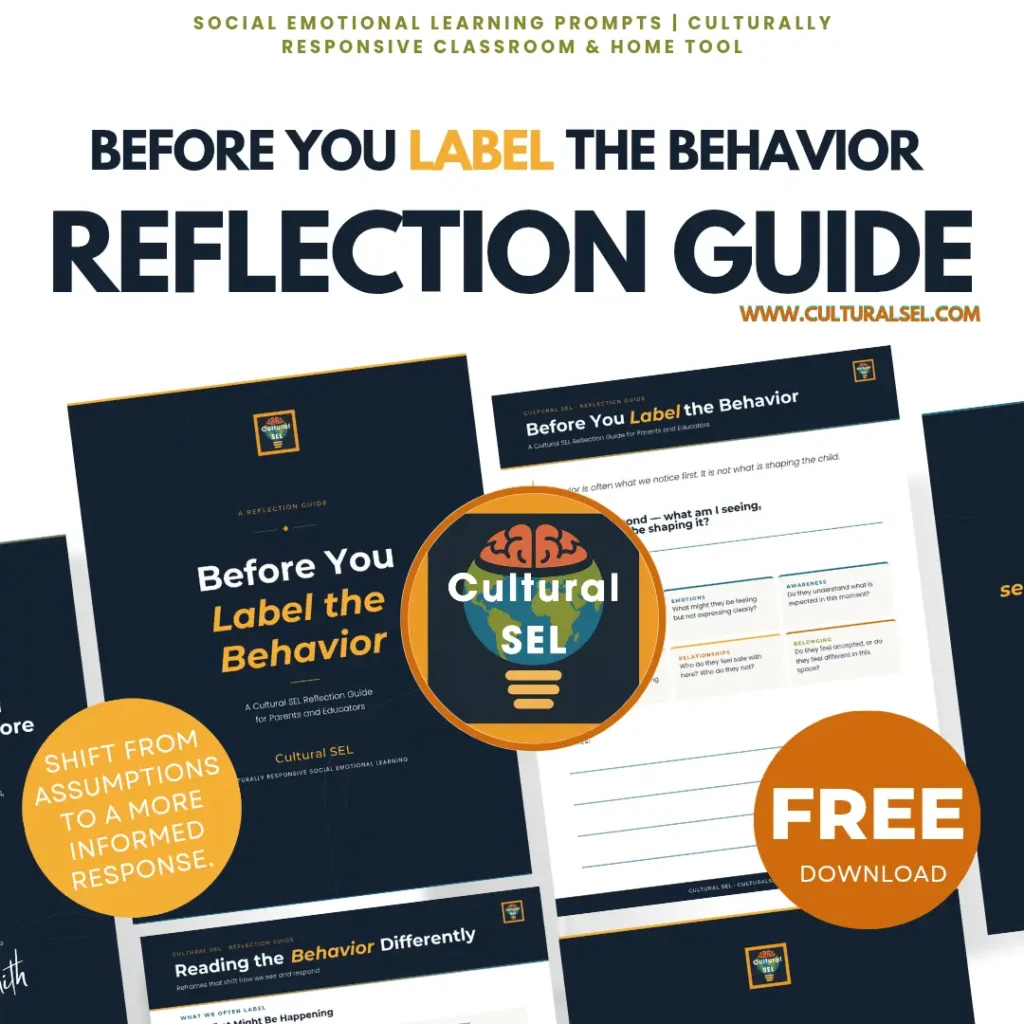
What if the behavior isn’t the whole story?
A free reflection guide that explores what may be influencing a child’s behavior before it is labeled, corrected, or misunderstood.
What You Already Have Stays
If your program is built around the five CASEL (Collaborative for Academic, Social, and Emotional Learning) competencies: self-awareness, self-management, social awareness, relationship skills, and responsible decision-making, none of that changes.
Those five areas hold up across cultural contexts. What changes is what counts as evidence that a student has the skill, and what your examples and materials assume is “normal” while getting there.
Five Adjustments You Can Make This Week
Swap the Examples in Your Scenarios
A conflict-resolution scenario set in a Sudanese household will not land the same way for every student as one set in a Japanese or Puerto Rican household.
Rotate through family structures, languages, and community contexts instead of defaulting to one version of a family every time.
Students notice when they’re never in the examples. They also notice when they are.
Add One Identity Question to Self-Awareness Lessons
When you teach self-awareness, add one prompt that connects the feeling to where it came from: which communities shaped how you learned to handle this, or what your family taught you about showing you’re upset.
The lesson structure stays the same. What changes is whose answer counts as valid inside it.
Explain the Expectation, Then Compare It to Home
When you teach a specific behavior, participation, turn-taking, how disagreement gets handled, say what you expect and why.
Then ask how that might look different at home. Most students don’t push back on an expectation they understand. They push back on one that feels like it’s telling them their home was wrong.
Bring Family Language Into the Room
Ask families what their household already teaches about responsibility, conflict, or care.
A lot of what SEL is trying to build, kids are already learning at home, in a different vocabulary. Find out what that vocabulary is before assuming it’s missing.
Check Who’s Missing From Your Materials
Look at your posters, your read-alouds, your worksheets. Whoever isn’t in them already knows it. A materials audit like this takes an afternoon, not a curriculum rewrite.
Why This Doesn’t Lower the Bar
The standard doesn’t move. A student still needs to manage conflict, name a feeling, and make a responsible decision.
What changes is whether the way they show that skill gets recognized or mistaken for not having it.
OECD’s PISA 2018 Results (Volume III): What School Life Means for Students’ Lives examines how a student’s sense of belonging relates to well-being and engagement across the education systems it studies.
That’s the mechanism these five adjustments are working with, not a separate goal on top of them.
I sit on our school’s PTA and family engagement committee, and I rarely see resistance to this kind of adjustment.
It’s adults reaching for the closest example they already have, because nobody handed them a different one. Swapping that example out is a smaller lift than the disengagement it prevents.
For the full explanation of what culturally responsive SEL is and why it developed, see the full guide.
Common Questions About Adding Culturally Responsive SEL
Do I need to buy a new curriculum?
No. Every adjustment here works inside a program you already run.
How long before I see a difference?
Most schools notice a shift in participation within a few weeks of the materials and example changes, since those are the most visible to students right away. The identity-question and expectation-setting changes take longer to show up because they build trust over time.
What if my school doesn’t use CASEL specifically?
The five adjustments apply regardless of which named framework you’re using. They’re about what counts as evidence and who’s represented, not about which competency model sits underneath.
Where do I start if I only have time for one thing?
Start with the materials audit. It takes the least time and tells you the most about what your students are already noticing.
For the fuller picture of what culturally responsive SEL means and where it comes from, visit the Cultural SEL hub.
CONTINUE EXPLORING CULTURAL SEL
Explore free Cultural SEL guides, culturally responsive SEL tools, and practical resources for understanding how cultural environments, identity, belonging, relationships, and lived experiences connect with children’s social and emotional development.
📌 Save or share this post with someone who is raising, teaching, or guiding children.

Hi, I’m Faith, the creator of Cultural SEL
I create practical tools and resources that support children’s social and emotional development and help parents, caregivers, educators, and community professionals look beyond behavior labels.
My work focuses on how cultural environments, identity, belonging, relationships, and lived experiences shape what children experience and how adults interpret and respond.
Read more about Faith and Cultural SEL: https://culturalsel.com/about
Join the Cultural SEL community: https://culturalsel.com/fb