Children’s Books on Girls’ Empowerment, Education, and Leadership
THIS POST MAY CONTAIN AFFILIATE LINKS. THIS MEANS WE MAY RECEIVE A COMMISSION FROM QUALIFYING PURCHASES YOU MAKE THROUGH OUR LINKS. KINDLY READ OUR DISCLOSURE NOTICE FOR MORE INFORMATION.
When girls are shown leading, learning, organizing, and solving real problems, students notice.
When they are only praised for confidence or kindness, students notice that too.
If you are building an SEL classroom, library, or small group where girls’ empowerment is modeled through education and leadership, the books need to show effort, decision-making, and real impact.
This list highlights titles where girls and women act, advocate, build, and persist across cultures and communities.
Stories shape expectations. Students watch who studies, who organizes, who speaks, who builds, and who is taken seriously.
Global education data from UNESCO shows that when girls have sustained access to schooling, outcomes improve for entire communities.
When leadership is shown through effort and learning, it becomes concrete rather than abstract.
A page turns, and a girl sees someone studying advanced math, organizing neighbors, protecting books, or standing up for education. The thought forms quickly. That can be me.
What if the right book still misses the child in front of you?
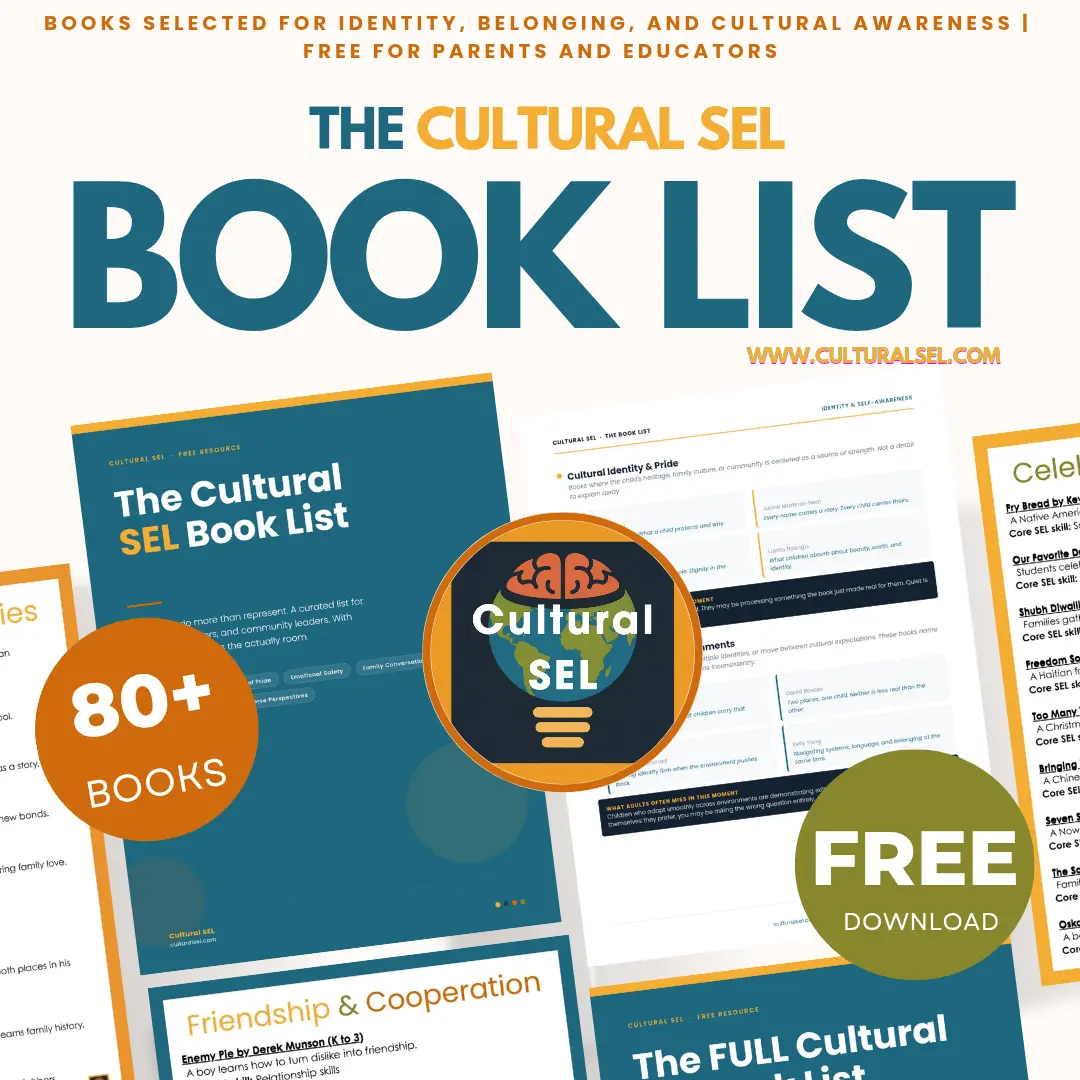
80+ books selected for identity, belonging, and cultural awareness. Each category includes what adults often miss, so you know how to use them, not just which ones to choose.
What to Look for in Children’s Books on Girls’ Empowerment, Education, and Leadership
Empowerment should be visible on the page. It should be shown through decisions, effort, and consequences, not described through praise alone.
Look for:
- A girl or woman making meaningful decisions that affect the direction of the story. Her choices should move events forward.
- Barriers that require effort. The obstacle should demand learning, practice, persistence, or courage.
- Growth connected to education, skill-building, or community impact. Progress should come from work, not luck.
- Leadership that affects others. Her actions should influence a group, a classroom, a family, or a community.
- Support systems that do not replace agency. Adults and peers may guide, but they do not solve the problem for her.
A strong book shows leadership in motion. It allows readers to see what it takes, not just how it feels.
Signals a Book Supports SEL Without Turning Into a Lecture
Empowerment books can easily slip into speeches. Strong SEL books do not explain the lesson. They show it through action and interaction.
Look for:
- Choice and agency. The character decides, initiates, or responds in a way that changes the outcome.
- Try-again moments. Mistakes happen. She adjusts, learns, and continues instead of succeeding immediately.
- Named emotions connected to action. Feelings are visible in behavior, dialogue, or reflection, not just stated as labels.
- Help that respects independence. Support is offered, but responsibility remains with the main character.
- Boundaries alongside kindness. She can be generous and still protect her time, space, or goals.
- Shared leadership. Others contribute ideas or effort, showing that leadership is collaborative rather than isolated.
If the lesson is explained instead of demonstrated, discussion will stay surface-level. When the skill is embedded in the story, students can analyze it instead of being told what to think.
Cultural Responsiveness and Trauma Awareness Before Reading Aloud
Before bringing a book into a group setting, read it closely. Empowerment stories can still carry stereotypes, oversimplifications, or unnecessary harm.
Pay attention to:
- Who tells the story. Consider the author’s perspective and whether the voice feels informed and respectful.
- How culture is presented. Cultural details should shape the character’s daily life, language, relationships, and decisions. They should not appear as background decoration or stereotypes.
- Whether stereotypes are reinforced or challenged. Notice how girls, families, communities, and authority figures are portrayed.
- How difficult moments are handled. If the story includes discrimination, violence, or exclusion, check whether those moments are contextualized and balanced with agency and support.
Scan for scenes involving humiliation, graphic harm, or intense fear that may be unnecessary for your setting.
Plan ahead for flexibility. Identify where you might pause. Offer alternatives for students who prefer to reflect privately. Do not require students to share personal connections in order to participate.
Empowerment in an SEL space should build understanding without demanding disclosure.
Children’s Books About Learning and Education Access
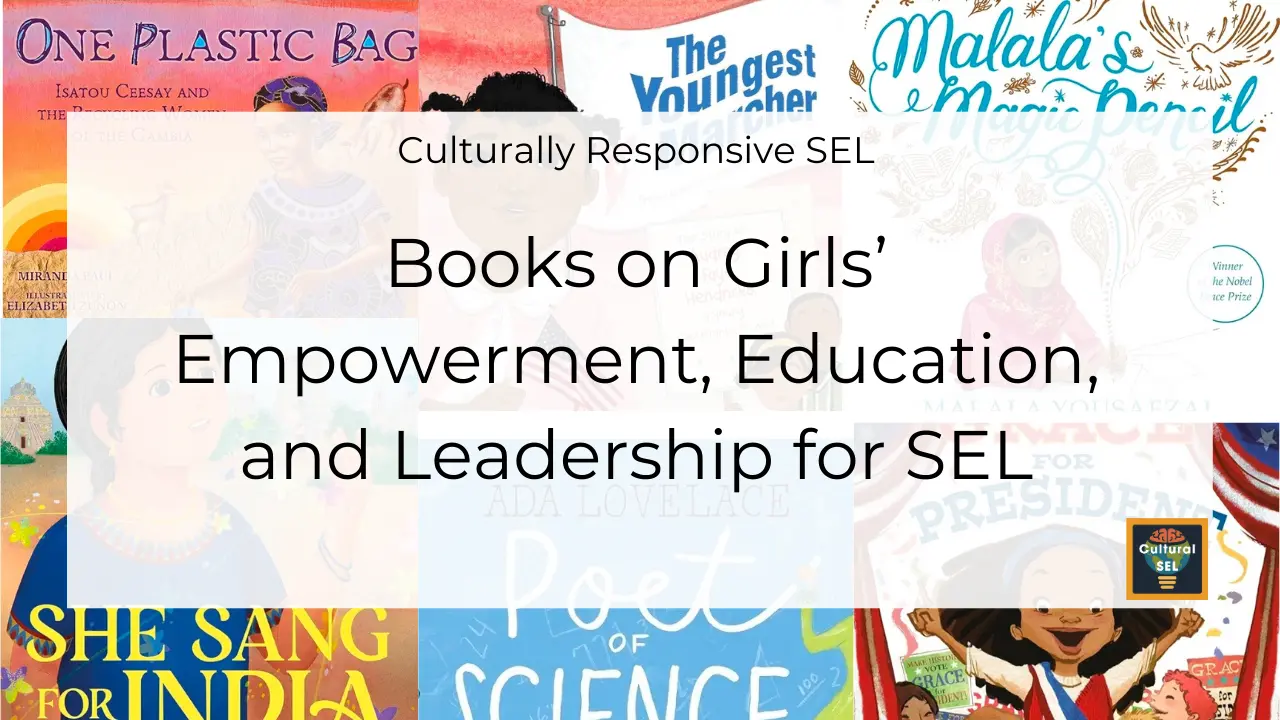
- A Computer Called Katherine by Suzanne Slade (Ages 6–10)
The story of Katherine Johnson’s mathematical skill and persistence at NASA.
SEL focus: academic confidence, persistence, problem solving. - Hidden Figures: The True Story of Four Black Women and the Space Race by Margot Lee Shetterly (Ages 8–12)
Four women whose education and expertise shaped space exploration.
SEL focus: collective leadership, intellectual courage. - Nasreen’s Secret School by Jeanette Winter (Ages 6–10)
A girl attends a secret school after losing access to education.
SEL focus: resilience, education rights. - The Oldest Student by Rita Lorraine Hubbard (Ages 6–10)
Mary Walker learns to read at 116 years old.
SEL focus: lifelong learning, determination. - A Girl Like Me by Angela Johnson (Ages 5–9)
A story affirming strength and possibility.
SEL focus: self-worth, confidence. - Wangari’s Trees of Peace by Jeanette Winter (Ages 5–9)
Wangari Maathai organizes women to plant trees and protect land.
SEL focus: environmental leadership, collective action. - My Name Is Sangoel by Karen Lynn Williams and Khadra Mohammed (Ages 6–9)
A Sudanese refugee boy advocates for his name to be understood correctly in school.
SEL focus: identity, advocacy, persistence in education. - Four Feet, Two Sandals by Karen Lynn Williams and Khadra Mohammed (Ages 6–9)
Two refugee girls share shoes and attend school in a camp.
SEL focus: education access, cooperation, resilience.
Children’s Books About Girls’ Leadership and Civic Action
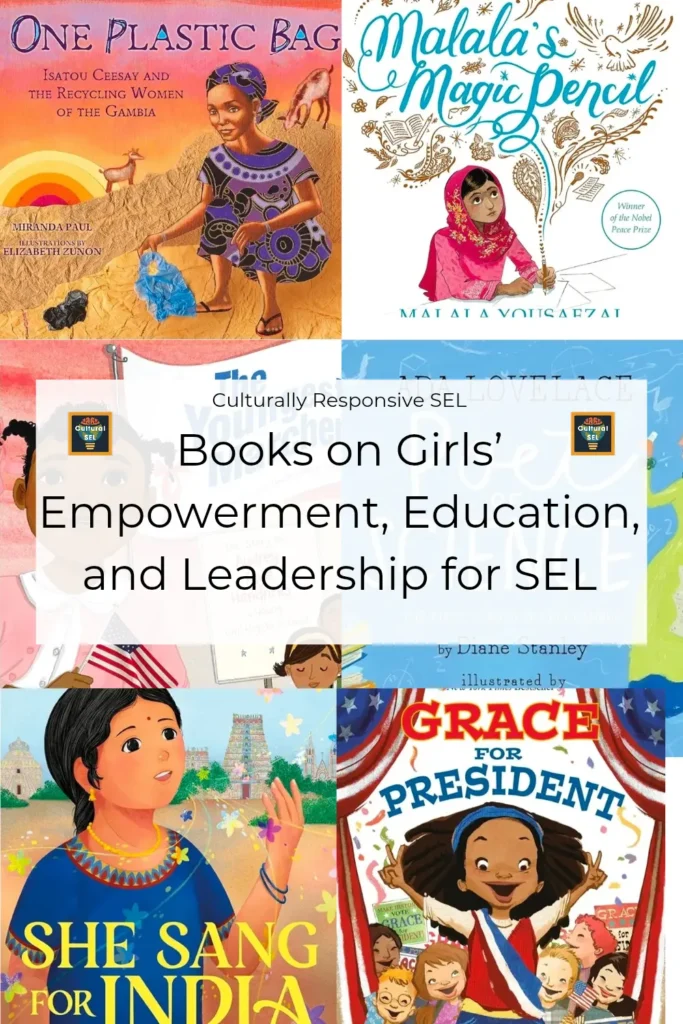
- Grace for President by Kelly DiPucchio (Ages 5–9)
A girl runs a school campaign after noticing imbalance.
SEL focus: initiative, civic awareness, teamwork. - Malala’s Magic Pencil by Malala Yousafzai (Ages 6–10)
A girl connects imagination with advocacy for education.
SEL focus: voice, educational rights. - The Youngest Marcher by Cynthia Levinson (Ages 6–10)
A child participates in the Children’s March.
SEL focus: bravery, collective action. - Separate Is Never Equal by Duncan Tonatiuh (Ages 7–12)
Sylvia Mendez and her family challenge school segregation.
SEL focus: justice awareness, advocacy. - She Sang for India by Janice P. Nimura (Ages 7–11)
Sarojini Naidu uses poetry and public speech in the Indian independence movement.
SEL focus: public voice, civic leadership. - One Plastic Bag by Miranda Paul (Ages 6–10)
Isatou Ceesay organizes recycling efforts in her community.
SEL focus: social responsibility, community initiative.
Children’s Books About Women as Mentors and Builders
- The Bluest of Blues by Fiona Robinson (Ages 6–10)
Anna Atkins combines science and art to document plant life.
SEL focus: curiosity, academic leadership. - Planting Stories: The Life of Librarian and Storyteller Pura Belpré by Anika Aldamuy Denise (Ages 5–9)
Pura Belpré expands access to books and preserves cultural storytelling traditions.
SEL focus: literacy leadership, cultural stewardship. - The Librarian of Basra by Jeanette Winter (Ages 6–10)
A librarian protects books during conflict.
SEL focus: courage, preservation of knowledge. - Ada Lovelace, Poet of Science by Diane Stanley (Ages 6–10)
Ada Lovelace connects imagination with mathematics and early computing theory.
SEL focus: intellectual leadership, creative problem solving.
How to Use These Books in SEL Groups and Classrooms
Be intentional about your purpose before you read.
Name the focus clearly. For example: persistence, public voice, boundary setting, or collaborative leadership. Students should know what skill they are listening for.
During reading, pause once to identify:
- A choice the character makes
- A feeling connected to that choice
- A support that helped or did not help
After reading, structure reflection. Students can write, draw, discuss in pairs, or respond silently. Not every student needs to speak publicly for the lesson to land.
Empowerment develops when adults guide students to examine what a character did and what happened as a result.
Students should not be required to share personal experiences in order to participate.
Book Matching Tips for Mixed Groups
Start with your instructional goal:
- Confidence building
- Education persistence
- Civic advocacy
- Community leadership
Then evaluate the text for fit:
- Age range and reading complexity
- Emotional intensity of conflict
- Cultural context and representation
- Visual clarity and accessibility
For multilingual learners, preview key vocabulary and rely on illustrations to support comprehension. Choose texts where visuals carry meaning alongside the words.
When the book fits the group’s age, reading level, and emotional readiness, students can focus on the character’s decisions and leadership instead of struggling to follow the story.
Explore More Titles
If you are building your shelf beyond this list, we share additional culturally responsive SEL books in our Amazon storefront.
If you prefer another retailer, many of these same titles are also available through Books-A Million.
Use the option that works best for your family, classroom, or library.
FAQ: Children’s Books That Support Girls’ Empowerment, Education, and Leadership
What age should I start reading empowerment books?
Preschool. Keep the focus on visible actions, effort, and decision-making rather than abstract encouragement.
Are these books only for girls?
No. Reading them with all students establishes shared expectations about leadership, collaboration, and respect.
How do I avoid stereotyped or performative titles?
Look for stories where growth comes from effort, learning, and agency. Cultural details should influence the character’s world, not sit on the surface as decoration.
Girls’ education: Gender equality in education benefits every child.
What Students See on the Page Matters
Choose intentionally.
Select one title that aligns with the leadership skill you want students to practice. Name the skill before you read. Return to it after the discussion.
Book choices shape what students come to expect from themselves and from others. Let’s make those expectations culturally responsive, visible and specific.
CONTINUE EXPLORING CULTURAL SEL
Explore free Cultural SEL guides, culturally responsive SEL tools, and practical resources for understanding how cultural environments, identity, belonging, relationships, and lived experiences connect with children’s social and emotional development.
📌 Save or share this post with someone who is raising, teaching, or guiding children.

Hi, I’m Faith, the creator of Cultural SEL
I create practical tools and resources that support children’s social and emotional development and help parents, caregivers, educators, and community professionals look beyond behavior labels.
My work focuses on how cultural environments, identity, belonging, relationships, and lived experiences shape what children experience and how adults interpret and respond.
Read more about Faith and Cultural SEL: https://culturalsel.com/about
Join the Cultural SEL community: https://culturalsel.com/fb