How We Design Culturally Responsive SEL Resources That Actually Work
Many behavior problems are not skill problems. They are interpretation problems.
When expectations stay vague, adults fill in the gaps with personal assumptions about respect, effort, participation, or attitude. Students feel judged. Adults feel frustrated. Trust weakens.
Culturally responsive SEL resources are built to prevent that breakdown. They define the skill in clear behavior terms, name cultural context directly, protect student identity, and guide adult interpretation.
This post explains the structure behind our Cultural SEL tools, why that structure prevents common classroom harm, and what you can expect every time you open a resource.
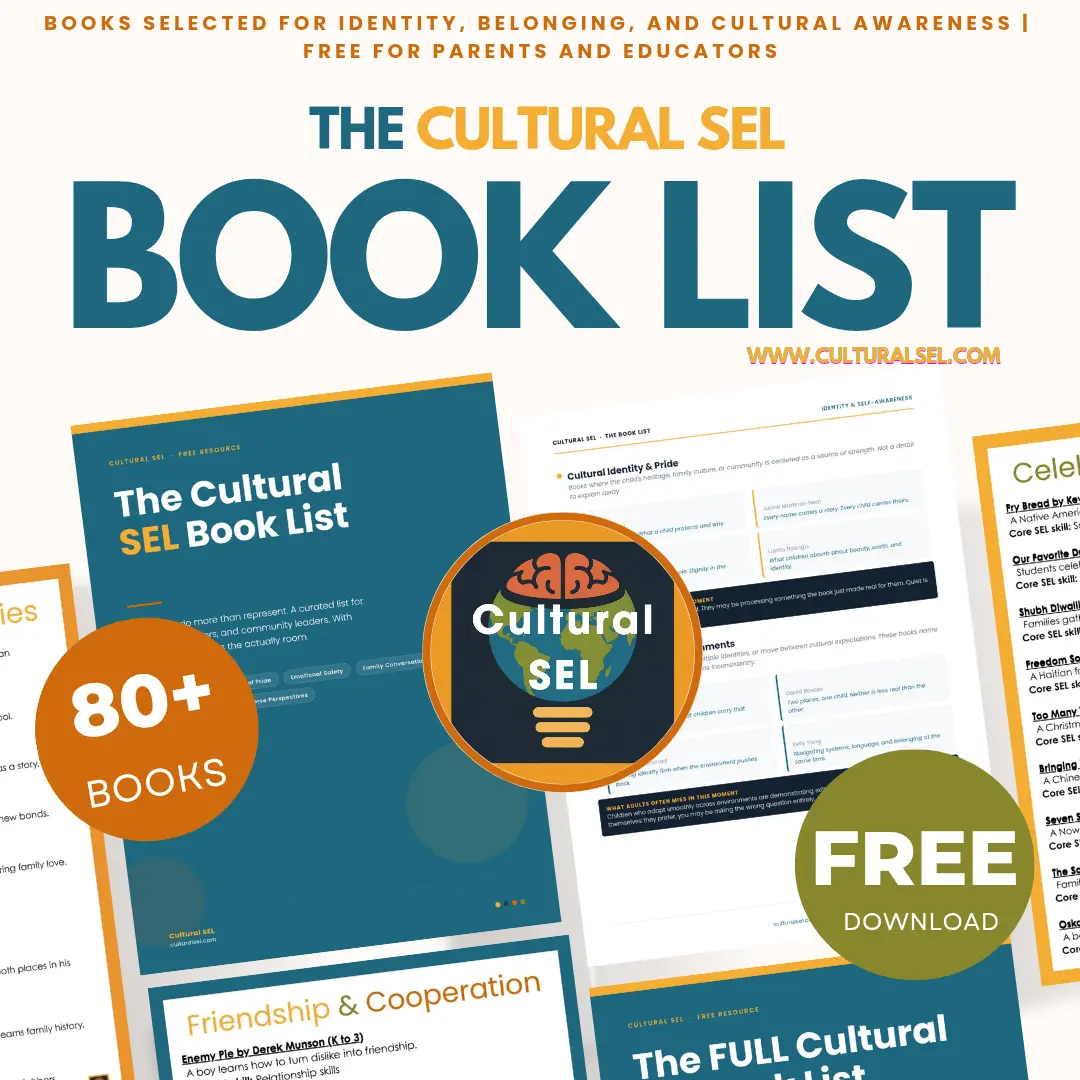
What if the right book still misses the child in front of you?
80+ books selected for identity, belonging, and cultural awareness. Each category includes what adults often miss, so you know how to use them, not just which ones to choose.
What Culturally Responsive SEL Resources Require
Culturally responsive SEL starts with a clear definition. It teaches social and emotional skills in ways that respect identity, language, and community norms, while staying usable on a hard day.
Four requirements show up in every resource.
First, SEL skills must be defined in behavior terms. “Self-management” cannot stay abstract. A usable definition sounds like, “I can pause, name what is happening in my body, and choose a next step that keeps me and others safe.”
Second, cultural context must be named, not assumed. Families teach emotion, conflict, and respect in different ways.
Even volume and tone can signal different things across homes. In some families, a loud voice means excitement or emphasis. In others, it signals disrespect. When context is ignored, behavior gets misread.
Third, identity must be respected and protected. A resource should never force personal disclosure or public sharing as the price of participation. Students need options for privacy.
Fourth, adult interpretation must be examined. Many behaviors that get labeled as “defiance” are also about unmet needs, cultural mismatch, or stress responses. Adults need tools that slow down fast judgment.
Many SEL worksheets focus only on feelings. Feelings matter. Cultural SEL connects feelings to thoughts, body signals, context, values, and choices, then supports adults in reading responses accurately.

The Structural Framework Behind Our Cultural SEL Resources
Strong SEL tools feel simple in the moment because the structure did the work ahead of time.
We design each resource so a student can use it with minimal guesswork, and so an adult can guide reflection without turning it into behavior control.
Clear Student Task Design
The student task states exactly what to do, where to write or draw, and how much to share. Each prompt uses clear language and short directions.
Clarity reduces confusion. When students feel unsure, they often freeze, joke, or shut down. A clear task lowers that pressure.
We build in choice. Students can keep work private, share with one person, or share with the group. Choice increases honest reflection and reduces performative answers.
Why Defined Sections Matter in SEL Resources
Sections are not decorative. Each one has a job.
A typical page might include sections such as feeling, thought, body signal, context, identity or values, next choice, and support needed.
Students learn what belongs where. That organization turns experience into a repeatable skill.
This also supports multilingual learners. When section titles repeat across resources, students build familiarity even when topics change.
Facilitator Guidance in Responsive SEL Resources
Every resource includes facilitator pages because adult decisions determine whether SEL lands well.
Early on, this was something I often saw missing. A worksheet would exist, but there was no guidance for the adult leading it. I knew if I was going to create resources, I wanted the adult layer built in.
Facilitator pages include a clear objective, materials, step-by-step directions, suggested timing, reflection questions, and cultural notes. The cultural notes prompt adults to pause and ask, “What else could this mean in this student’s world?”
When adults have clarity, interpretation improves. It reduces misreading student responses and lowers the urge to correct before understanding.
Clear Learning Objectives
Each resource clearly states what is being taught and how to use it. The skill is defined in behavior terms. The cultural layer is named, such as how respect norms shape conflict responses.
Adults cannot teach what they cannot name. When objectives are clear, teams can use shared language across classrooms and home.
That consistency strengthens practice and reduces mixed messages for students.
What Makes Our Cultural SEL Resources Culturally Responsive
A resource can look inclusive and still cause harm. Cultural responsiveness shows up in how the resource is built, especially around context, identity, and adult interpretation.
In SEL, harm can mean reinforcing stereotypes, pressuring students to represent a group, mislabeling behavior shaped by home norms, or requiring disclosure that feels unsafe.
For example, a worksheet may include diverse images but still assume one definition of respect, participation, family structure or leadership.
It may treat one communication style as appropriate and another as disruptive. It may invite a student to explain their culture publicly, placing pressure on them to speak for others.
When adult interpretation is not guided, cultural differences can be mistaken for skill gaps.
That is harm. It shows up as mislabeling, lowered expectations, stereotype reinforcement, or students withdrawing from participation.
Design choices determine whether those patterns continue or are interrupted.
Why Naming Cultural Context Improves SEL Accuracy
Our resources identify where culture influences social and emotional skills. This includes home routines, communication patterns, expectations around authority, and definitions of respect.
Instead of assuming one standard, we prompt adults to consider variation before deciding what needs correction.
Students are given structured ways to practice skills that allow for those differences.
Naming context improves accuracy. It helps adults separate cultural difference from skill development and keeps instruction focused on growth rather than control.
How Identity Protection Strengthens SEL Participation
Participation does not require personal disclosure. Students can write privately, respond with low-detail examples, choose from options, or observe without sharing.
This protects students who carry trauma, strong family privacy norms, immigration stress, or safety concerns. It also prevents students from being positioned as representatives of a culture.
There are times when SEL is used to help a child process something difficult or unsafe. That work matters.
But it should never be forced through a public worksheet or required sharing activity. Processing sensitive experiences requires trust, consent, and the right setting.
Students practice skills without being asked to defend, explain, or perform their identity.
If an SEL activity requires disclosure to “count,” some students will opt out, and others will perform.

Why Adult Learning Matters in Culturally Responsive SEL
Students learn emotional awareness, choice making, perspective taking, and self-advocacy.
Adults also learn. They practice noticing how culture shapes interpretation, when support should come before correction, and how identity affects behavior in group spaces. Prompts widen the lens without lowering expectations.
Our resources align skills to widely used SEL competencies, including CASEL’s framework. We also draw from global research and guidance, including OECD social and emotional skills research, UNESCO educational guidance on inclusion, World Health Organization research on stress and trauma, and peer-reviewed education policy research.
Adult learning should never be opinion-based. It should be grounded in established research on belonging, emotional regulation, and classroom climate across regions.
When adults strengthen their own understanding, implementation becomes more consistent and more equitable.
Common Classroom Challenges
Our resources are built with real classroom pain points in mind.
Students report feeling misunderstood, corrected before supported, labeled disruptive, feeling different, and pressured to perform calm.
Sometimes it shows up in ordinary situations. A child is laughed at for the food they bring to school or the way they eat.
A student wears their country’s jersey with pride and is suddenly treated as “other” by peers who previously assumed they were the same.
These experiences shape belonging. They influence how safe a student feels speaking in a group, resolving conflict, or participating in reflection activities.
Structured clarity reduces these harms. It slows adult reactions, gives students safer ways to participate, and creates shared routines that do not depend on one teacher’s personality.
When adults are guided to examine interpretation and participation options are built in, students are less likely to be singled out or misread.
Shop Our Culturally Responsive SEL Resources
Digital Cultural SEL resources for parents, caregivers, educators, community professionals, and children.
Explore practical tools, guides, reflection resources, and activities focused on social and emotional development, cultural environments, identity, belonging, relationships, lived experiences, and behavior.
Why Clear SEL Skill Framing Comes First
Before adding cultural framing, we start with the skill itself. We define it simply, explain why it matters in daily life, and offer practical strategies students can try.
This supports families and staff who want usable language and strengthens consistency across settings.
General SEL + Cultural Understanding = Empowered, Connected Learners.
How to Run a Culturally Responsive SEL Activity (10 Minutes)
Use this routine with most structured SEL pages.
- Name the skill in one sentence.
- Preview privacy options.
- Model one low-detail example.
- Give quiet work time for two to four minutes.
- Invite optional sharing.
- Close with one next step students can try.
This routine provides predictability on days when students are dysregulated or distracted.
How Cultural Context Is Integrated Into SEL Skill Practice
Once the skill is clearly defined, we connect it to the environments students actually live in.
Culture influences how emotions are expressed, which behaviors are praised, how respect is shown, and how authority is experienced at home and in community spaces.
We include prompts that connect skill practice to family routines, community expectations, and how elders may talk about responsibility, patience, or conflict.
Students are invited to consider how the same skill might look different at home, at school, or in public.
We also make space for differences in how emotions are discussed. In some communities, direct discussion of feelings is common.
In others, emotional guidance may be shared through spiritual teaching, faith leaders, storytelling, or practical advice rather than therapy-style language.
Our resources do not assume one model of emotional expression as the standard.
Some emotion words in English do not exist in other languages. In some communities, feelings are described through physical sensations such as tightness in the chest or a heavy stomach.
In others, emotions are described through values such as honor, responsibility, or harmony.
The goal is to teach skills in ways that stay connected to a student’s lived experience. Adults are guided to interpret student responses with cultural awareness rather than assumption.
Why This Structure Matters for Schools and Families
When SEL tools stay vague, adults fill gaps with assumptions. Structure reduces that risk.
It reduces behavior mislabeling because adults can separate skill gaps from defiance. It strengthens family trust because materials respect home norms and privacy.
It creates shared language across school and home. It supports multilingual learners through predictable routines.
Most importantly, it increases emotional safety because students control how much they share.
The comparison below shows what changes when structure and culture are built in from the start.
| Design Choice | Common SEL Worksheet Result | Our Structured, Culturally Responsive Result |
|---|---|---|
| Prompts focus only on feelings | Students guess what counts as a good answer | Students map feeling, body signal, context, and next choice |
| Sharing required | Some students shut down or perform | Privacy options support honest participation |
| No adult guidance | Adults interpret responses through personal bias | Facilitator notes slow down misinterpretation |
| Culture treated as a theme | Students feel singled out or stereotyped | Context is named as a normal part of SEL |
Structure helps adults teach. It helps students feel safe enough to practice.
Why Structured Cultural SEL Protects Student Dignity and Instructional Integrity
This work is personal for me.
I grew up as the only Ghanaian child in many school spaces in Germany. Being different did not always show up through open conflict. It often appeared through questions about my lunch, comments about my name, or moments when cultural references did not connect.
Now, as a parent, I watch children navigate being different while still wanting to belong. I see how easily culture becomes something a child shares with pride when prompted. I also see how quickly that same child may choose not to mention it to avoid teasing or being treated as “other.”
Those experiences shape how these resources are built.
They are not designed to spotlight difference. They are designed to protect dignity while teaching skill.
Skills align to widely used SEL competencies. Cultural notes address real classroom decisions. Language stays clear so families can use the same tools at home.
Integrity shows up in clear objectives, careful prompts, adult reflection, and respect for privacy.

What Educators and Families Can Expect From Our SEL Resources
These materials are used by classroom teachers, school counselors, librarians, after-school leaders, homeschool parents, and caregivers.
Each resource includes:
• Clear student directions
• Adult guidance with steps and reflection questions
The format stays usable across classrooms, small groups, counseling sessions, libraries, and home settings.
You should not have to guess how to use an SEL tool. When expectations are clear, students can focus on practicing the skill instead of figuring out what the activity is asking.
What Culturally Responsive SEL Looks Like in Homeschool Settings
In homeschool settings, culturally responsive SEL is built into daily routines rather than taught as a separate subject.
It can look like:
• A short reflection page after a conflict between siblings
• Naming body signals before a difficult conversation
• Using a structured SEL page once or twice a week
• Talking through a mistake using clear skill language
• Reviewing a “next choice” plan before entering a new setting
Structured SEL tools work well in homeschool settings because they provide clear prompts, defined sections, and privacy options without turning reflection into a performance.
At home, structure still matters. Clear directions reduce power struggles. Defined sections help children organize feelings, context, and choices.
Homeschool families can use the same skill language across daily routines, community activities, and academic work.
The goal is not to recreate school systems. The goal is to build emotional skills in ways that respect identity, family norms, and lived experience.
FAQ: Questions About Culturally Responsive SEL
What is culturally responsive SEL?
Culturally responsive SEL teaches social and emotional skills while honoring culture, language, and identity. It helps adults interpret behavior more accurately and helps students participate without disconnecting from who they are.
Why is culturally responsive SEL important?
It reduces mislabeling and supports belonging. It also strengthens relationships between schools and families by acknowledging that skills may look different across contexts.
How do you implement culturally responsive SEL in a busy school?
Start with short, repeatable routines and shared language. Use clear skill definitions, predictable structures, and adult reflection prompts. Build adult learning alongside student practice.
Does culturally responsive SEL work for all students?
Yes. When skills are clearly taught and context is named, all students benefit. Students who have felt misunderstood often benefit the most.
What makes these culturally responsive SEL resources different from regular SEL worksheets?
These resources include clear student directions, defined sections, adult guidance, cultural context prompts, and identity protection. They guide interpretation instead of leaving adults to fill in gaps.
Do students have to share personal experiences?
No. Sharing is optional. Students can respond privately, use low-detail examples, or observe without speaking. Participation never requires personal disclosure.
“Culturally responsive SEL works when the structure is clear, the cultural context is named, and adult interpretation is guided.” – Faith
Clear structure, straightforward context, and guided adult interpretation create practice students can repeat across settings without pressure to perform or disclose.
That combination creates structured practice students can repeat across settings without pressure to perform or disclose.
If your current materials feel surface level or hard to use, start with resources that protect identity and guide adult interpretation. Try one routine for a week. Notice what changes in participation and trust.
CONTINUE EXPLORING CULTURAL SEL
Explore free Cultural SEL guides, culturally responsive SEL tools, and practical resources for understanding how cultural environments, identity, belonging, relationships, and lived experiences connect with children’s social and emotional development.
📌 Save or share this post with someone who is raising, teaching, or guiding children.

Hi, I’m Faith, the creator of Cultural SEL
I create practical tools and resources that support children’s social and emotional development and help parents, caregivers, educators, and community professionals look beyond behavior labels.
My work focuses on how cultural environments, identity, belonging, relationships, and lived experiences shape what children experience and how adults interpret and respond.
Read more about Faith and Cultural SEL: https://culturalsel.com/about
Join the Cultural SEL community: https://culturalsel.com/fb