Adult Emotional Regulation and Student Behavior: Why SEL Must Start With Us
Student emotional regulation improves when adults model calm, consistent behavior. Social-emotional learning starts with us, because adult reactions and stress responses shape the emotional climate in a classroom or home.
This post explains how adult emotional regulation shapes student behavior, why adult stress is rising, and how culturally responsive SEL helps schools and families get on the same page.
When a student melts down, most adults look for the right words to fix it. Yet before children process our words, they read our tone, facial expression, and posture.
Those signals teach a lesson before we even say a thing.
FREE DOWNLOAD · REFLECTION GUIDE
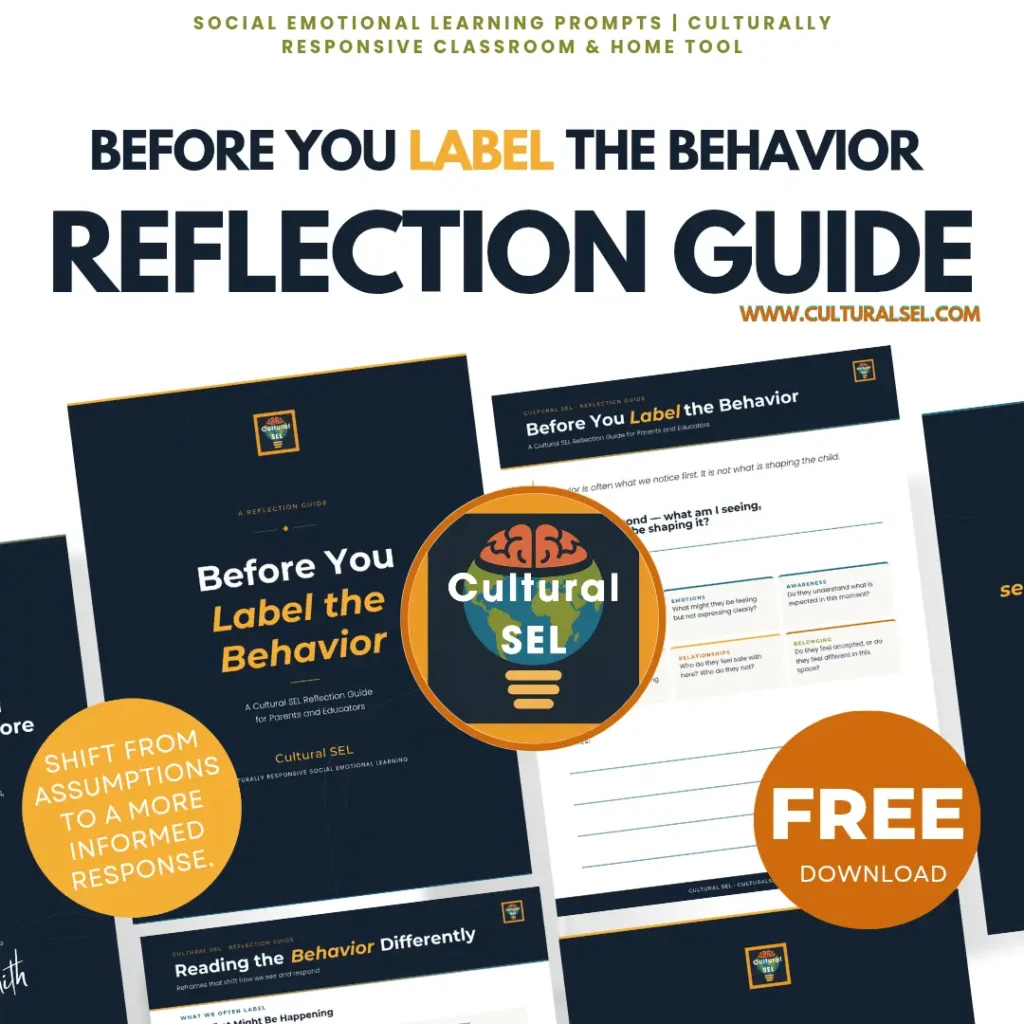
What if the behavior isn’t the whole story?
A free reflection guide that explores what may be influencing a child’s behavior before it is labeled, corrected, or misunderstood.
How Adult Emotional Regulation Is Learned Through Observation
We can teach SEL skills directly. Regulation, though, is usually learned by watching. Children pay attention to how adults act under pressure and later repeat it.
That learning happens during transitions, mistakes, arguments, and corrections. It does not happen during calm moments.
During moments of conflict or correction, students watch how adults respond. When adults keep their responses clear and controlled, arguments are less likely to grow. When adults react with visible frustration, disagreements can escalate.
Adult behavior does not control student behavior, but it can influence whether a disagreement turns into a power struggle or stays a short correction.
How Children Learn Emotional Regulation From Adults
Children learn how to handle strong feelings through daily interactions. These moments add up, even when adults think no one noticed.
They watch how adults respond to stress. Do we raise our voice, interrupt, cut them off, or point while speaking? They also watch how we handle conflict. Do we blame, dismiss, or pause and listen?
They notice how we correct mistakes. Some adults explain what went wrong and give the next step.
Others react with visible frustration. Students begin to expect the same pattern the next time something goes wrong.
They also notice how adults express frustration. A slammed door, a long sigh, or a sarcastic comment sends a message.
This matters for student behavior because many classroom disruptions happen during periods of stress. When adults react with visible frustration, some students argue, joke to deflect, withdraw, or refuse to do their work.
How Adults Model Escalation or Reset During Conflict
Modeling happens in real time. If an adult escalates quickly, children absorb escalation as normal. They learn that intensity wins.
When an adult pauses before responding and speaks without raising their voice, students see that frustration does not have to turn into shouting or punishment.
You can see the difference during correction or disagreement:
• A student talks back. The adult raises their voice. The student raises theirs.
• A student talks back. The adult lowers their voice, names the limit, and gives a short choice.
The second option is clear and regulated. It maintains authority without raising the emotional temperature.
This is modeling. Students repeat the patterns they see in adults.
We spend time teaching empathy, regulation, and respectful communication.
Real-life conflict often shows that adults are still learning these skills alongside students.
Why Adult Stress Is Increasing in Schools
Adult emotional regulation becomes harder when adults are managing high workloads and constant decision-making.
According to the 2025 RAND State of the American Teacher survey, 53 percent of K-12 teachers report burnout, and 44 percent report feeling burned out often or always.
The OECD Teaching and Learning International Survey shows that U.S. teachers report higher levels of job stress than many international peers.
In the United Kingdom, workforce reports show high levels of reported job-related stress among teachers and school leaders.
High job stress does not excuse harmful responses, but it does explain why adult regulation requires intentional support.
What Educators Carry
Educators are teaching content while also managing operational demands that extend beyond instruction.
Common responsibilities include:
• Documentation and compliance requirements
• Parent communication across multiple platforms
• Academic recovery planning
• Behavior tracking and reporting
• Coordinating with counselors and support staff
Many schools are also responding to increased student mental health needs while staffing remains tight. Teachers often move from instruction to crisis response within the same class period.
What Families Carry
Families are often stressed before the school day starts. That stress can show up as tension in the morning routine, missed messages, or strong reactions to school calls.
Common family stressors include:
• Financial strain and housing costs
• Work instability or multiple jobs
• Cultural misunderstandings with schools
• Fear of their child being misinterpreted or labeled
When families feel judged, trust drops. Then every message feels confrontational, even if the school meant well.
Supporting Adult Emotional Regulation Without Blame
Adult regulation is a capacity issue. When adults are juggling too many tasks at once, they are more likely to react quickly instead of thinking before responding. That includes teachers, parents, and support staff.
Blame often leads to defensiveness. Support increases the likelihood that adults will reflect and change their approach.
Schools can reduce reactive moments by setting clear behavior procedures, limiting last-minute schedule changes, and using consistent language for correction across classrooms.
Families can reduce friction by maintaining consistent routines at home and communicating early with teachers when a child is dealing with stress or change.
Cultural Expectations Shape Adult Reactions
Adults react based on what they were taught was respectful, safe, or normal. Those beliefs often come from culture, community, and past school experiences.
Two adults can see the same student behavior and interpret it differently. The student then receives mixed messages.
Different communities hold different assumptions about tone, directness, and correction.
In some communities:
• Direct correction signals clarity
• A raised voice signals urgency
• Emotional intensity signals care
In other communities:
• A calm tone signals authority
• Public correction feels shaming
• Emotional restraint signals control
None of these patterns is automatically wrong. Conflict increases when one style is treated as the only acceptable style.
How the Same Adult Behavior Can Land Differently
| Adult Behavior | One Interpretation | Another Interpretation | Possible School Impact |
|---|---|---|---|
| Direct correction | Clear guidance | Harsh or rejecting | Escalation or withdrawal |
| Raised voice | Urgent and serious | Unsafe or threatening | Power struggle |
| Quiet clipped tone | Controlled authority | Cold or dismissive | Limit testing or shutdown |
| Public correction | Accountability | Shame or humiliation | Defiance or avoidance |
The same adult move can land in very different ways.
When School and Home Expectations Differ
When school and home expectations differ, students can feel caught in the middle. They may use home communication habits at school and face disciplinary action for them. They may code-switch all day, which takes emotional energy.
Adults can misread intent. Defiance might be discomfort. Attitude might be directness. Silence might be respect in one home and avoidance in another.
Cultural SEL helps adults slow down and check meaning before reacting.
General SEL and Cultural SEL
General SEL teaches skills like naming feelings, calming down, and solving problems. These skills matter.
Cultural SEL adds another layer. It helps adults notice how identity, language, race, and upbringing shape expectations. It helps adults recognize patterns in discipline and interpretation.
The effectiveness of any SEL program depends on how adults apply it during correction and conflict.
What Adult SEL Looks Like in Practice
Adult SEL shows up in daily habits.
In practice, that includes:
• Pausing before responding
• Separating student identity from behavior
• Using observable language instead of labels
• Repairing after escalation
• Modeling apology when needed
I have seen that when adult responses stay consistent, corrections take less time and involve fewer repeated back-and-forth exchanges.
When expectations and consequences do not shift from moment to moment, arguments are less likely to continue.
Adult SEL also includes reflection. It means noticing personal triggers, examining assumptions about respect, and adjusting responses when a pattern is not working.
It is not only about staying calm. It is about reconsidering how behavior is interpreted before reacting.
A 60 Second Adult Reset During Conflict
When a student escalates, use this short routine.
- Stop your body first. Plant your feet. Relax your shoulders.
- Lower your voice. Use fewer words.
- Name what you see in one clear sentence.
- State the limit briefly.
- Offer one next step or a simple choice. Then wait.
This routine is not about perfection. It is about remembering that even when patience is tested, adults are still responsible for setting the tone in the room.
Why Adult Emotional Regulation Affects Student Behavior
Adult regulation shapes trust, discipline patterns, and the amount of time spent learning.
Students learn academic content and adult behavior at the same time. While they are learning reading and math, they are also learning how adults handle correction, conflict, and mistakes.
A regulated adult chooses their response. An escalated adult lets emotion choose it.
When adults regulate well:
• Corrections are less likely to turn into power struggles
• Students are more likely to focus on the instruction instead of the adult’s reaction
• Disagreements are less likely to involve raised voices or repeated exchanges
• Consequences can be delivered without adding humiliation
Regulation does not prevent every conflict. Students will still argue, test limits, or refuse at times.
Calm delivery does not remove consequences, but it reduces the chance that a behavior reminder becomes a long back-and-forth.
Shop Our Culturally Responsive SEL Resources
Digital Cultural SEL resources for parents, caregivers, educators, community professionals, and children.
Explore practical tools, guides, reflection resources, and activities focused on social and emotional development, cultural environments, identity, belonging, relationships, lived experiences, and behavior.

The Cultural SEL Lens
Cultural SEL keeps standards firm while clarifying expectations across lived experiences.
It asks adults to notice their defaults. It asks schools to review patterns in who gets labeled and who gets explained.
If students are expected to regulate, adults must demonstrate regulation in real time as well.
That work begins with adults, even when we feel tired, rushed, or unsupported.
FAQ: Adult Emotional Regulation and Student Behavior
Can teachers really change student behavior with their own regulation?
Yes. Adult behavior sets emotional tone. Students often mirror stress signals. A calm adult response reduces power struggles.
What if a student’s behavior is extreme or unsafe?
Safety comes first. Follow crisis procedures. Afterward, adult repair and steady routines reduce repeat incidents.
How does cultural background affect respect at school?
Tone, eye contact, and directness can signal different meanings across communities. Checking meaning before reacting reduces conflict.
Is adult SEL the same as self-care?
Self-care supports regulation. Adult SEL also includes in-the-moment skills like pausing, using observable language, and repairing conflict.
What is one quick change families can try at home?
Use the reset language out loud. Saying “I am getting frustrated. I am taking a breath.” models regulation clearly.
Adult emotional regulation influences student behavior more than we realize.
Start with one shift this week.
Choose one moment to pause instead of reacting. Choose one sentence you will use during stress. Practice it until it becomes natural.
Some days will not go as planned. Frustration will surface. That is normal.
Responding with control, even in those moments, is part of the role adults hold in classrooms and homes.
Adult emotional regulation is not extra work. It is part of how we lead.
CONTINUE EXPLORING CULTURAL SEL
Explore free Cultural SEL guides, culturally responsive SEL tools, and practical resources for understanding how cultural environments, identity, belonging, relationships, and lived experiences connect with children’s social and emotional development.
📌 Save or share this post with someone who is raising, teaching, or guiding children.

Hi, I’m Faith, the creator of Cultural SEL
I create practical tools and resources that support children’s social and emotional development and help parents, caregivers, educators, and community professionals look beyond behavior labels.
My work focuses on how cultural environments, identity, belonging, relationships, and lived experiences shape what children experience and how adults interpret and respond.
Read more about Faith and Cultural SEL: https://culturalsel.com/about
Join the Cultural SEL community: https://culturalsel.com/fb