What Culturally Responsive SEL Looks Like in Homeschool Settings

In homeschool settings, family life and academic learning happen in the same space. How conflict, correction, and stress are handled becomes part of the curriculum.
Culturally responsive SEL in homeschool settings means teaching emotional skills while honoring a child’s identity, family values, language, and lived experience during daily learning.
Homeschool already shapes how children handle emotion, correction, and belonging. Cultural awareness simply makes those patterns visible and intentional.
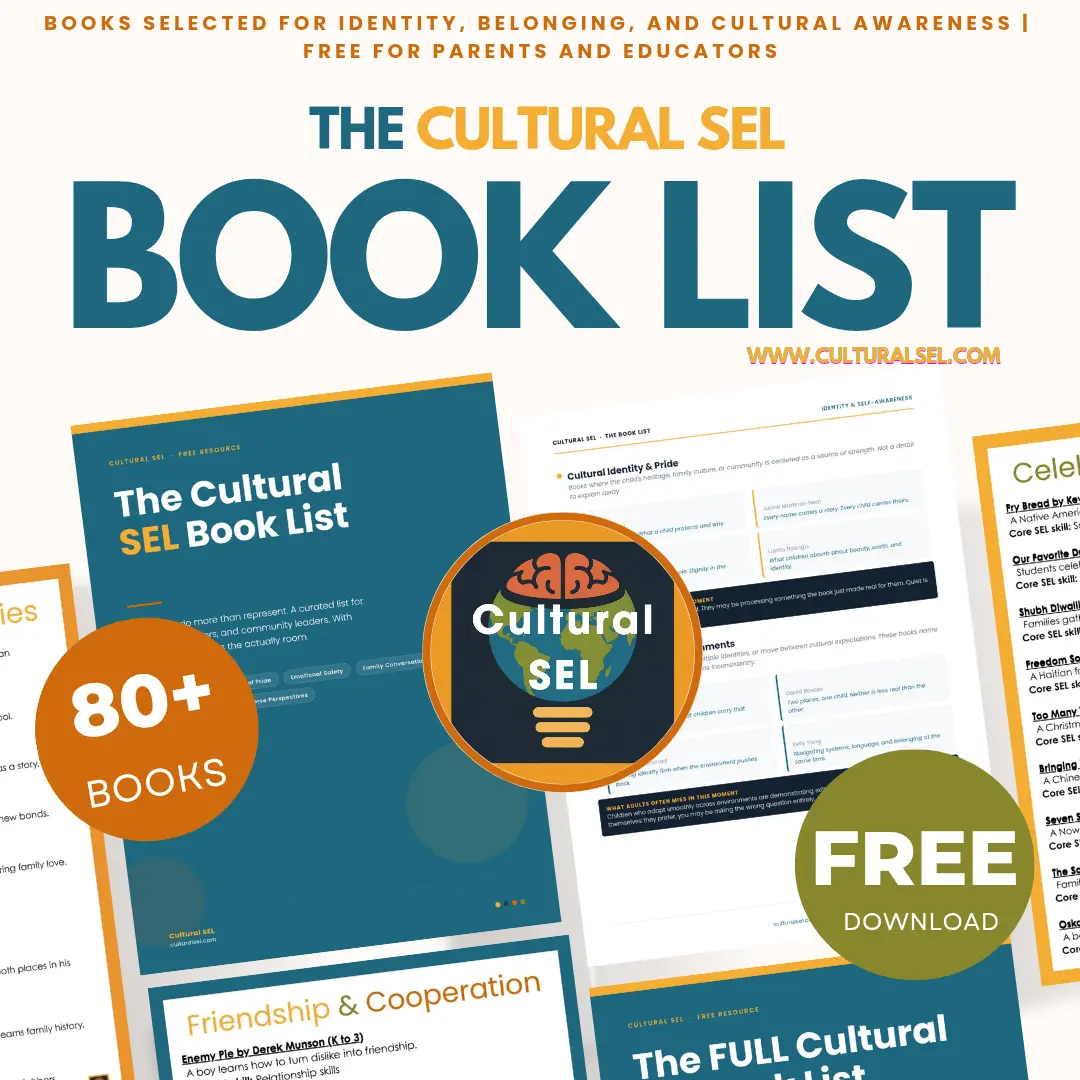
What if the right book still misses the child in front of you?
80+ books selected for identity, belonging, and cultural awareness. Each category includes what adults often miss, so you know how to use them, not just which ones to choose.
A Personal Note on Homeschool and Transition
Our family homeschooled for almost three years before transitioning into the public school system.
That season shaped how I think about emotional regulation, identity, and structure at home. It also began my involvement in PTA work and family engagement inside schools.
Homeschool taught us that emotional skills cannot be separated from family culture. Public school reinforced how important it is for those skills to transfer across settings.
Culturally responsive SEL needs to work in both spaces.
Social Emotional Learning at Home Starts With Daily Skill Building
Social emotional learning includes naming feelings, managing reactions, solving problems, repairing conflict, and making thoughtful choices. In homeschool settings, these skills appear in real moments:
• Frustration with math
• A sibling argument
• Avoiding independent work
• Disappointment over a schedule change
These moments are not interruptions. They are part of the lesson. They teach children how to respond to frustration, repair conflict, and stay engaged.
When you homeschool, your whole life becomes part of the curriculum. Everything you do teaches something.
SEL is often treated as something needed only when behavior breaks down. In homeschool settings, it belongs in daily routines.
It builds regulation, responsibility, and decision-making before conflict escalates.
Simple routines help:
• A short morning feelings check-in
• A calm-down spot for reset, not punishment
• A weekly family meeting
• A short reflection journal
• A clear repair script after conflict
When routines repeat, emotional regulation becomes predictable instead of reactive.

How Identity Shapes SEL in Homeschool Settings
In many homes, culture already shapes the curriculum through language, discipline style, traditions, and daily routines.
These choices define what respect, responsibility, and belonging look like in daily life.
Identity influences how children interpret correction and praise. A child’s understanding of independence, authority, and cooperation often comes from home norms.
Pause and name your definitions out loud:
What do we call respectful?
What do we call defiant?
What does responsibility look like in our family?
Clarity reduces confusion about expectations and keeps correction focused on behavior, not identity.
Behavior Can Look Different Across Cultural Contexts
Families may want the same outcomes, such as kindness and responsibility, yet define behavior differently.
Independence is one example. In some homes, completing work alone shows responsibility and maturity.
In others, helping siblings or working together shows growth and leadership. A child who asks for help may be seen as unprepared in one setting and cooperative in another.
Expectations around independence shape how effort is interpreted.
Because homeschool parents act as both caregiver and teacher, assumptions can move quickly. Slowing down prevents mislabeling.
If you would interpret the same behavior differently from another child, bias may be influencing the moment.
The goal is flexibility without shame. Children can learn how their home norms work while also learning how to adapt in other settings.
Emotional Regulation in Homeschool Is Modeled Before It Is Taught
Children watch adult responses closely. During lessons, your nervous system often sets the tone.
When you name your own emotion, you give your child a script:
“I’m getting frustrated. I need a minute.”
“I spoke too sharply. Let me try again.”
Repair matters more than perfection. It takes intentional effort when tempers rise or patience runs low.
Homeschool families may face unique pressures, including teaching multiple ages, managing finances, or carrying past school stress.
Modeling calm recovery builds safety faster than strict control.
How Language and Legacy Strengthen SEL in Homeschool
Many families homeschool to stay connected to language, history, or faith traditions. These elements can strengthen SEL when used intentionally.
Heritage language expands emotional vocabulary. Proverbs and family stories teach values about courage, humility, or perseverance. Community service teaches responsibility.
Different cultures guide emotional expression differently. Some emphasize restraint. Others encourage expressive dialogue.
Both require skill. What matters is that children understand when and how to use those skills safely.
Naming values out loud strengthens clarity about who we are and how we act.

Trauma Awareness in Homeschool Environments
Some families homeschool because of past bullying, discipline stress, racism, disability barriers, or chronic anxiety. Even when the reasons differ, stress can shape how children respond to demands.
Trauma-aware, culturally responsive SEL avoids labeling children as difficult or manipulative. It asks what context shaped the reaction.
Focus on consistent foundations:
• Predictable routines
• Clear expectations
• Repair instead of harsh punishment
• Small choices to build autonomy
Watch for patterns such as shutting down, explosive reactions, or perfectionism that blocks effort.
If concerns persist, consider support from a qualified professional who respects your family’s culture and values.
Simple Ways to Practice Cultural SEL in Homeschool
You do not need a new curriculum. Start small and repeat.
Try this weekly rhythm:
- Choose one SEL skill.
- Name the family value connected to it.
- Teach a short script your child can use.
- Practice during daily disagreements, mistakes, and transitions.
- Reflect for five minutes at the end of the week.
Additional ideas:
• Hold a short reflection circle
• Use identity-based writing prompts
• Discuss how an elder might handle a situation
• Pause during stories to name emotion words
• Practice repair language for sibling conflict
• Share planning decisions within clear limits
Consistency matters more than creating elaborate SEL plans.
Shop Our Culturally Responsive SEL Resources
Digital Cultural SEL resources for parents, caregivers, educators, community professionals, and children.
Explore practical tools, guides, reflection resources, and activities focused on social and emotional development, cultural environments, identity, belonging, relationships, lived experiences, and behavior.
FAQ: Culturally Responsive SEL in Homeschool Settings
What is culturally responsive SEL in homeschool settings?
It is social emotional learning that builds regulation and relationship skills while respecting a child’s identity, language, family values, and lived experience.
Do homeschool families need a separate SEL curriculum?
Not necessarily. Many skills can be built into daily routines. Structured tools help, but they do not require a separate class block.
How is culturally responsive SEL different from general homeschool discipline?
Discipline focuses on correction. Culturally responsive SEL teaches skills, explains family values, and builds repair instead of relying only on punishment.
Can these skills transfer into public school later?
Yes. When children understand emotional regulation and clear family values, they adapt more easily across settings.
What if our family culture feels mixed or changing?
Use what is real in your home. Multiple languages, traditions, and transitions can all be named clearly. Clarity builds stability.

Culturally Responsive SEL in Homeschool Settings Builds Confidence
When children understand who they are and how to manage emotions, they take initiative more easily and recover faster when something does not go as planned. When values are named clearly, children know what is expected and why it matters.
Culturally responsive SEL in homeschool settings prepares children for settings beyond home. They learn their family norms and how to apply those skills in classrooms, workplaces, and community spaces.
Keep the focus simple:
Teach skills.
Name values.
Practice repair.
Then revisit one question regularly:
What values are shaping how emotion and behavior are taught in our home?
CONTINUE EXPLORING CULTURAL SEL
Explore free Cultural SEL guides, culturally responsive SEL tools, and practical resources for understanding how cultural environments, identity, belonging, relationships, and lived experiences connect with children’s social and emotional development.
📌 Save or share this post with someone who is raising, teaching, or guiding children.

Hi, I’m Faith, the creator of Cultural SEL
I create practical tools and resources that support children’s social and emotional development and help parents, caregivers, educators, and community professionals look beyond behavior labels.
My work focuses on how cultural environments, identity, belonging, relationships, and lived experiences shape what children experience and how adults interpret and respond.
Read more about Faith and Cultural SEL: https://culturalsel.com/about
Join the Cultural SEL community: https://culturalsel.com/fb