Discipline Across Cultures: How Societies Shape Children’s Behavior, Respect, and Independence
A student talks back, another won’t make eye contact, a third won’t speak unless called on. Adults often read these moments as attitude or lack of confidence. Yet many times, they’re signs of learned rules.
This guide on discipline across cultures explains how different societies teach behavior and independence at home and in school.
The goal isn’t to rank cultures. It’s to help educators, families, and community leaders understand what children may be trained to do, and why.
When we understand the “why,” we choose better responses. We also reduce shame, power struggles, and mislabeling.
FREE DOWNLOAD · REFLECTION GUIDE
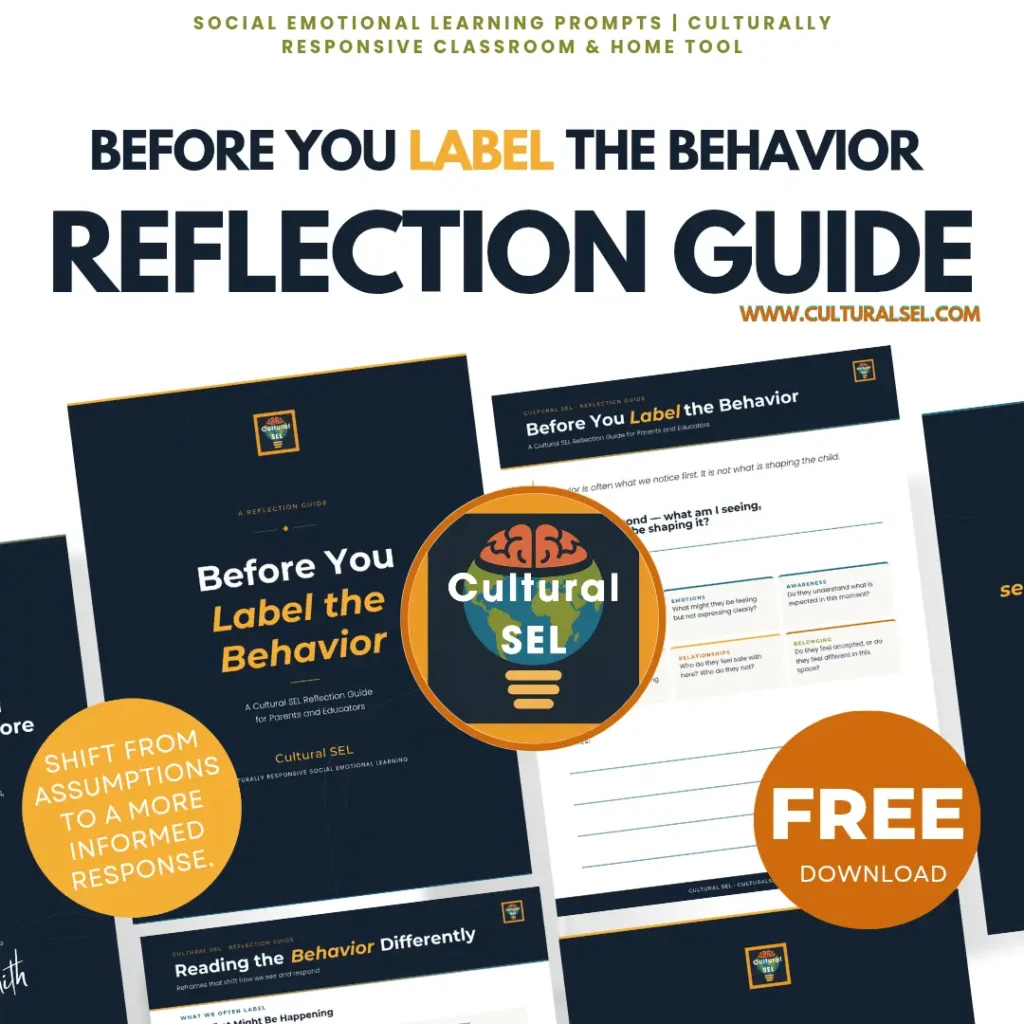
What if the behavior isn’t the whole story?
A free reflection guide that explores what may be influencing a child’s behavior before it is labeled, corrected, or misunderstood.
Discipline Helps Children Learn Behavior Expectations in Daily Life
Discipline has a basic job in every community: it teaches kids how to live safely with others.
That includes limits, routines, and repair after harm. Kids don’t learn this through rules alone. They learn through repeated practice with caring adults.
Much of discipline happens in ordinary moments. A parent reminds a child to use an inside voice. A teacher redirects a student who grabs materials.
A coach sets a rule about turn-taking. With repeated practice, children connect actions with outcomes.
Emotions matter here. When an adult corrects with steady tone and clear steps, many kids can think and adjust.
When correction feels scary or unpredictable, kids may freeze, hide mistakes, or lash out. Those reactions often look like “behavior,” but they are also stress responses.
Clear boundaries also help children manage school routines. For example, a child who’s used to consistent limits at home often shows more predictable behavior during transitions.
They may line up faster, follow a schedule, and accept reminders without a long back-and-forth.
Discipline teaches more than rules. It teaches children what adults do when something goes wrong.
Cultural Values Influence What Discipline Looks Like at Home and School
Culture shapes what adults notice, what they correct, and how they correct it. Families pass down ideas about respect, voice, and the role of elders.
Schools also carry cultural norms, even when they call them “standard expectations.”
In some cultures, children show respect by listening quietly. Adults may correct interrupting quickly because it signals disrespect.
In other cultures, kids are encouraged to ask questions, explain their thinking, and speak with confidence. There, a quiet child might receive prompts to share more.
Communication style matters too. Some families use direct language and firm tone to show seriousness.
Others use softer wording, humor, or indirect cues. Neither approach automatically means “better.” The meaning comes from the shared understanding in that community.
These differences show up in classrooms. A student who waits to be invited into a conversation may look disengaged to a teacher who expects quick participation.
Meanwhile, a student who speaks freely may look rude in a setting where adults expect formal turn-taking.
Knowing this helps adults pause before labeling. The same behavior can have different meanings depending on the child’s home expectations.
I’ve seen this play out in school spaces where I support family engagement. A child’s behavior gets read quickly, but once we look at what respect looks like at home, the situation often makes more sense.
I use that moment to help adults shift from reacting to understanding what the child has been taught.
Different Societies Define Harmful and Acceptable Discipline in Different Ways
People often search for a simple line between acceptable discipline and harmful discipline.
Definitions of harm vary across communities and legal systems. Global guidance from organizations like UNESCO highlights how cultural context shapes what is considered appropriate in education settings.
Still, most adults agree on a few basics: children need safety, dignity, and guidance that doesn’t leave lasting fear.
Discipline practices vary across societies in four common areas:
- Physical correction: Some communities view it as normal; others reject it fully.
- Public vs. private correction: Some correct right away in front of others; others see that as humiliating.
- Strictness vs. negotiation: Some expect quick compliance; others invite discussion.
- Emotional tone: Some use raised voices to signal urgency; others experience yelling as emotional harm.
A common classroom situation illustrates this. One family may see raised voices as a normal “time to listen” signal.
Another family may see that tone as a threat. The child brings those meaning systems into school.
For trauma-aware practice, the focus stays on what helps kids feel safe while learning new skills. Many schools aim for calm, predictable correction because it reduces fear and supports attention.
If you work with families, it helps to use shared language: safety, respect, repair, and skill-building. That keeps the conversation practical, not personal.
Belief Systems and Moral Training Shape Discipline Approaches
Beliefs about right and wrong often guide discipline. For many families, moral training is part of daily life.
That can come from religion, community ethics, or family tradition. Adults may connect behavior to character, duty, or spiritual growth.
Because of that, discipline sometimes targets more than manners. It may reinforce:
- responsibility to family members
- honesty and modesty
- service, generosity, and self-control
- rituals and community commitments
A child may be corrected for skipping prayer, missing a ritual, or not using respectful greetings. In that home, those actions aren’t “extras.” They are core life guidance and a sign of belonging.
These moral systems can support strong self-control and care for others. They can also create pressure when a child lives in more than one value system.
A student might feel torn between home expectations and peer norms.
Educators don’t need to adopt a family’s beliefs. Still, it helps to recognize that discipline may be tied to identity, not only behavior.
When adults treat that connection with respect, families tend to trust the school more.
These belief-driven approaches also shape how children learn independence and when they are expected to use their own voice.
Independence and Personal Voice Are Emphasized Differently Across Cultures
Independence doesn’t mean the same thing everywhere. Some cultures teach early self-reliance.
Others teach interdependence, where a child learns to think as part of the group. Both paths can support healthy adulthood.
These values shape discipline moments. In some homes, adults expect children to explain feelings during correction.
The child may hear, “Tell me what happened, then we’ll fix it.” In other homes, children accept correction first, then reflect later. The adult may say, “Do as you’re told, then we’ll talk when you’re calm.”
You can see the difference in school expectations too. Many classrooms reward self-advocacy, eye contact, and speaking up.
Some students have been taught that direct eye contact with an adult is disrespectful, or that speaking up looks like arguing.
Independence also shows up in daily tasks. One child may choose clothes, manage homework, and make small purchases alone.
Another may do those tasks with an adult because family closeness and shared responsibility matter more.
When adults understand these differences, they can teach school-based independence without shaming home values.
Children Navigating Multiple Discipline Systems May Experience Confusion
Many kids move between different rulebooks all day. Home rules, school rules, after-school rules, and peer rules can clash. That clash can create real stress, even for well-behaved children.
As a multicultural parent, I’ve had to explain to my own kids that different spaces expect different behavior.
At home, something may be respectful, while at school it may be misunderstood. I don’t just point that out.
I walk them through what each setting expects so they can move between both without feeling like they are doing something wrong.
A common example is classroom talk. A child may stay quiet to show respect at home. At school, that same quiet can be read as lack of effort.
The student might also avoid asking for help because they were taught not to “bother” adults.
The reverse happens too. A child who debates ideas at home may speak up often in class. In one setting, that’s curiosity. In another setting, it may be labeled defiance.
As this pattern continues, children may:
- second-guess every choice
- mask emotions to avoid trouble
- copy peers to fit in
- feel shame when adults respond with surprise or anger
This is also an SEL issue. Kids need clear cues about what each setting expects. They also need reassurance that adjusting behavior across settings is a skill, not a betrayal of identity.
Supportive Adults Help Children Understand Behavior Expectations Across Contexts
Adults can reduce confusion by naming expectations and teaching the “why.” Kids usually handle different systems better when rules are clear, consistent, and explained without sarcasm.
A simple approach works across many ages: correct the action, then teach the replacement. After that, reconnect. That sequence keeps discipline from turning into a relationship break.
The same behavior can carry different meanings depending on the setting.
A simple how-to for teachers and family partners
- Ask, don’t assume: “What does respect look like at home when an adult speaks?”
- Share school norms clearly: explain the rule and the reason in plain words.
- Plan for hot moments: agree on calm-down steps the child understands.
- Follow up after correction: a short repair talk builds trust and memory.
- Check labels: replace “defiant” with a description of what happened.
A teacher who asks about home expectations can prevent misreading behavior as disrespect. Families also feel seen, which improves communication when problems happen.
Balanced Discipline Supports Emotional Security and Social Confidence Over Time
Children learn best when discipline feels predictable and fair. Consistency matters because it reduces guessing. Respectful correction matters because it keeps relationships intact.
Across cultures, kids tend to do well when adults:
- set clear limits
- correct without insults
- model the behavior they want
- allow practice and repair after mistakes
Cultural understanding supports this work. When adults learn a family’s expectations, they can explain school rules in a way that fits the child’s life. That reduces conflict and repeated discipline.
Consider a student who knows how to shift behavior by setting. They can be quiet during a ceremony, then speak up in a group project.
They can accept a firm “no,” then ask questions later. As they gain experience, that flexibility often supports peer relationships, because the child reads social cues with less stress.
Balanced discipline also supports SEL skills like self-control, empathy, and responsible choices. Those skills grow through many small moments, not one big talk.
“Children don’t struggle with behavior in isolation. They respond to the expectations they know and the environments they are trying to belong in.”
Discipline teaches children how to act safely, repair harm, and live with others. Still, discipline across cultures looks different because values, beliefs, and community rules differ.
Ideas about what counts as acceptable or harmful also vary, and that shapes how children respond to correction.
Many kids move between home and school systems that don’t match, which can cause stress and misread behavior.
Supportive adults make a big difference when they explain expectations, partner with families, and teach flexible skills without shame.
When adults begin with curiosity rather than quick labels, they create space for children to understand expectations without losing their sense of belonging.
CONTINUE EXPLORING CULTURAL SEL
Explore free Cultural SEL guides, culturally responsive SEL tools, and practical resources for understanding how cultural environments, identity, belonging, relationships, and lived experiences connect with children’s social and emotional development.
📌 Save or share this post with someone who is raising, teaching, or guiding children.

Hi, I’m Faith, the creator of Cultural SEL
I create practical tools and resources that support children’s social and emotional development and help parents, caregivers, educators, and community professionals look beyond behavior labels.
My work focuses on how cultural environments, identity, belonging, relationships, and lived experiences shape what children experience and how adults interpret and respond.
Read more about Faith and Cultural SEL: https://culturalsel.com/about
Join the Cultural SEL community: https://culturalsel.com/fb