How Culture Shapes Children’s Emotional Intelligence

A child’s emotional intelligence shows up everywhere. It appears during morning drop-off, group work, sibling fights, and bedtime worries.
When children can name what they feel and calm their bodies when they feel overwhelmed, daily life becomes easier to manage at home and at school.
Calming the body might include slowing their breathing, unclenching their hands, or stepping away from a stressful moment.
Children also learn to read other people’s signals such as facial expressions, tone of voice, body posture, or the way someone responds during a conversation.
These skills help children explain what they feel, resolve small conflicts before they grow, and stay focused during learning.
These skills do not develop on their own. Children learn emotional habits by watching the people around them and practicing those responses in daily interactions.
Family life, community expectations, language, faith traditions, and everyday experiences all shape how emotional intelligence develops in children.
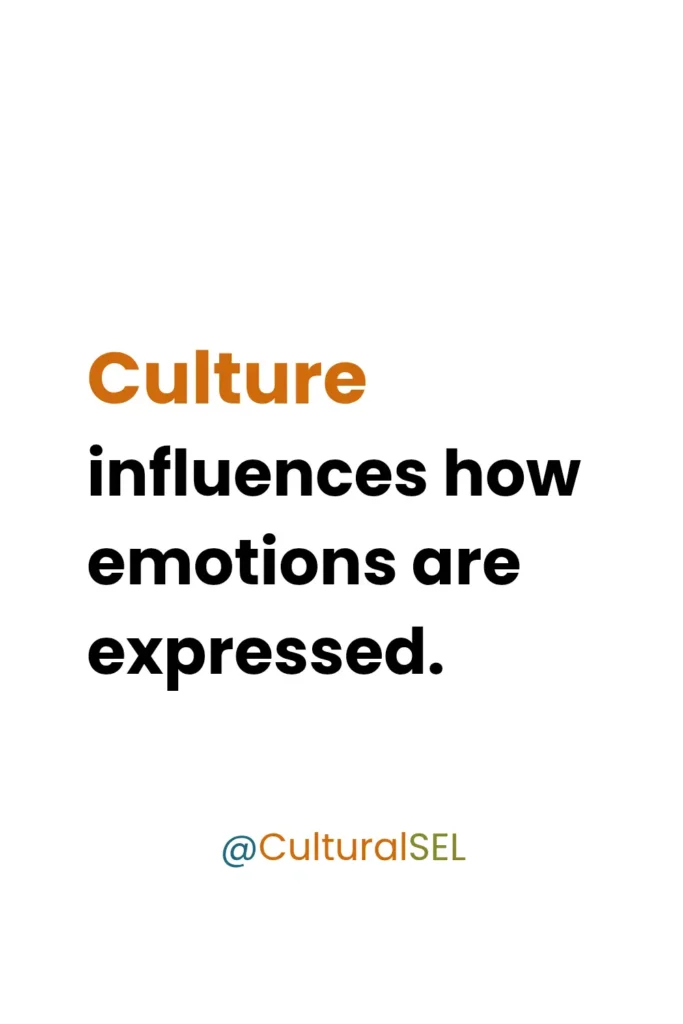
Culture shapes what respect looks like, how feelings are expressed, and which emotions are safe to show in public.
This matters for parents, educators, counselors, librarians, and community leaders. In my own experience working with families and volunteering in school settings, I see these differences in emotional communication play out every day.
When adults understand the cultural roots of emotional behavior, they respond with more accuracy, less bias, and better support.

Struggling to find children’s books for social and emotional learning that reflect culture and lived experience?
This FREE Culturally Responsive SEL Book List, with 80+ thoughtfully selected books, adds a culturally responsive layer to social and emotional learning by helping you choose stories that reflect identity, relationships, and experiences that are often overlooked.
Created for parents, educators, counselors, and caregivers who already value SEL and want book choices that reflect the full picture of children’s lives.
Emotional Intelligence Helps Children Navigate Feelings and Relationships
Emotional intelligence (EI) is a set of skills children build over time.
These skills include noticing feelings, naming them, understanding how other people feel, and choosing actions that match the moment, such as speaking calmly during a disagreement, asking for help when confused, or stepping away when frustration becomes too strong.
Emotional intelligence also includes emotional regulation, which means calming the body when emotions become intense, such as anger during an argument, embarrassment in front of classmates, or frustration during a difficult task.
In school, emotional intelligence often determines whether a small problem grows into a bigger one. A child who can pause before reacting is more likely to keep a friendship.
A child who can say “I’m frustrated” is more likely to ask for help instead of shutting down. These moments protect learning time because strong emotions can pull attention away from classroom tasks.
Emotional intelligence also supports peer relationships. Children with stronger emotional skills tend to handle misunderstandings with fewer insults and fewer power struggles.
Instead of hitting or walking away, they may say, “I didn’t like that.” Over time, these responses build trust with classmates.
Adults play an important role because children often regulate their emotions by watching how adults respond.
When adults stay calm during stressful moments, children learn that the situation is manageable and begin to mirror that response.
When a teacher lowers their voice and names what they observe, children often calm their breathing, relax their posture, and return their attention to the task or conversation.
When a caregiver helps a child label a feeling, the child learns that emotions can be managed.
Research across education and child development continues to show that emotional skills support mental well-being, stronger relationships, and better classroom engagement.
These skills are closely connected to social-emotional learning, which many schools and families practice intentionally through everyday routines and conversations.
Children Learn Emotional Skills First at Home
Before children learn emotion words in school, they watch how adults respond to stress.
Home is the first place where children see anger, disappointment, joy, worry, and pride. They also see what happens after those emotions appear.
Children notice patterns such as:
• how adults react when plans change
• whether disagreements involve yelling or calm problem-solving
• whether someone apologizes after being hurtful
• how comfort is offered when someone is upset
At home, I notice how closely our children watch our adult reactions. If we respond calmly to a mistake, the atmosphere changes almost immediately.
If we respond with frustration, the tension spreads just as quickly. Children study those reactions carefully and often repeat them in their own conflicts.
A calm discussion after a conflict shows children that problems can be solved without shouting.
A caregiver who says, “I’m irritated, and I need a minute,” shows that strong emotions can be handled safely. A sibling who sits nearby or brings a tissue shows quiet support.
Repair matters as much as conflict. When adults say, “I was wrong. I’m sorry,” children learn that relationships can recover after mistakes.
When adults blame, shame, or ignore the problem, children may copy that pattern in their friendships.
Home routines also act as repeated emotional lessons. Mealtimes teach turn-taking and listening. Errands teach patience.
Bedtime often becomes the moment when children talk about worries they held in during the day.
The quiet environment, fewer distractions, and the sense of safety with a caregiver make it easier for children to share concerns they did not mention earlier.
Many families are already practicing SEL at home through everyday routines like meals, errands, and bedtime conversations.
Culture Teaches Children “Emotion Rules”
Every culture teaches what researchers often call emotion rules. These rules guide which emotions children show, when they show them, and how they communicate feelings to adults and peers.
Some families emphasize emotional restraint in public settings. Children may learn to keep a calm face, speak softly, and avoid interrupting.
Other families encourage open discussion of feelings. Children may learn to name emotions quickly and talk through problems as they happen.
Many cultures also prioritize respect toward elders and group harmony. In these settings, children may learn to manage frustration quietly and think about how their behavior affects others in the group.
In cultures that emphasize personal independence, children may practice speaking up, expressing preferences, and negotiating boundaries earlier.
These patterns reflect traditions about self-control, communication, and belonging. One style is not automatically healthier than another. What matters is the context in which the behavior developed.
| Cultural value | What a child may learn | What adults can do |
|---|---|---|
| Group harmony | Notice others’ needs and avoid public conflict | Teach respectful repair |
| Emotional restraint | Keep a calm face in public | Offer private emotional check-ins |
| Open emotional talk | Name feelings quickly | Teach timing and listening |
| Respect for elders | Avoid direct challenge | Provide polite disagreement tools |
| Personal independence | Express preferences | Teach empathy and compromise |
Cultural Intelligence Helps Children Understand Different Emotional Norms
Cultural intelligence (CQ) is the ability to understand and adapt to different cultural expectations.
In emotional development, this means children learn that feelings can be expressed and managed differently across families, schools, and communities.
A child with growing cultural intelligence begins to recognize that one setting may expect quiet emotional control, while another encourages open discussion.
This awareness supports flexibility, empathy, and respectful communication across cultures.
Culturally Responsive Emotional Learning Reduces Misunderstandings
When cultural context is ignored, adults may label a child’s behavior too quickly as disrespectful, defiant, rude, or disengaged before understanding the cultural expectations behind it.
Communication style is one common example. In some families, children are taught to speak directly when they disagree and explain their reasoning immediately.
In other families, children learn to soften disagreement and use indirect language to avoid sounding disrespectful.
A student who responds directly to a teacher may believe they are simply explaining their thinking. In a classroom that expects softer language, that same response may be interpreted as arguing.
Volume, facial expression, and personal space can also create confusion. A child who speaks energetically at home may sound too loud in a quieter classroom.
A child who used to seek physical closeness may surprise peers who prefer more personal space.
Culturally responsive SEL begins with a pause before reacting or disciplining. Adults take a moment to observe the situation, consider cultural context, and gather more information about what the behavior might mean.
Curiosity helps more than quick judgment. Adults can ask what a behavior means at home and then clearly explain classroom expectations.
This protects dignity and helps children learn new skills without feeling that their home culture is wrong.
Families Can Teach Emotional Intelligence Through Everyday Life
Families do not need special programs to strengthen emotional intelligence. Children learn most through daily interactions.
Start by naming feelings in real moments.
“You look disappointed.”
“I’m feeling stressed, so I’m going to take a breath before I answer.”
Children learn emotional vocabulary faster when words match what is happening in the moment.
Model calm conflict when possible. If adults raise their voice, repair still matters. A short apology followed by a calmer response shows children that people can correct their behavior.
Family values also shape emotional learning. Some families teach respect through quiet listening. Others teach respect through honest conversation.
When I volunteer at school, I often notice how empathy appears in small moments between students.
After a disagreement, one child might quietly return a pencil to a classmate or sit nearby when another student looks upset.
These small gestures show that children are beginning to recognize when someone else is having a difficult moment and respond with care.
How to Talk About Feelings in a Culturally Respectful Way
- Describe what you see
- Offer two feeling words
- Connect to family values
- Teach the setting rule
- Practice a repair sentence
- End with reassurance
These conversations work well during daily routines such as meals, car rides, or bedtime.
Stories also help. Sharing how a parent or grandparent handled a difficult moment gives children examples they remember.
Children Benefit When Emotional Learning Reflects Their Cultural Context
Children gain confidence when emotional learning reflects their lived experience. When schools recognize language, traditions, and family values, students feel understood.
This sense of safety supports attention, participation, and relationship building.
Culturally grounded emotional learning supports two important abilities.
- First, children understand their own emotional experiences more clearly.
- Second, children learn to navigate different social environments while maintaining their identity.
This flexibility supports a sense of belonging across home, school, and community settings.
FAQ: Culture and Children’s Emotional Intelligence
Can emotional intelligence be taught?
Yes. Children develop emotional intelligence over time. Adults can teach vocabulary for feelings, calming strategies, empathy, and conflict repair.
Does emotional restraint harm children?
Not automatically. Restraint can support self-control when children also have safe opportunities to express emotions privately.
Why do communication styles vary across families?
Families teach different expectations for respect, disagreement, and emotional expression.
How can schools support culturally responsive emotional learning?
By asking families about communication styles and explaining classroom expectations clearly.
What if home and school expectations are different?
Children can learn to move between different expectations as a social skill.
“Children learn emotional intelligence through everyday moments where culture, family, and relationships show them how feelings are understood and handled.”
Culture shapes how children learn to name feelings, show respect, and handle conflict long before they enter a classroom.
Families build emotional intelligence through daily routines, conversations, and examples of repair after conflict.
Schools strengthen those lessons when educators stay curious about cultural context and communicate expectations clearly.
Emotional intelligence grows through everyday moments. A calm conversation during a car ride, a patient response to frustration, or a quiet bedtime check-in can help children practice naming feelings and choosing their next step.
Over time, those habits give children emotional skills they can carry across home, school, and community life.
IF THIS POST RESONATES WITH YOU, EXPLORE MORE OF CULTURAL SEL ON OUR SITE.
You’ll find free guides, practical tools, and reflections to help families, educators, and communities bring culture, identity, and connection into social-emotional learning.
💬 Want to keep the conversation going? Join our Facebook community and connect with others exploring Culturally Responsive SEL.
📌 Save or share this post so other families and educators can bring these ideas into their own homes, classrooms, and communities.
Together, we can keep growing, connecting, and raising empowered learners.

Hello Everyone!
I’m Faith
Founder of Cultural SEL.
I create tools and resources that help families and educators connect identity, legacy, and social emotional learning in simple, practical ways.
My work is shaped by lived experience and intentional growth.
Read more here: https://culturalsel.com/about