Is Eye Contact Respectful? Culture, Kids, and Social Expectations
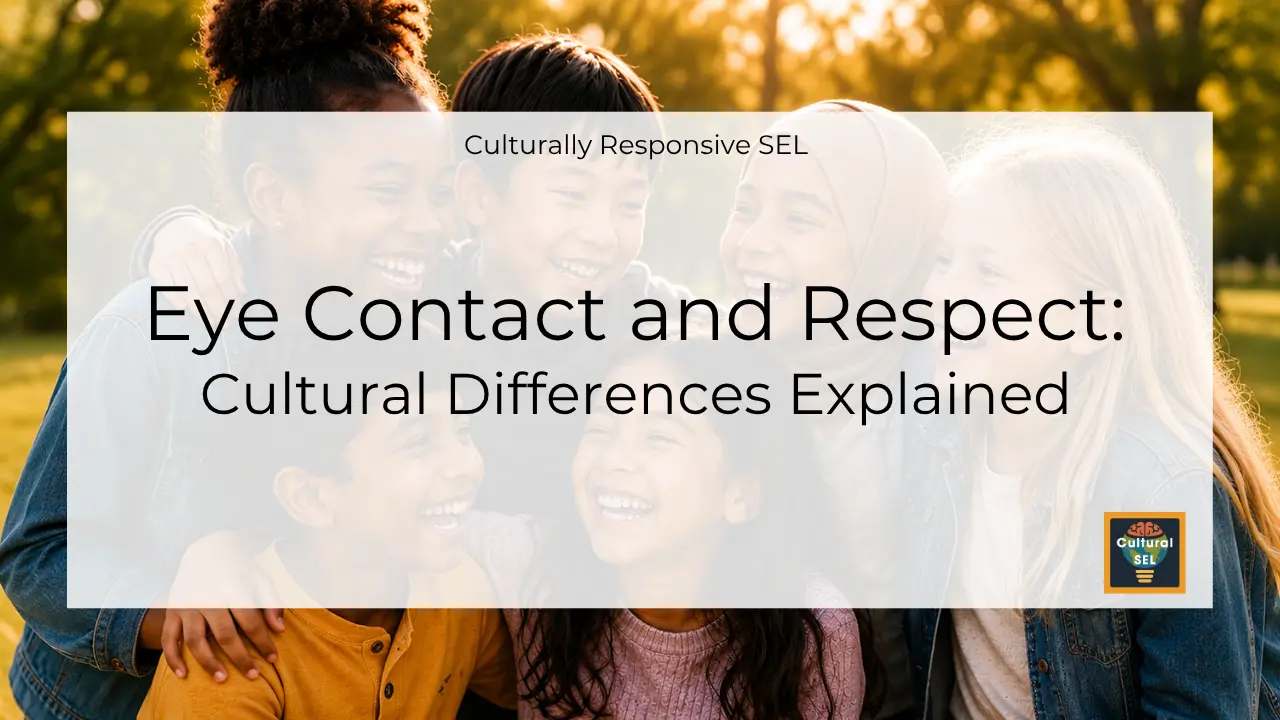
A child looks down while an adult speaks, and many adults decide what that means before the child says a word.
With eye contact, people often assume one shared rule: look at me if you’re listening, honest, confident, and respectful.
That expectation changes across homes, communities, languages, and countries, and children get misread quickly when a single rule is treated as universal.
FREE DOWNLOAD · REFLECTION GUIDE

What if the behavior isn’t the whole story?
A free reflection guide that explores what may be influencing a child’s behavior before it is labeled, corrected, or misunderstood.
Why Eye Contact Is Often Taught as a Social Skill
Eye contact is often taught as a social skill because many adults link it with listening, confidence, engagement, and respect.
You see that teaching in classrooms, job interview advice, social skills programs, and everyday correction at home.
A teacher says, “Look at me when I’m talking.” A parent says, “Eyes up.” An interview coach says a firm gaze shows confidence.
None of that comes from nowhere. In many settings, direct gaze does carry those meanings.
The problem starts when those meanings are treated as human nature instead of learned social expectations.
A child can be following one valid rule set and still be corrected by an adult who learned another.
Understanding which cultural environments shape those expectations makes the interpretation more accurate.
That matters because children receive those corrections early. Before adults assess language, effort, or intent, they often read the face first.
Is Eye Contact Respectful in Every Culture?
No. A direct gaze does not mean the same thing everywhere.
In some communities, eye contact shows confidence and attention. In others, prolonged eye contact with elders or authority figures can be read as disrespectful, confrontational, or out of place.
That difference is why the same child’s behavior can be praised in one setting and questioned in another.
What Eye Contact Means Across Different Cultural Environments
Eye contact does not hold a single fixed message. Its meaning shifts with relationship, setting, age, status, and community norms. Children learn those norms early, often before they can explain them.
Eye Contact and Respect Toward Adults
In many North American and Northern European settings, children are taught to look adults in the eye.
Adults may read that as honesty, attention, and confidence. A lowered gaze can be mistaken for hiding something.
In other families and communities, respect looks different. Some children are taught to soften their gaze, look down briefly, or avoid a long, direct stare with older adults.
The respectful behavior is in the listening, the tone, the posture, and the response.
That pattern shows up across many places, including some West African, East Asian, Indigenous, Middle Eastern, and Caribbean communities.
Research in cross-cultural psychology has consistently documented this.
Psychologist Harry Triandis identified how collectivist cultural environments, common across parts of Africa, Asia, Latin America, and the Middle East, organize social behavior around group harmony and relational hierarchy rather than individual self-expression.
In those environments, a child who lowers their gaze with an elder is not disengaging. That child is following a social map.
These are learned responses. They do not tell you whether a child respects adults. They tell you what the child was taught respect looks like.
Eye Contact and Authority Figures
Expectations can shift within the same family or community. A child may look directly at a sibling, glance away from a teacher, and lower their eyes in the presence of an elder or faith leader. Each response can fit the relationship.
Think about how many kinds of authority children move through in one week. Parents, teachers, principals, coaches, religious leaders, and relatives. The rule does not always stay the same.
A child who speaks easily with peers but avoids a long stare with a principal is not automatically disengaged. That child may be applying a rule about status and respect that makes sense in another part of life.
Direct Gaze, Group Orientation, and Social Harmony
Some cultural environments teach children to read the room more than signal themselves.
Psychologists Hazel Rose Markus and Shinobu Kitayama identified two broad orientations that shape how people understand themselves in relation to others.
In interdependent cultural contexts, where the self is understood through relationships and group membership rather than individual identity, a sustained direct gaze can feel too assertive.
It can come across as self-promotion or as challenging the other person.
This connects directly to how cultural communication styles show up in classroom participation. Attention may show up in quieter ways.
A child may answer when called, follow directions, stay still, or track the conversation without holding a constant gaze. That is still communication. That is still a social skill.
Adults sometimes miss this because they are looking for one visible sign. A child can be fully present without performing presence in the way the adult expects.
When a Child Is Managing Two Different Communication Expectations
Many children live inside two social systems at once. Home teaches one thing. School teaches another.
Community spaces may teach a third. Understanding what social means depends on the environment the child is in at any given moment.
That does not mean the child is confused or inconsistent. It means the child is managing two legitimate sets of expectations.
What an adult reads as avoidance may be the child’s first learned form of respect.
I saw this early because I grew up between Ghanaian and German environments. The same look could be read in opposite ways depending on who was in the room.
In some settings, lowering your eyes can show respect. In another, it could make adults wonder why you were not looking up.
What that experience made clear is how much communication depends on the expectations the adult brings into the interaction, not only on the behavior the child is producing.
How Adults Misread Nonverbal Communication and What That Costs the Child
Adults read children’s behavior through their own training and memory. What feels familiar gets read as positive. What feels unfamiliar gets treated like a warning.
You can see this pattern any time adults are trying to understand a child. A direct gaze becomes “engaged.” An averted gaze becomes “disrespectful,” “dishonest,” “disengaged,” “anxious,” or “withdrawn.”
How quickly children are labeled disrespectful for a behavior that was never disrespectful in the first place is one of the clearest examples of what happens when one cultural expectation is treated as the only valid one.
Those labels come quickly, and they stick. Once a label sticks, future interactions change.
The child may get more correction, less trust, and fewer chances to explain. An adult may start watching for proof of a problem that was never there in the first place.
Adults will always have expectations. The trouble starts when one set of expectations is treated as fact instead of as a learned social preference.
Once you can name your expectation as an expectation, your reading of the child gets more accurate and more responsive to what is actually in front of you.
I see this most consistently when adults are genuinely trying to understand a child’s behavior. The expectations they are using are valid.
They learned them somewhere. Once those expectations become visible as expectations rather than facts, the conversation about what the child is doing usually shifts.
Adults start asking different questions. The interpretation gets closer to what is actually happening.
Eye Contact, Anxiety, and Neurodiversity
Culture is one part of the picture, not the whole picture. Anxiety, stress, sensory differences, autism, trauma, and unfamiliar environments can all affect eye contact, too.
Some children avoid direct gaze because it feels intense or distracting. Others can make eye contact at times but lose it when they are overwhelmed, tired, or unsure.
A child may know the local rule and still struggle to follow it in the moment.
That is why adults should pause before settling on one explanation. Culture matters. So do nervous systems, stress levels, and context.
What Adults Can Notice Before Labeling a Child Disrespectful
A short pause can change the whole interaction. Before assigning meaning, look wider.
- Who is the child speaking with, a peer, a teacher, an elder, or a stranger?
- What relationship already exists between them?
- What does respect look like in this setting?
- What might respect look like at home or in the child’s community?
- Does the child avoid direct gaze everywhere, or only in certain places?
- What other signs of attention are present, such as stillness, response time, tone, or follow-through?
Those questions do not excuse harmful behavior. They help adults stop attaching the wrong meaning to behavior that may be respectful, stressed, or sensory-driven.
Understanding how discipline looks different across cultures is part of what makes those questions worth asking.
What Changes for a Child When Adults Interpret More Accurately
When an adult pauses before correcting, the child does not get punished for something that was never wrong. That changes the relationship immediately.
Children notice when their home’s ways of showing respect are welcomed and when they are treated like problems.
When adults keep correcting harmless differences, children learn to monitor themselves constantly.
They track whether their posture, gaze, and expression are landing correctly before they focus on what is actually being said or asked of them.
That self-monitoring takes up real attention. It pulls focus away from learning, from answering, from asking questions, and from building the kind of relationship with an adult that makes participation feel possible.
When the correction stops, that attention comes back. The child can answer, ask, and engage without spending energy managing how they are being read.
That is what a more accurate interpretation actually produces. Not just better feelings in the room, but a child who can show up more fully because they are not bracing for the next correction.
Cultural SEL and the Meaning of Eye Contact
Cultural SEL asks adults to read behavior with culture, setting, relationship, and lived experience in view. Eye contact is one clear example of why that matters.
A child does not walk into a room as a blank social being. That child arrives with family norms, community rules, language habits, sensory needs, and prior experiences with adults.
When those layers are ignored, interpretation gets blurred and less reliable.
The better question is not “Is this child being respectful?” The better question is “What could this behavior mean here, for this child, with this adult?”
That shift in the question changes what the adult sees and what the child experiences on the receiving end.
Frequently Asked Questions About Eye Contact and Culture
Is avoiding eye contact disrespectful?
Sometimes, but not by default. In many cases, it reflects learned respect, anxiety, sensory strain, or uncertainty about the relationship or setting.
Why do some cultures avoid direct eye contact?
Some communities teach children that a long, direct gaze with elders or authority figures is rude or confrontational. Respect may be shown through careful listening, tone, posture, and restraint rather than sustained gaze.
Should children be taught to make eye contact?
Children can be taught local expectations, but that teaching should include context. Children also need to know that respectful communication does not look identical everywhere.
Is eye contact a social skill?
Yes, in the sense that it is a learned social behavior. Like turn-taking or greeting styles, its meaning depends on the setting and the relationship.
Can anxiety affect eye contact?
Yes. Anxiety can make direct gaze harder, especially during stress, conflict, or unfamiliar interactions.
Can autistic children struggle with eye contact?
Yes. Some autistic children find eye contact uncomfortable, distracting, or overwhelming. That does not mean they are not listening or engaged.
Why does my child make eye contact at home but not at school?
Settings change expectations, stress levels, and relationships. A child may feel more regulated and more certain of the social rules at home than in a school environment.
How does Cultural SEL interpret eye contact?
Cultural SEL treats eye contact as context-based behavior. It asks adults to consider culture, relationship, setting, and the child’s lived experience before assigning meaning to what they see.
CONTINUE EXPLORING CULTURAL SEL
Explore free Cultural SEL guides, culturally responsive SEL tools, and practical resources for understanding how cultural environments, identity, belonging, relationships, and lived experiences connect with children’s social and emotional development.
📌 Save or share this post with someone who is raising, teaching, or guiding children.

Hi, I’m Faith, the creator of Cultural SEL
I create practical tools and resources that support children’s social and emotional development and help parents, caregivers, educators, and community professionals look beyond behavior labels.
My work focuses on how cultural environments, identity, belonging, relationships, and lived experiences shape what children experience and how adults interpret and respond.
Read more about Faith and Cultural SEL: https://culturalsel.com/about
Join the Cultural SEL community: https://culturalsel.com/fb