Diaspora Children and the Messages They Grow Up With
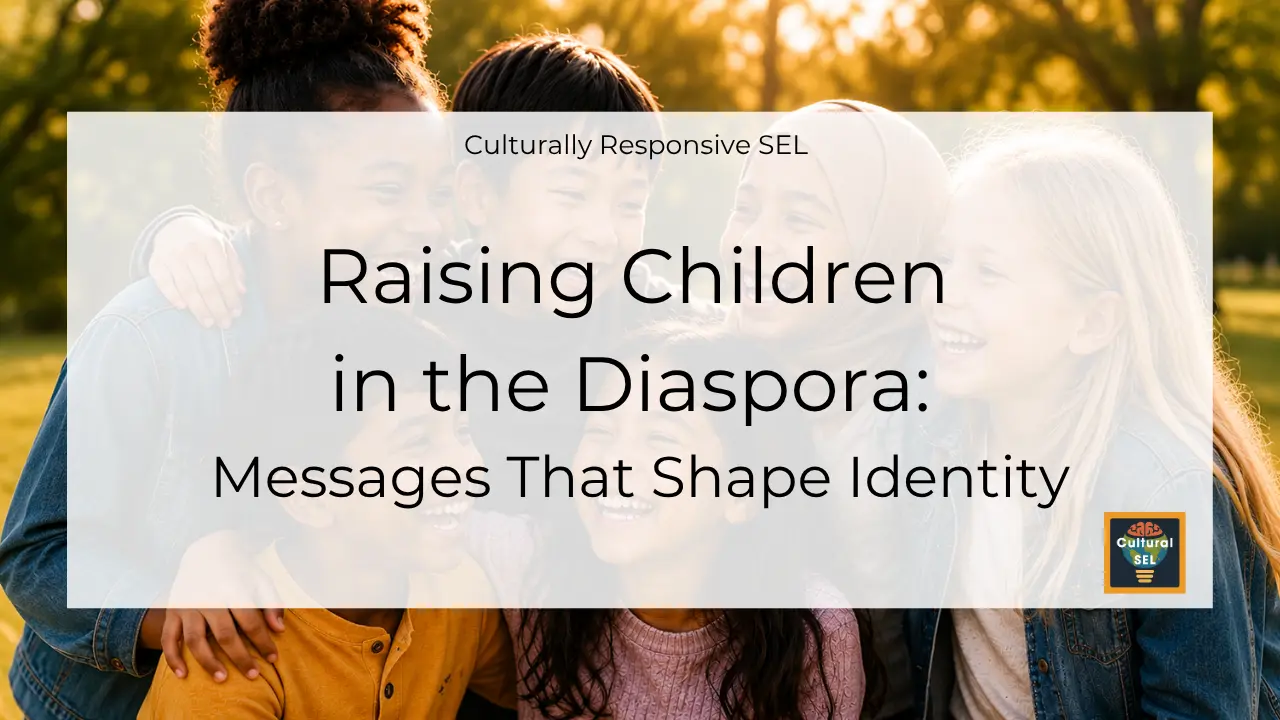
Diaspora children hear their parents’ love, fear, and cultural loyalty all at once, often in the same sentence.
What adults mean to protect, children sometimes receive as pressure. What adults mean by connection, children sometimes experience as conditions.
That gap between adult intent and child experience shapes identity, belonging, and how safe a child feels telling the truth about what they are experiencing.
FREE DOWNLOAD · REFLECTION GUIDE
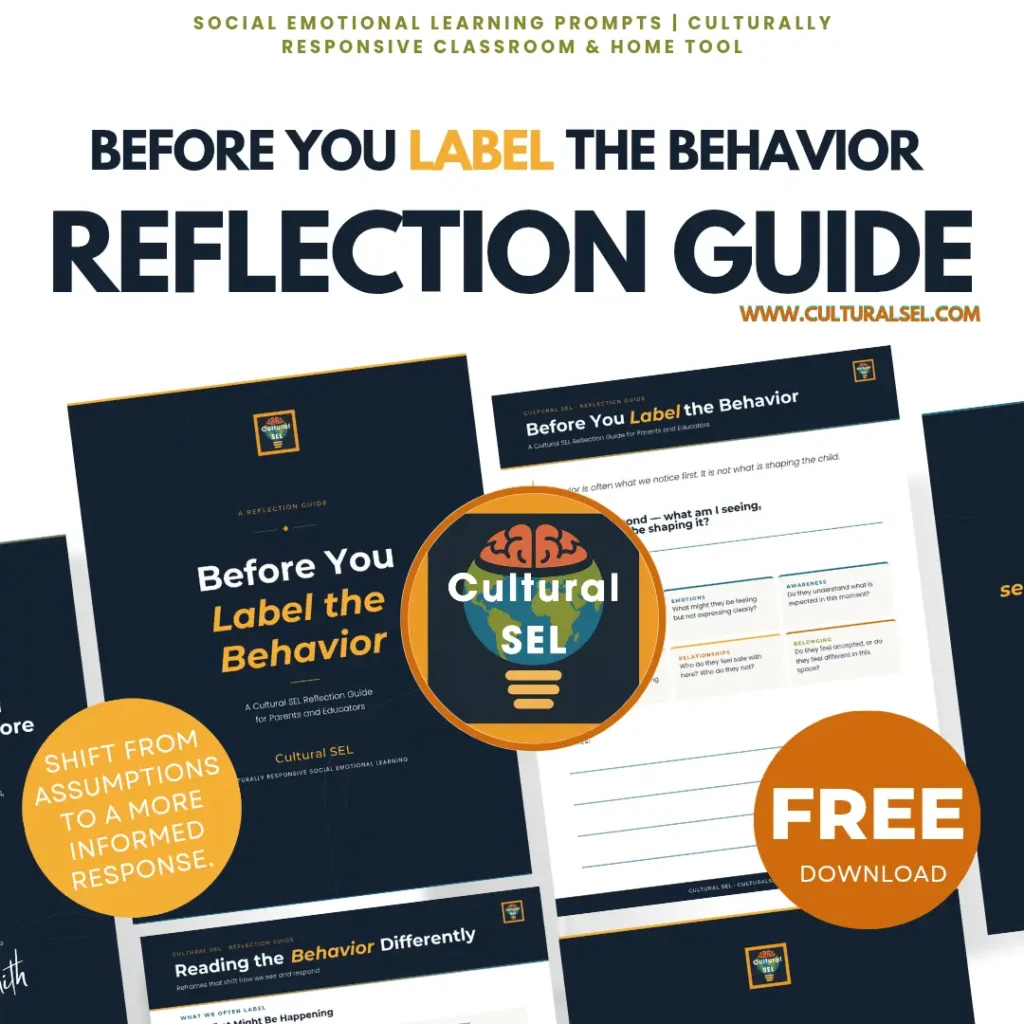
What if the behavior isn’t the whole story?
A free reflection guide that explores what may be influencing a child’s behavior before it is labeled, corrected, or misunderstood.
Understanding Diaspora and What It Means for Children
Diaspora refers to people and families living outside their ancestral, cultural, or national place of origin.
A diaspora child grows up with that distance shaping daily life.
The home may focus on one language. The school may reward another. Extended family, peers, media, faith spaces, and the country around them all add their own rules, expectations, and ways of belonging.
Children read those shifts early, often before they have words for them. Understanding what culture actually is and how it shapes the environments children move through helps adults see why the same child can feel fluent in one space and foreign in another.
Common Experiences of Growing Up Between Cultures
Many children in diaspora communities learn more than one code at once.
They notice when eye contact is respectful in one place and rude in another. They learn which clothes, words, jokes, and manners are accepted in different settings.
Some feel understood at home and misread outside it. Others feel more at ease at school than with relatives.
Not every child has the same experience, but questions about fit, loyalty, identity, and belonging show up across many communities worldwide.
These experiences are not limited to one nationality, ethnicity, or migration story.
They appear across African, Caribbean, Asian, Middle Eastern, Latin American, European, Indigenous, and multicultural diaspora communities, even though the details may look different from one family to another.
This includes children of immigrants and refugees, who may be navigating not only cultural distance but also the weight of what their families left behind, survived, or lost in the process of getting here.
It also matters that cultural identity is not the same as race. Representation in a classroom or curriculum does not automatically mean a child feels understood.
A child can see someone who looks like them and still feel invisible if the cultural experience behind that identity goes unrecognized.
How Conflicting Expectations Across Home, School, and Community Affect Children
The strain often comes from a mismatch.
A child may be told to speak up at school, to stay reserved at home, to be formal in a religious setting, and to act relaxed with friends.
Those rules all come from real social worlds. Children moving between them are constantly adjusting. Adults often see the behavior change. They miss the work behind it.
Growing up between Ghanaian and German environments, I learned quickly that behaviors praised in one setting could be questioned in another.
A directness that read as confidence in one room could read as disrespect in another. Looking back, those shifts were not confusion.
They were observation and adaptation. What I help adults recognize now is that when a child adjusts their behavior across environments, that is information about how the child reads each space, not evidence that something is wrong with them.
When my children started school in the United States, I watched the same pattern surface.
The Ghana bracelet, the food in the lunchbox, the name that teachers mispronounced, the cultural pride that got met with curiosity at best and ridicule at worst.
I recognized it immediately because I had lived a version of it first.
What that experience made clear to me is this: children do not just need well-meaning adults.
They need adults who understand what it costs a child to carry their full identity into a room that was not built for it.
How a child behaves in each setting is shaped by what that setting rewards, punishes, and ignores.
What looks like inconsistency to an adult is often a child who has learned the rules of each room very well.
Messages About Belonging and Cultural Identity
“You’re Becoming Too Western”
Adults may mean, “I don’t want you to lose our ways.”
A child may hear, “The self you are becoming is a problem.”
Better words are: “I want you to know our culture, and I know this place shapes you too.”
“You’re Forgetting Where You Come From”
This often comes from worry about memory, history, and family connections. Children often hear it as a loyalty test.
Try: “Our story matters, and you don’t have to pretend you grew up somewhere else to honor it.”
“You’re Not Really One of Us”
This can follow a comment about language, dress, behavior, or cultural knowledge. To a child, it can sound like belonging has conditions.
Say: “You belong here, even while you’re still learning parts of this culture.”
“Why Can’t You Be More Like Your Cousins Back Home?”
Adults may be comparing manners, effort, language skills, or cultural ease. Children often hear failure.
A better response is: “Your cousins live in a different setting. I care about how you move through your own setting well.”
How Common Phrases Shape a Child’s Sense of Identity Across Cultural Environments
“You’re Acting Foreign”
This phrase can mean many things depending on the room. In each case, the child often hears: “You are out of place.”
Better words are: “You seem different here. What feels different to you in this space?”
“Don’t Bring Your Outside Behavior Into This House”
Home rules matter. Context matters too. A child may be bringing school habits, peer language, stress, or expectations home with them.
Try: “This house has its own expectations. Let’s talk about what fits here and what doesn’t.”
“You Talk Differently Around Your Friends”
Many children code-switch. They change tone, pace, words, accent, or behavior to match the environment around them. That is not always pretending. Often, it is adaptation.
Say: “I notice your voice shifts with different people. What helps you feel comfortable in each place?”
“I Didn’t Raise You Like This”
This often comes from frustration or surprise. Children may hear: “Who you are becoming shames me.”
Better words are: “I’m confused by what I saw. Help me understand what was going on for you.”
Messages About Language, Culture, and Connection
Language is not only language. It is closeness, memory, status, grief, identity, and who gets counted as “really” part of the family.
Language shapes social and emotional experience in ways that go far beyond vocabulary, and for diaspora children, being corrected or shamed for how they speak can quietly teach them that parts of who they are need to stay hidden.
“Stop Speaking Like Them”
Accent and word choice shift quickly, especially in multilingual environments. Constant correction can turn language into a trap.
Try: “I hear your speech changing. Let’s keep practicing our home language too.”
“You Don’t Understand Your Own Culture”
Children cannot know what nobody taught them. History, humor, rituals, stories, and social rules are learned.
Say: “There are parts of our culture you haven’t been shown yet. Ask me. I’ll teach what I can.”
“You Should Already Know This”
Unspoken expectations create shame quickly. A child may miss a greeting, custom, or expectation because nobody explained it.
Better words are: “This matters in our family. Let me show you how it works.”
“Why Don’t You Speak the Language?”
Sometimes the answer is school pressure, migration, embarrassment, disability, limited exposure, or lack of opportunity. Blame rarely helps.
Try: “I wish you had more of the language. We can still build it now, without embarrassment.”
Shop Our Culturally Responsive SEL Resources
Digital Cultural SEL resources for parents, caregivers, educators, community professionals, and children.
Explore practical tools, guides, reflection resources, and activities focused on social and emotional development, cultural environments, identity, belonging, relationships, lived experiences, and behavior.
Messages That Shape Whether Children Feel Safe Expressing Emotions and Asking for Help
Some of these messages appear far beyond diaspora families. They still matter here because they influence children’s social and emotional experiences and whether children feel safe sharing what is happening inside them. Emotional expression is interpreted differently across cultural contexts, which means an adult and a child can be in the same conversation and read its emotional temperature very differently.
“You’re Too Young to Feel That Way”
Age does not cancel emotion. A child may not have adult words, but the feeling is real.
Say: “I didn’t know that affected you so strongly. Tell me more.”
“You Don’t Need Therapy”
In some families, therapy may be associated with failure, exposure, weakness, or family disloyalty. Children may hear: “Keep your pain hidden.”
Better words are: “If outside support would help, we can think about what kind feels right.”
“You’re Too Sensitive”
Often this means: “Your reaction is difficult for me to understand.” Children may hear: “Your feelings are a burden.”
Try: “That hurt you more than I expected. Let’s figure out why.”
What Diaspora Children Hear in Messages About Expectations, Sacrifice, and Family Reputation
Migration often involves sacrifice, uncertainty, risk, and public judgment. Children feel that weight, even when adults never say it directly.
“I Sacrificed Everything for You”
The sacrifice may be real. The sentence still places a debt on the child.
Better words are: “We worked hard to give you opportunities. I want you to use them with care, not fear.”
“You’re Lucky to Be Here”
That may be true. Children can still struggle.
Try: “You have opportunities here, and I know that doesn’t make every part of life easy.”
“People Will Talk”
Community pressure is real in many places. Children still need room to be human.
A clearer response is: “Other people’s opinions can affect us, but shame cannot be our main teacher.”
Why Adults Say These Things
Most adults are trying to protect something: culture, language, family connection, safety, community reputation, future opportunity, or belonging.
Some are speaking from migration grief. Some are reacting to racism, exclusion, or experiences their children may never fully see. Some fear their children will lose the thread back to home.
Research across 48 studies on migrant children found that when parents demanded children reject the host culture to preserve traditions, it created barriers rather than connections, and negatively affected children’s mental health (PMC, 2023).
I have caught versions of these impulses in myself. Not as someone watching from the outside, but as someone inside the same patterns I ask other adults to examine.
The worry that my children will not know where they come from. The frustration when cultural fluency that matters to me does not land naturally for them. ‘
Recognizing that impulse in myself is what keeps me honest about what I ask of other adults. It is also what makes this work specific: knowing the difference between protecting culture and imposing expectations on a child who was never meant to hold them alone.
Adults may mean to protect. A child who hears sacrifice as debt or love as a loyalty test will still feel it, regardless of what the adult intended
What Adults Can Say Instead
Children growing up between cultures do not need perfect adults. They need clear teaching, room for questions, permission to adapt without being treated as disloyal, and connection without shame.
Useful replacements are often simple:
- “Teach me what school feels like for you.”
- “You belong here, even while you’re learning.”
- “I want to pass something on, not make you perform it.”
- “Let’s practice the language together.”
- “Help me understand what this experience is like for you.”
These kinds of conversations keep the connection open.
A Cultural SEL View of Growing Up Between Cultures
Cultural SEL focuses on identity, belonging, communication, relationships, and the environments children move through each day.
It also asks adults to examine how their own expectations influence what they notice, praise, correct, or misunderstand.
When behavior shifts between home, school, peers, faith spaces, and community settings, that can reflect awareness, observation, adaptation, stress, belonging needs, or emotional safety.
Cultural identity shapes how children understand themselves, how they read the rooms around them, and how they decide what is safe to show and what to hold back.
Children are not moving through one environment. They are moving through many.
“I know which version of me works in this room.” “I don’t want to lose one part of myself to keep another.” These are common internal tensions for children growing up across cultures.
Adults do not need to flatten those shifts. Children need help naming them and understanding why they happen.
Questions Adults Ask About Diaspora Children and Cultural Identity
What does diaspora mean, and who is a diaspora child?
Diaspora refers to people and families living outside an ancestral, cultural, or national place of origin. A diaspora child grows up with that distance shaping family life, identity, language, and belonging.
What challenges do diaspora children often face?
Common experiences include mixed expectations, language pressure, comparison to relatives, identity questions, belonging concerns, and feeling too much or too little of one culture. Some children also experience racism, xenophobia, or tension between generations.
Why do children act differently at home and school, and what is code-switching?
Children often behave differently because each environment has different expectations, rewards, and social rules. Code-switching refers to changing language, tone, style, communication patterns, or behavior to fit a particular setting. It can be a skill, a stress response, or both.
Can children belong to more than one culture, and how does culture shape identity?
Yes. Identity develops through repeated experiences, relationships, stories, expectations, and feedback from the environments children move through. A child can belong to more than one culture without being divided by it.
How can adults preserve culture without shame, and what does Cultural SEL add?
Teach culture directly. Explain why traditions matter. Practice language without ridicule. Leave room for questions. Cultural SEL adds context by examining how identity, community, relationships, and environment shape what children feel, communicate, and need.
“Sometimes we feel we straddle two cultures; at other times, that we fall between two stools.” – Salman Rushdie
What adults say to diaspora children is part of how those children learn what is safe to be, where, and with whom. The words that come from protection can still teach a child that parts of themselves are a problem.
Adults can preserve culture while making room for adaptation, honesty, and questions. Both can happen at the same time.
Reflection prompt: Which message did you hear as protection when you were young, and how might a child hear it now?
CONTINUE EXPLORING CULTURAL SEL
Explore free Cultural SEL guides, culturally responsive SEL tools, and practical resources for understanding how cultural environments, identity, belonging, relationships, and lived experiences connect with children’s social and emotional development.
📌 Save or share this post with someone who is raising, teaching, or guiding children.

Hi, I’m Faith, the creator of Cultural SEL
I create practical tools and resources that support children’s social and emotional development and help parents, caregivers, educators, and community professionals look beyond behavior labels.
My work focuses on how cultural environments, identity, belonging, relationships, and lived experiences shape what children experience and how adults interpret and respond.
Read more about Faith and Cultural SEL: https://culturalsel.com/about
Join the Cultural SEL community: https://culturalsel.com/fb