Why People Hear “SEL” And Mean Different Things
SEL usually refers to social-emotional learning, a school term for skills such as self-awareness, emotion regulation, empathy, and healthy relationships.
Social-emotional learning focuses on how children understand emotions, relationships, communication, and behavior in everyday life.
Yet public arguments about SEL often turn into broader conversations because people hear different meanings inside the same three letters.
One adult hears support. Another hears overreach. A third hears behavior management, therapy, or politics.
A calming corner in a classroom may feel supportive to one family, while another family may see it as labeling children emotionally too early.
This article does not pick a winning side. It explains why social-emotional learning debates become heated so quickly and why culture, trust, past experiences, school systems, and identity shape what people think the term means.
Many conflicts around SEL happen because adults are reacting to different ideas about support, authority, behavior, and emotional well-being.
FREE DOWNLOAD · REFLECTION GUIDE
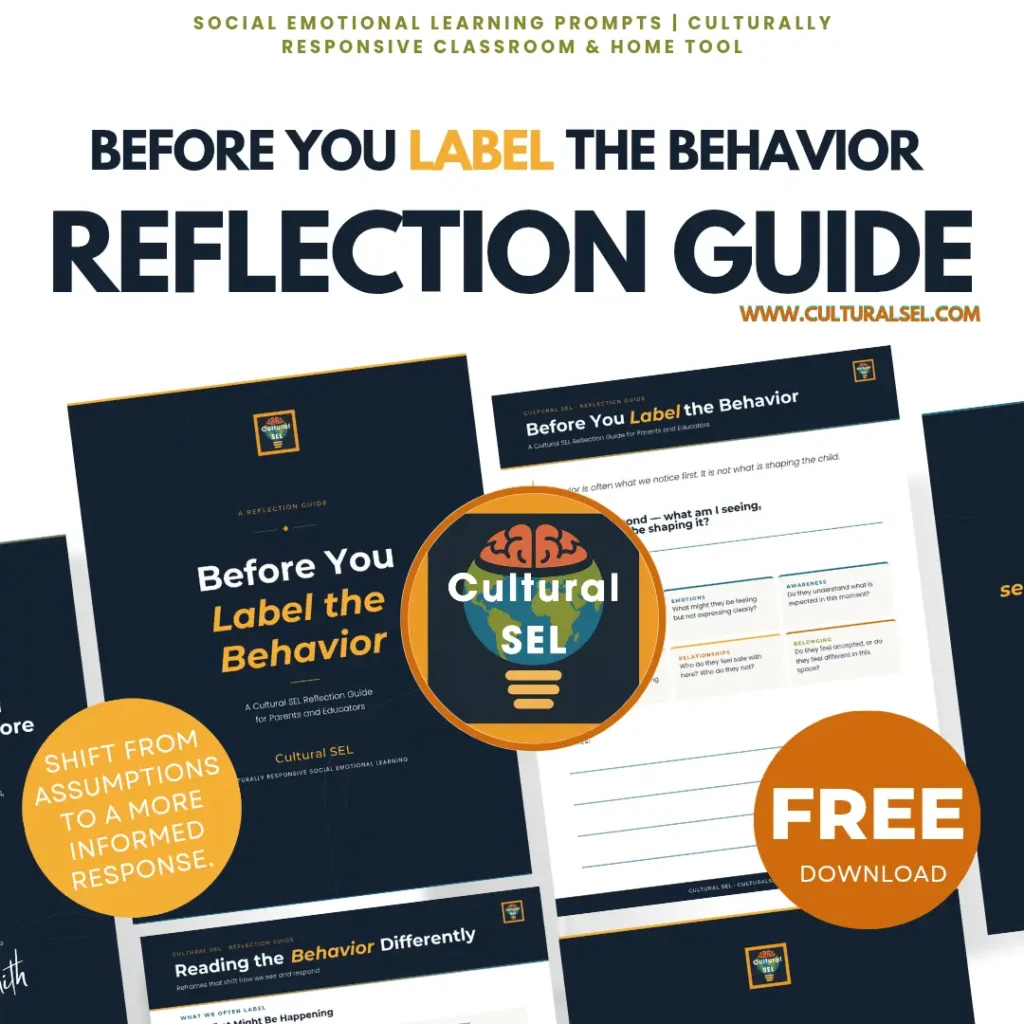
What if the behavior isn’t the whole story?
A free reflection guide that explores what may be influencing a child’s behavior before it is labeled, corrected, or misunderstood.
SEL Does Not Mean The Same Thing To Everyone
What SEL Usually Includes In Schools
In many schools, SEL includes emotional regulation, communication skills, peer relationships, conflict resolution, and decision-making.
CASEL, one of the most widely referenced SEL organizations in the United States, defines social-emotional learning as helping children develop self-awareness, self-management, relationship skills, responsible decision-making, and social awareness.
Teachers may use class discussions, check-ins, calming strategies, reflection exercises, or group activities to help students manage emotions and work with others.
Schools often view these skills as connected to learning because emotions, peer dynamics, stress, and communication affect classroom participation every day.
Schools Often Define SEL Around Emotional Skills And Classroom Functioning
In many schools, SEL means teaching children to name their feelings, calm their bodies, resolve peer conflicts, and feel part of the class.
A teacher may see a morning check-in as practical help for learning, not a personal or political act.
Schools often focus on what helps children function during the school day. That includes peer relationships, emotional regulation, classroom participation, and conflict resolution.
Some Families Associate SEL With Boundaries, Values, Or Parental Authority
That same check-in can raise different concerns at home. A parent may wonder who is asking the questions, what gets shared, and whether the school is stepping into family guidance or private emotions.
Some families also question where emotional support ends and where parenting or counseling begins. Those concerns are often tied to authority, privacy, trust, or earlier experiences with institutions.
I notice this often in multicultural spaces. Two adults may both care deeply about children’s well-being and still react very differently to the same SEL lesson because they are attaching different meanings to the language being used.
Online Discussions: Collapse Different Topics Into One SEL Debate
Online, SEL often gets mixed with therapy, discipline, trauma-informed teaching, identity lessons, counseling, and political messaging.
When those topics blend, people respond to a bundle of worries, not to a single clear school practice.
Some adults are thinking about kindergarten emotion lessons, while others are thinking about school counseling, district policies, or viral political debates online.
Those are very different conversations, yet they often get grouped together under the same label.
Culture Shapes How Emotional Support Is Understood
Families Teach Emotional Regulation In Different Ways
Some families welcome open talk about feelings. Others teach privacy, composure, or restraint and may rely on elders, faith leaders, or close family rather than on school-based discussions.
Children learn emotional expectations from the environments around them.
In some homes, children are encouraged to speak openly about frustration or sadness. In others, children may be taught to regulate emotions quietly and privately.
Neither approach automatically means a family does or does not care about emotional well-being.
Mental Health Language Carries Different Weight Across Communities
Words like “trauma,” “screening,” “intervention,” and “counseling” do not land the same way everywhere.
In some communities, those terms suggest care, while in others they suggest crisis, stigma, or involvement with the system.
A school may use a term routinely, while a family hears it through years of fear, shame, discrimination, or mistrust around mental health systems.
That difference shapes reactions before a conversation even fully begins.
Ideas About Respect, Discipline, And Authority Differ Across Cultures
Adults do not agree on what respectful behavior looks like. Eye contact, speaking up, questioning adults, showing emotion, and directness all carry different meanings across homes, schools, and communities.
A child who speaks openly with adults may be praised in one environment and viewed as challenging authority in another. A child who stays quiet may be seen as respectful in one setting and emotionally withdrawn in another.
Growing up across cultures taught me that adults can use the same words while expecting completely different things.
“Support,” “respect,” and “guidance” do not always mean the same thing across homes, schools, or communities.
Past Experiences Strongly Shape How Families Interpret SEL
Families Bring Earlier School Experiences Into New Conversations
A family that has faced biased discipline, stereotyping, or special education conflict may hear school language with extra caution.
That history changes how present-day SEL messages are received, even when the lesson sounds harmless.
Parents who once felt dismissed or judged may react faster when schools introduce broad emotional or behavioral frameworks.
Their reaction is often tied to past experiences, not just the present conversation.
Parents Often React Faster When They Feel Judged
Tone matters early. If a parent feels a school has already labeled their child, even a simple SEL conversation can sound like a warning, a record, or a step toward blame.
A sentence like “We wanted your perspective” usually lands differently than “We are concerned about your child’s behavior patterns.” The first sounds collaborative. The second can sound final.
Distrust Of Systems Does Not Automatically Mean Distrust Of Children’s Well-Being
Many families want their children to develop emotional skills, yet still question how schools teach them. A parent can support self-control and empathy while asking hard questions about privacy, method, and fit.
Families are not always rejecting emotional growth itself. Sometimes they are questioning language, boundaries, transparency, or how support is delivered.
Schools, Families, And Communities Often Define “Support” Differently
Schools Often Focus On Daily Classroom Functioning
Schools deal with peer conflict, attention, group routines, and emotional outbursts in real time. Because of that, they often define support through what helps a child learn and participate during the school day.
Teachers may see emotional regulation tools as practical classroom support because they directly affect learning, relationships, and daily routines.
Families May Focus More On Privacy, Identity, And Long-Term Values
Families often think farther ahead. They may worry about reputation, emotional privacy, cultural expectations, and how repeated school messages shape a child’s identity over time.
A family may support emotional awareness while still wanting stronger boundaries around personal conversations or documentation involving their child.
Teachers, Counselors, And Parents Are Sometimes Expected To Fill Different Roles
Role confusion raises fear fast. Teaching feeling words, offering counseling, responding to a crisis, and guiding family values are different jobs, yet adults often talk as if they are the same thing.
When those roles blur, families may become unsure about who is responsible for what. Schools also struggle when emotional expectations expand far beyond academics without clear communication around boundaries.
Why Public SEL Debates Become Polarized
Social Media Rewards Strong Reactions Instead Of Context
Short clips travel faster than full explanations. A single worksheet, video, or teacher comment can go viral without the classroom context that would change how people understand it.
Online discussions also reward certainty. Complex conversations about childhood development, emotional support, school systems, and family values are often reduced to short arguments intended to provoke a reaction.
People Often Argue About Different Versions Of SEL
One person may mean breathing tools and conflict resolution. Another may mean identity lessons, behavior tracking, or mental health referrals.
Because adults often imagine entirely different versions of SEL, conversations break down quickly. People respond to the version in their head instead of clarifying what the other person means first.
People often use the same SEL language while picturing very different meanings underneath it.
Polarization Makes Productive Conversation Harder
Once the debate turns into “pro-SEL” and “anti-SEL,” people stop asking clarifying questions. Families feel dismissed, educators feel attacked, and careful conversation gets replaced by team loyalty.
That environment makes honest discussion harder. Adults become more focused on defending positions than understanding concerns, and children often end up caught in the middle of that tension.
Children Often Sit Between Adult Expectations
Children Adapt To Different Emotional Expectations Across Environments
Children learn fast that home and school may expect different kinds of expression. A child who stays quiet at home may be asked to share more at school, or the reverse.
Many children adjust their behavior depending on the setting to meet different expectations around emotion, authority, communication, and belonging.
Misalignment Between Adults Creates Pressure For Children
When adult expectations clash, children often protect themselves. They may mask feelings, shut down, people-please, or withdraw because each setting rewards a different response.
That pressure can look like behavior problems, lack of participation, or emotional distance when the child is actually trying to stay safe across multiple environments.
Children Are Often Interpreted Before They Are Fully Understood
Behavior is easy to see, while context takes time. If adults judge the behavior first, support may miss the child’s real need, and the child may be seen as a problem to manage.
Children are often interpreted through adult expectations long before adults fully understand what the child is navigating internally or across environments.
Stronger Communication Reduces Fear And Confusion
Families Need Clear Explanations Instead Of Vague Language
Schools should say what SEL includes, what it does not include, who leads it, what gets documented, and when parents are contacted. Clear language lowers fear because families know what is happening.
Vague language creates space for assumptions, rumors, and mistrust to grow.
Parents Need Space To Ask Questions Without Being Dismissed
Questions about values, privacy, and mental health terms deserve direct answers. When schools treat those questions as resistance, trust drops and conflict grows.
Families are more likely to stay engaged when they feel heard instead of managed.
Schools Build Trust Faster When Families Feel Included Early
Early communication changes the tone of the whole relationship. Families respond better when they hear partnership language, see transparent plans, and know their voice matters before a concern appears.
Through family engagement work, I have seen conversations change completely when parents feel included instead of managed. The same concern sounds very different once trust enters the room.
“Not every disagreement needs a defense. Some need a better definition.”
People often use the same SEL language while picturing very different meanings underneath it. That gap shapes public debate more than most adults realize.
Disagreements about social-emotional learning usually grow from trust, interpretation, culture, role boundaries, and past experience.
Schools, families, and communities may all want children to succeed emotionally and socially, yet still disagree on language, methods, authority, and boundaries.
Better conversations begin when adults stop assuming everyone defines support, behavior, authority, emotional well-being, and belonging the same way.
Before the next SEL debate, ask one clear question first: “What do you mean when you say SEL?”
Common Questions About SEL, Family Concerns, And School Expectations
Why Do People Disagree So Strongly About SEL?
People often attach different meanings to the same term. One person may think of emotional skills and classroom support, while another may think of therapy, behavior control, or broader social issues.
Why Do Some Families Distrust Social Emotional Learning?
Distrust can come from past school experiences, unclear communication, concerns about boundaries, or fear that family values are being overlooked or replaced.
Can Culture Affect How Families View SEL And Mental Health Support?
Yes. Culture shapes how emotions are expressed, who children turn to for support, and what feels appropriate to discuss in school versus at home.
Why Do Schools And Parents Interpret Support Differently?
Schools often focus on what helps children function during the school day, while parents may focus more on privacy, identity, and long-term values.
Are Schools Trying To Replace Parents Through SEL?
Most schools are not trying to replace parents. Concerns often stem from unclear communication about roles, which can blur boundaries.
Why Do Children Behave Differently At Home And School?
Children adjust to different expectations, relationships, and environments. Behavior often reflects context, not inconsistency.
CONTINUE EXPLORING CULTURAL SEL
Explore free Cultural SEL guides, culturally responsive SEL tools, and practical resources for understanding how cultural environments, identity, belonging, relationships, and lived experiences connect with children’s social and emotional development.
📌 Save or share this post with someone who is raising, teaching, or guiding children.

Hi, I’m Faith, the creator of Cultural SEL
I create practical tools and resources that support children’s social and emotional development and help parents, caregivers, educators, and community professionals look beyond behavior labels.
My work focuses on how cultural environments, identity, belonging, relationships, and lived experiences shape what children experience and how adults interpret and respond.
Read more about Faith and Cultural SEL: https://culturalsel.com/about
Join the Cultural SEL community: https://culturalsel.com/fb