Is Strict Parenting Controlling, or Just a Different Definition of Respect?
A parent checks every assignment, sets a firm curfew, and expects a child to listen the first time. The parent sees careful, responsible involvement.
A teacher or another adult watching from outside the family might see control. Both are looking at the same parenting choices. They are just using different standards to judge them.
The question “is strict parenting controlling?” often gets answered before anyone asks what standard is being used.
Ideas about independence, respect, safety, and family responsibility do not mean the same thing in every home.
Before labeling a parent, look at the meaning behind the rule and the relationship around it.
FREE DOWNLOAD · REFLECTION GUIDE
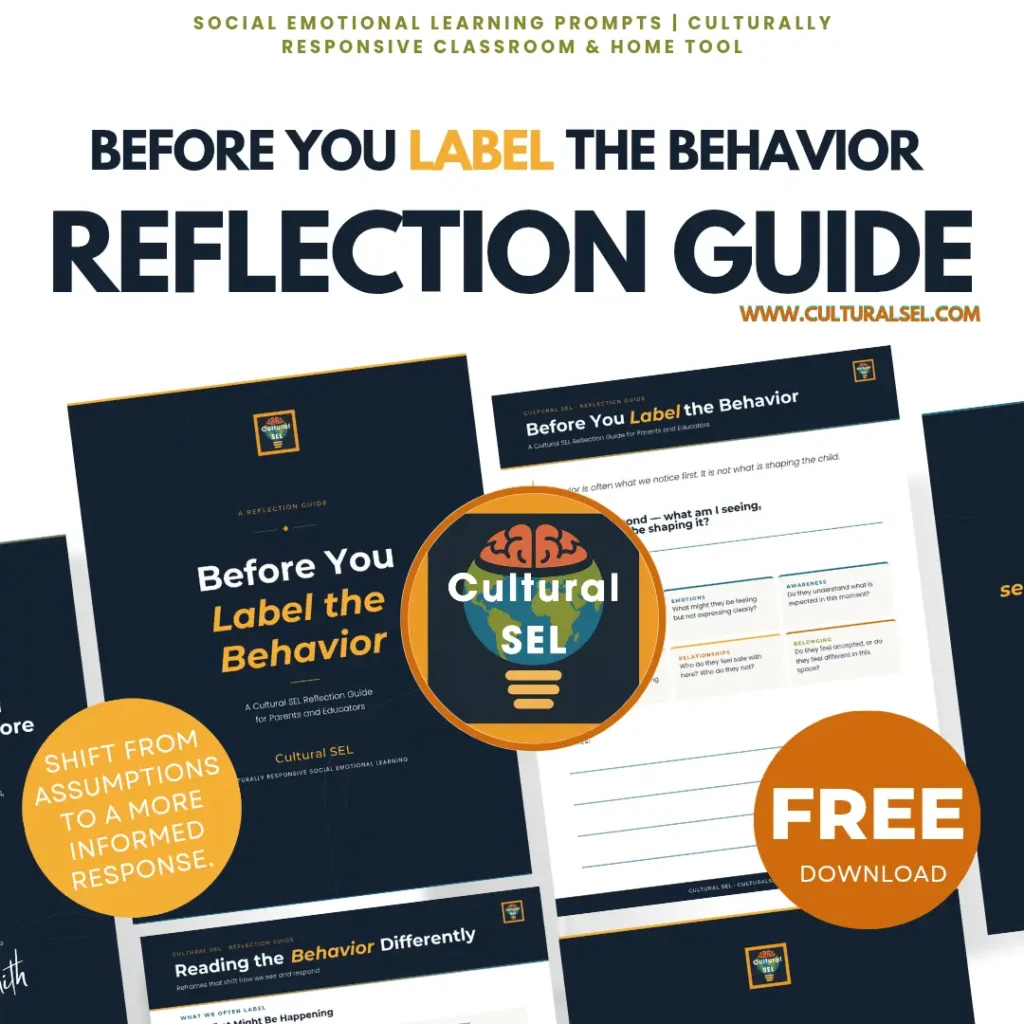
What if the behavior isn’t the whole story?
A free reflection guide that explores what may be influencing a child’s behavior before it is labeled, corrected, or misunderstood.
What “Controlling” Actually Means, and Who Gets to Decide
“Controlling” sounds like a plain description. It is usually a judgment.
A parent checking every assignment may look like caring involvement in one family. In another, it may look like hovering.
A parent who chooses a child’s activities may be seen as responsible and attentive. Someone else may see that same choice as overreach.
The label depends on what the observer believes healthy independence should look like. That belief may come from their own childhood, community, training, religion, class background, or school culture.
The default lens behind the label
Many adults use an unspoken default lens: a child should make their own choices early, speak freely to adults, solve peer problems alone, and separate from family decision-making as they grow.
That is one definition of healthy development. It is not the only one.
In many families, independence includes knowing how to take on family responsibilities, consider elders, protect younger siblings, and make choices that account for the group. Respect may look like listening before speaking. Care may look like close supervision.
The blind spot appears when one standard gets treated as universal.
Behavior tells only part of the story
Rules have a tone, a purpose, and a relationship around them, and all three change what the rule means to the child receiving it.
A parent who says, “You will finish this work because I know you can do it,” is communicating something different from a parent who humiliates a child for a low grade.
Both parents may demand completed homework. The behavior looks similar from a distance. The child experiences it differently.
If you interpret the behavior without its cultural context, you can miss what the child is actually experiencing.
Order-Keeping vs. Dominating Control: What the Research Actually Shows
Research on parenting has long treated “control” as a broad category. That broad label can hide major differences in how adults guide children.
Researchers studying parenting across cultures have distinguished two forms of parental control that get flattened into the same word far too often: dominating control and order-keeping control. Ruth Chao’s 1994 study names the paradox directly.
Parenting styles labeled “controlling” or “authoritarian” predicted poor school achievement among the European American children in her sample, yet the Chinese immigrant children raised under those same labeled styles were succeeding in school (Chao, 1994, “Beyond Parental Control and Authoritarian Parenting Style”).
Dominating control harms children
Dominating control uses fear and force to get a child to comply. It can include threats, shame, harsh punishment, and demands for obedience without explanation.
This form of control was linked to poor outcomes in the Western research samples where many parenting theories were built.
Children may comply because they are afraid. They may also learn that their thoughts, feelings, and efforts do not matter.
A strict rule does not erase a child’s need for emotional safety. Cultural context explains where a rule comes from. It doesn’t excuse harm.
Order-keeping control has another purpose
From the outside, order-keeping control looks like high expectations, close supervision, clear family roles, and an adult who is clearly in charge.
What often gets missed is what comes with this kind of control. Parents using it tend to explain their reasoning and stay warm and connected to the child, even while staying firm.
This shows up often in families that put the group ahead of the individual, sometimes called collectivist cultures.
A parent may direct a child firmly because the child is understood as part of a family, not as someone making every major decision alone. A child can live under firm rules and still feel like they belong. The two are not opposites.
Treating dominating control and order-keeping control as the same thing is the misread. It also makes culturally-informed parenting look suspect before anyone has actually asked what is happening inside the home.
What This Looks Like in Our Own Home
In our home, my husband and I expect our children to be respectful and take family responsibility seriously.
We know that respect goes both ways. We owe them that same respect back. Those expectations feel normal to us.
They don’t always match what gets treated as normal in other homes, or in the Western schools and communities our children are growing up in.
The same rule that feels like care at home can get judged as controlling once it’s measured against a standard someone else set, without ever asking us.
When someone calls a home too strict, I ask what standard they’re using, and whether respect runs in both directions in their own home too.
What I’ve Seen Watching Families Get Labeled in School Settings
That same gap, between a family’s own standard and someone else’s, shows up outside the home too.
Through PTA and family engagement work, I’ve watched how quickly a family’s parenting gets labeled: overprotective, too strict, too hands-off, against one unspoken standard of what healthy involvement is supposed to look like, a standard nobody in the room ever actually names.
The label rarely asks whose definition is doing the judging. A parent checking in on every assignment might be building closeness and teaching responsibility by one standard, and get judged as controlling by another.
A parent who lets a child work through a conflict alone might be building capability by one standard, and get seen as checked-out by another.
Before calling a parenting style controlling or hands-off, it’s worth asking whose definition of the child’s own independence is actually being used to judge the moment, and whether that standard was ever named out loud or just assumed.
The parent who checks every assignment
One parent reviews every assignment because school success is a family responsibility. Their child sees that routine as closeness, accountability, and care.
The parent is teaching, “Your effort matters here. We do not leave you alone with a problem we can help you solve.”
Another adult may see the same routine as a child being denied independence.
Both adults may care about the child’s growth. They are using different standards to measure it. As explored in Discipline Across Cultures, the same underlying value can produce very different rules depending on what a family believes discipline is for.
The parent who steps back
A parent who tells a child to work through peer conflict alone may be building capability. The child learns how to speak up, repair harm, and handle a hard moment without an adult taking over.
Someone else may see that same parent as checked out.
One family gets judged for staying close. Another gets judged for giving space. Change the default lens, and the label changes too.
The same thing happens when children’s own behavior gets labeled disrespectful across cultures. The child’s behavior stays the same. The adult’s standard is what decides the label.
Shop Our Culturally Responsive SEL Resources
Digital Cultural SEL resources for parents, caregivers, educators, community professionals, and children.
Explore practical tools, guides, reflection resources, and activities focused on social and emotional development, cultural environments, identity, belonging, relationships, lived experiences, and behavior.
When Guidance Reads as Control Across Cultures
The same parenting choice can mean something different across homes, regions, and communities.
A family in Seoul, Lagos, Toronto, Phoenix, or a rural town may share values while showing them differently.
The point is not that every family within a culture parents alike. Families are never that simple. Cultural context gives adults better questions than quick assumptions.
Making decisions on a child’s behalf
A parent may choose a child’s school, activities, or college path because the whole family shares the cost and the outcome, not just the child.
The child may expect adults to weigh what the choice means for the family, not only for them.
Another observer may believe the child should make that choice alone. They may call the parent’s involvement controlling.
The question is whether the child has any voice, how decisions are discussed, and whether the relationship allows respect in both directions.
Stepping back from conflict
Some parents encourage children to solve disagreements with peers before adults step in. They may be building self-reliance and problem-solving.
Other parents step in quickly for a different reason. When race, language, a disability, or an unsafe neighborhood are already part of the picture, a conflict between children doesn’t always get judged fairly.
A teacher, another parent, or another child may decide who’s at fault before anyone asks what actually happened.
A parent who has seen this happen may step in fast, not because the child can’t handle conflict, but because waiting for an adult to notice could mean the child gets blamed, hurt, or left to handle something alone that was never theirs to fix.
A child who asks for help is not always avoiding responsibility. A parent who intervenes is not always taking over.
Enforcing an early curfew
An early curfew may come from concern about safety, family routines, faith practices, transportation, or neighborhood conditions.
In some homes, it also reflects respect for shared space and the people waiting up.
A different family may allow later hours because they see that freedom as a normal part of adolescence.
Curfew alone cannot tell you whether a parent is restrictive. You need the reason, the flexibility, the child’s age, and the way the rule is enforced.
A Practical Check Before You Label a Parenting Style
You do not need a long interview before responding thoughtfully. You do need to pause long enough to avoid making your own default lens the rule for everyone else.
This matters in conferences, family conversations, counseling offices, youth groups, and everyday family disagreements. The child in front of you deserves more than a shortcut label.
Ask yourself:
- What is this parent actually trying to build in the child: safety, responsibility, academic persistence, family loyalty, independence, respect, or something else?
- What standard am I measuring this behavior against?
- Did I name that standard out loud, or did I assume everyone shares it?
- What does the child say this rule or routine means in their home?
- Is there warmth, explanation, repair, and room for the child to be heard?
These questions do not make adults agree with each other. They make it clear exactly what the two adults disagree about, instead of leaving it as an unnamed clash of opinions.
A teacher might say, “I value students practicing self-advocacy at school. How does that fit with the way your family handles decisions at home?”
That invites a conversation. Saying, “Your child needs more independence,” sounds like a verdict that the parent is getting it wrong.
What Changes When the Standard Gets Named Out Loud
Naming the standard changes the conversation.
A parent is no longer reduced to “controlling.” A teacher is no longer assumed to be disrespectful of family values.
The disagreement can move toward the actual issue: what adults believe a child needs, and why.
For example, a school may expect a middle school student to email teachers directly. A parent may expect to contact the teacher first.
The school may value self-advocacy. The parent may value protection, respect for adult authority, or clear family responsibility.
This is the same separation Skill vs. Style in Social Emotional Learning draws for children’s behavior: the standard being enforced matters more than the surface disagreement.
Once those expectations are named, adults can discuss a plan. Perhaps the student drafts the email with a parent. Perhaps the parent stays copied on the first few messages. Adaptation is not inconsistency.
Adults don’t have to agree with each other. They do need to say what standard they’re each using, and listen to the family’s actual reasons for their rules.
Common Questions About Cultural Bias in Parenting Labels
People pass parenting labels around fast. These questions slow the process down and separate cultural interpretation from real harm.
Is All Strict Parenting Controlling?
No. Research distinguishes order-keeping control from dominating control.
Order-keeping control can include firm rules, close supervision, and high expectations, alongside warmth, explanation, and praise.
Dominating control relies on fear and force instead of connection. The two forms are often flattened into the same label because the rules look similar from the outside.
Whether the parent explains the rule and stays connected to the child changes what the rule means, even when the rule itself looks the same from outside.
Why Does the Same Parenting Choice Look Different Depending on Who’s Judging It?
Most labels assume a particular standard for healthy independence without naming it. One adult may believe a child needs early personal freedom. Another may believe a child needs close family guidance while learning responsibility.
The person making the judgment also brings their own idea of the child’s “own goals.” Some families understand a child’s goals as connected to family hopes, duties, and shared resources. Others place personal choice first.
Neither view should be treated as neutral by default.
How Can a Teacher or Family Member Avoid Mislabeling a Parenting Style?
Ask what the parent is trying to build in the child. Then ask what the child experiences at home.
Avoid treating a familiar school-based expectation as the only healthy option. A parent who sits beside a child during homework may be teaching persistence. A parent who expects the child to work alone may be teaching confidence. Ask before deciding what the behavior means.
The standard used to judge the behavior may be the real issue.
Does This Mean Any Parenting Behavior Can Be Excused as “Cultural”?
No. Cultural context can explain where a value or parenting practice comes from. It does not excuse behavior that causes real harm.
Fear, humiliation, physical violence, isolation, and persistent emotional cruelty need clear attention. Cultural interpretation and actual harm are separate questions. Adults can respect family context while still protecting children.
Some parents already know exactly how they would describe their own parenting. A parent might say, “Yes, I’m controlling, and I’m working on that,” naming dominating control honestly and choosing to change it.
Another might say, “Yes, I’m controlling, and I don’t care,” and mean it as a settled stance, not a cultural difference waiting to be understood. Self-awareness about the label doesn’t change what the behavior does to the child.
The question is never just whether a parent will admit to the word. It’s whether the child is experiencing warmth, explanation, and safety, or fear and control for their own sake.
The Standard Behind the Label
Strict parenting can come from care, or from fear. It can protect a child, or control them. Often it is several of these at once. A label alone cannot sort that out.
The better question is what the adult is asking of the child, how they are asking it, and what cultural standard is shaping the judgment.
Naming the standard turns a character judgment into a conversation about expectations and values.
Asking whose standard is being used, naming it out loud, and asking what it protects is the Cultural SEL Lens in practice. To see the full framework behind it, see what Cultural SEL means.
Before calling a parent controlling, ask yourself which definition of healthy independence you are using.
CONTINUE EXPLORING CULTURAL SEL
Explore free Cultural SEL guides, culturally responsive SEL tools, and practical resources for understanding how cultural environments, identity, belonging, relationships, and lived experiences connect with children’s social and emotional development.
📌 Save or share this post with someone who is raising, teaching, or guiding children.

Hi, I’m Faith, the creator of Cultural SEL
I create practical tools and resources that support children’s social and emotional development and help parents, caregivers, educators, and community professionals look beyond behavior labels.
My work focuses on how cultural environments, identity, belonging, relationships, and lived experiences shape what children experience and how adults interpret and respond.
Read more about Faith and Cultural SEL: https://culturalsel.com/about
Join the Cultural SEL community: https://culturalsel.com/fb