Reading Through Culturally Responsive SEL: A Practical Lens for Emotional Learning
SEL can start to feel like posters on a wall, scripted lessons, or behavior charts that don’t match real kids’ lives.
You see a student shut down, talk back, or crack jokes at the wrong time, and the “expected response” in the lesson plan doesn’t fit the actual moment.
Reading gives adults and kids a shared place to talk about feelings, identity, belonging, safety, and power.
When that reading is culturally responsive, stories stop pushing one “right” way to behave or respond.
Instead, they help students name what’s happening, understand context, and practice repair in ways that respect who they are.
It’s a way to choose and use books through a culturally responsive and trauma-aware lens, so your read-alouds and library picks support social and emotional growth without flattening culture, ignoring trauma, or turning kids into examples.
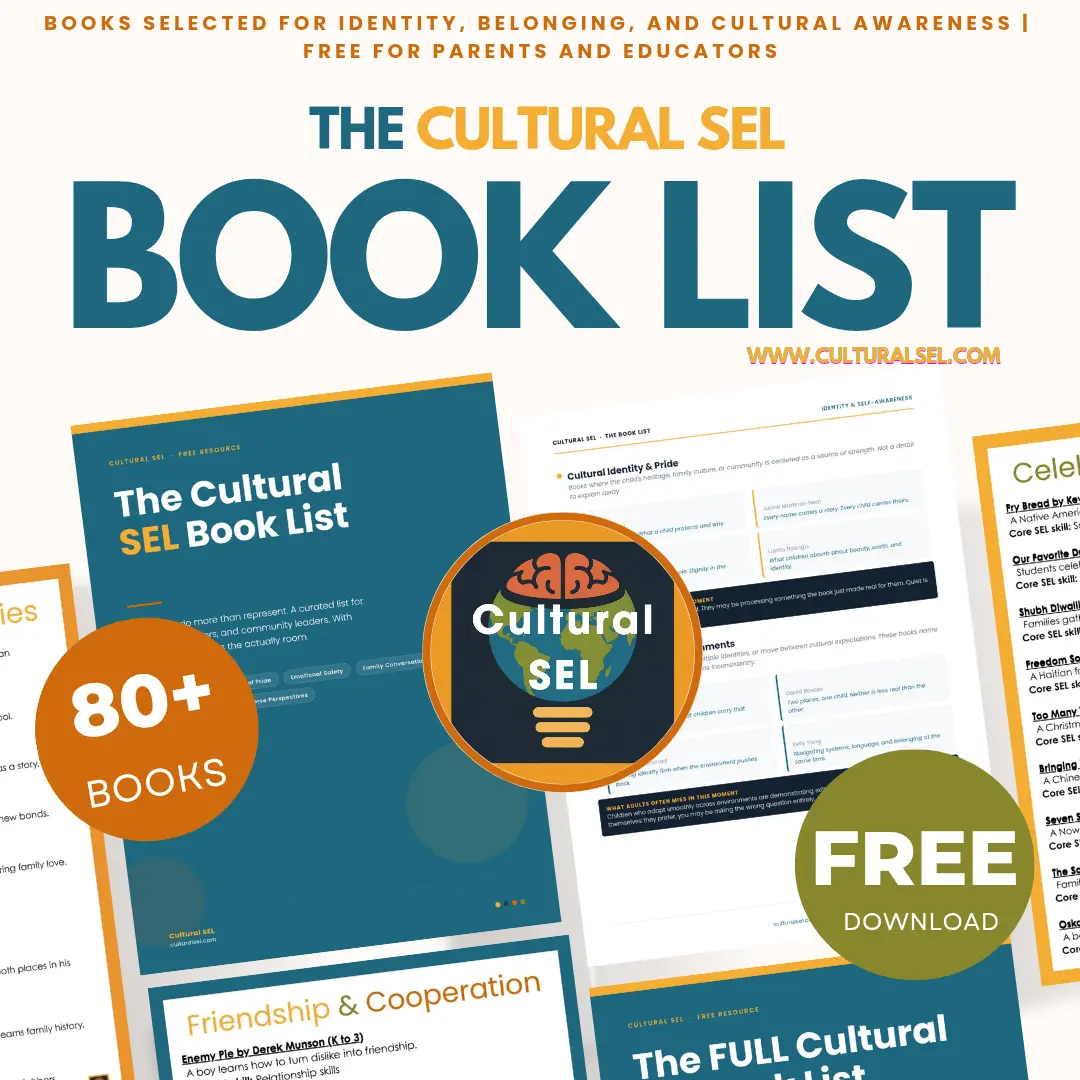
What if the right book still misses the child in front of you?
80+ books selected for identity, belonging, and cultural awareness. Each category includes what adults often miss, so you know how to use them, not just which ones to choose.
Books Teach Emotional Norms Even When We Do Not Name Them
Every story teaches “how people are” even when the author never says it out loud.
Kids learn what families look like, how adults respond to stress, which feelings are safe to show, and what happens when someone breaks a rule. Those lessons land as emotional norms.
I remember reading a popular SEL book while volunteering at my children’s school. In the story, the child solved the conflict by calmly explaining their feelings and trusting the adult to fix it.
After the reading, one student said, “That’s not how it works at my house.” The story wasn’t wrong. It assumed one version of childhood and did not reflect their emotional world.
That assumption shows up in many books.
The home might look the same in every story. The “good kid” might always use calm words, trust adults, and speak in the same style. The “problem” might get solved by one apology and a quick hug.
In a classroom, those patterns can quietly shape how you teach emotions. For example, a story can send the message that anger is always a character flaw, instead of a signal.
Another book might treat silence as a sign of guilt, not a sign of respect, stress, or careful thinking. If the books you use only show one set of emotional rules, students who live by different rules will get corrected more often.
Culturally responsive SEL reading starts earlier than the discussion. It begins when adults preview books and ask, “What emotional norms does this story reward?”
If a story only celebrates one “acceptable” way to speak, grieve, or disagree, it teaches compliance, not emotional skill.

Stories Shape Who Gets Comfort and Who Gets Corrected
Across many children’s stories, the same patterns show up. One character’s anger gets punished, while another’s anger gets explained away.
One child’s tears bring comfort, while another gets told to toughen up. Some characters are labeled “too much” because they are loud, expressive, direct, or intense.
In many children’s books, patterns in power and correction still send messages, even when the book never directly names a character’s background.
When you preview a book for culturally responsive SEL, keep your questions simple:
- Who gets comfort when they’re upset, and who gets corrected first?
- What emotion is treated as “bad,” and what emotion is treated as “normal”?
- Who is given a reason for their behavior, and who is called a problem?
- How do adults respond to mistakes, with curiosity or with shame?
- What changes at the end: the child, the environment, or both?
If your answers always point in one direction, that pattern becomes the rule. Children learn it by noticing who is corrected more often and who is given more grace.
Mirrors and Windows Support Identity and Social Awareness
“Mirrors” help students see themselves in a story. “Windows” help them learn about lives different from their own.
Culturally responsive SEL needs both, because identity and belonging shape how safe it feels to participate.
Mirrors matter for students who rarely see their families, languages, or communities shown with respect.
When a book includes a familiar family structure, a shared tradition, or a similar way of speaking, many students take more social risks.
They raise a hand. They write more. They share a feeling without awaiting judgment.
Windows matter because SEL includes social awareness. Reading stories about families, languages, and communities different from their own helps students see that “respect” does not look the same everywhere.
It can also help adults stop expecting one style of communication.

Culturally Responsive Stories Reflect Joy, Identity, and Everyday Life
Culturally responsive stories do not only center conflict or protection. They reflect the full emotional range of children’s lives.
That includes joy. Identity. Language. Humor. Everyday life. Pride. Belonging. Agency. Curiosity. Community.
In one DEI literacy planning meeting at my children’s school, the goal was simple: find SEL books that centered children of color talking openly about emotions.
As books were reviewed, many relied on animals or abstract characters to teach feelings. Far fewer centered children from diverse racial and cultural backgrounds navigating emotions in everyday settings.
That difference shapes what children see as typical, whose emotions are explored in depth, and whose stories are treated as universal.
In conversations with educators, this concern comes up often.
Students sometimes struggle to connect with stories when their communities only appear as occasional additions rather than as part of the everyday narrative of the curriculum.
When representation feels translated instead of woven into the broader learning experience, students can sense that the stories were not originally built with them in mind.
When representation centers hardship for some identities more than others, that pattern shapes expectations.
Children benefit from stories where they are creative, capable, funny, loved, and fully themselves. Identity is built through ordinary moments as much as through challenge.
Stories shape not only how children survive difficulty, but how they understand who they are allowed to be.
Culturally Responsive Stories Reduce Quick Behavior Labels
Adults often have to make quick decisions. Is that tone rude or stressed? Is that silence defiance or processing? Is that joking a disruption or a coping tool?
Reading can slow quick judgment. Stories widen the context adults and children use to interpret behavior.
As a result, classroom SEL becomes less about fixing kids and more about understanding what is happening around them.
When reading shifts how adults interpret behavior, discipline patterns shift too.
Fewer behaviors are labeled as defiance. More moments are treated as context. Over time, this affects who is sent out of class, who is trusted, and who feels safe.
Books help because they give you a shared case study. Everyone can analyze the character’s choice without putting a real student on display.
Behavior Carries Different Meanings Across Cultures and Communities
The same behavior can mean different things in different families and cultures.
Direct communication can be honesty in one home and “talking back” in another.
Silence can signal respect, discomfort, trauma, or second-language processing.
Avoiding eye contact can be a sign of politeness, not guilt. Strong body language can reflect passion, not aggression.
When adults only hold one “correct” meaning, labels come quickly: defiant, disengaged, rude. Reading does not automatically fix quick judgments, but it gives adults more context to work with.
Trauma-Aware Reading Protects Emotional Safety While Teaching Coping and Repair
Trauma-aware means you teach skills while staying sensitive to children’s lived experiences and how they shape behavior. You avoid shame. You protect dignity. You plan for strong reactions.
Many students live with stressors adults may not know about. Books can help students name feelings and see healthy ways to handle conflict, calm down, ask for help, and repair harm or rebuild trust. At the same time, stories can stir up memories or fear.
Trauma-aware reading does not avoid hard topics. It prepares adults to respond to children’s strong reactions with structure, choice, and dignity.
What to Look for in a Trauma-Aware SEL Story
When you preview a book, look for stories that show healthy ways to handle conflict and repair harm. Avoid stories where one character’s suffering exists only to teach others.
Helpful patterns include adults who listen, boundaries that make sense, realistic time for healing, community support, and accountability that restores relationships.
Red flags include humiliation played as humor, quick-fix endings, punishment-only conclusions, and stereotypes used to create conflict or teach a lesson.
Responding to Big Feelings During a Read-Aloud
Plan a simple response before you read.
- Look through the book for scenes of loss, separation, bias, or violence.
- Tell students they may listen quietly, take a short break, or step out with an adult if they need space.
- Plan a few places to pause and check how the character is feeling.
- Keep simple calming tools nearby, such as slow breathing, stretching hands, drawing, or getting water.
- End with a steady routine or a neutral question so students leave calm.
Phrases that protect emotional safety:
- “You can listen quietly or take a break.”
- “Let’s pause.”
- “You don’t have to explain.”
Full Stories Support Deeper Emotional Understanding
Culturally responsive SEL requires attention over time.
In a complete story, whether it is a picture book or a novel, emotions develop step by step. Relationships shift. Context becomes clearer as events unfold. Readers see what happened before a conflict and what follows after it.
Short excerpts often focus on a single moment or a clear takeaway. A full story shows how behavior develops, how misunderstandings build, and how resolution rarely happens in one instant.
Reading the whole book allows children to see complexity. Feelings change. Choices are influenced by history. Consequences unfold. Accountability takes time.
That fuller view supports stronger interpretation than one scene alone.
Choosing SEL Books With a Repeatable Lens
You do not need hundreds of titles. You need a consistent lens.
Include librarians, families, and students in selection when possible. Balance struggle stories with joy, humor, friendship, and pride. Notice whose voice sets the norm in the narration.
A Culturally Responsive SEL Checklist for Previewing Books
- The story honors context instead of flattening it.
- The story avoids turning characters into stereotypes or reducing them to a single trait.
- Emotional responses fit the situation, including anger, grief, and fear.
- Adults respond with listening and problem-solving, not only control.
- Conflict leads to accountability and relationship, not humiliation.
- The ending does not rely on shame as the main teaching tool.
- Language and dialect are treated with respect, not as a joke.
- The narration does not position one culture as the standard and others as unusual.
- You can identify who might feel unseen and decide whether to pair the book with a stronger mirror, adjust your questions, or add context before reading.
Building Shared Language Without Power Struggles
A story creates a shared reference point that is not about one student’s mistake.
Instead of direct correction, move to character-based reflection. Short routines like a weekly 10-minute read-aloud discussion or a 5-minute written reflection at the end build repeated practice.
Make Reading a Core Tool in Culturally Responsive SEL
Culturally responsive SEL works best when reading becomes part of how you teach emotional life, not an add-on.
Key takeaways:
- Books teach norms.
- Stories expand behavior interpretation.
- Trauma-aware reading protects emotional safety.
- Representation shapes emotional rules.
- A consistent lens matters more than a perfect list.
Pick one favorite SEL read-aloud this week. Audit it with the checklist. Then fill the gaps with stronger mirrors and windows.

FAQ: Reading Through Culturally Responsive SEL
How do I start if I do not share my students’ cultural backgrounds?
Start with curiosity and a clear lens. You do not need to be an expert in every culture. You do need to notice patterns in your books.
Preview for context. Ask who gets comfort. Ask who gets corrected. Invite librarians and families into the selection process when possible. Students will tell you quickly when a story feels true or flat.
Culturally responsive SEL begins with paying attention.
How do I teach tough topics without causing harm?
Preview the story first. Look for scenes of loss, bias, separation, or violence, even if they are subtle.
Before reading, name simple options. A student can listen quietly. A student can take a break. A student does not have to share.
Pause during strong moments. Close with grounding. Keep discussion focused on the character. No child should feel like they have to represent a group or explain their experience.
Trauma-aware reading protects dignity while still teaching coping and repair.
How can I fit culturally responsive SEL reading into existing time?
You do not need a new block in your schedule.
Use one weekly read-aloud. After reading, ask:
- One question about feelings.
- One question about context.
- One question about repair.
Or use a five-minute reflection prompt where students name:
- A feeling.
- A need behind it.
- A possible repair.
The SEL lives in the questions you ask, not in extra minutes.
“Children are not things to be molded, but are people to be unfolded.” – Jess Lair
Using This Lens Across Our Book Lists
This lens shapes the book lists shared on this site.
- The Black History SEL Book List
- The African, Caribbean, and Afro-Diasporic SEL Book List
- The Culturally Responsive Kindness Books
- The Children’s Books About Love for SEL
Each list applies the same questions about emotional norms, identity, behavior, and context.
New titles and topics are added as posts are published. If there is a theme, identity group, or SEL topic you would like to see reflected in a future list, let us know.
Your input helps expand the range of stories shared here.
Reading Changes What We Notice
When you change the books, you change what gets noticed.
You change:
- who is seen as capable
- who is seen as difficult
- who is given context
- who is given grace
Culturally responsive SEL is not about adding more lessons. It is about reading in a way that widens understanding before correction.
Stories give you a third space. A place where adults and students can look at behavior without putting one child on display. A place where context matters. A place where repair feels possible.
If we want classrooms where belonging mirrors real life, reading cannot be neutral. It must be intentional.
Pick one book this week. Read it with a lens. Notice who gets comfort. Notice who gets corrected. Notice what repair looks like.
That noticing is where change begins.
CONTINUE EXPLORING CULTURAL SEL
Explore free Cultural SEL guides, culturally responsive SEL tools, and practical resources for understanding how cultural environments, identity, belonging, relationships, and lived experiences connect with children’s social and emotional development.
📌 Save or share this post with someone who is raising, teaching, or guiding children.

Hi, I’m Faith, the creator of Cultural SEL
I create practical tools and resources that support children’s social and emotional development and help parents, caregivers, educators, and community professionals look beyond behavior labels.
My work focuses on how cultural environments, identity, belonging, relationships, and lived experiences shape what children experience and how adults interpret and respond.
Read more about Faith and Cultural SEL: https://culturalsel.com/about
Join the Cultural SEL community: https://culturalsel.com/fb