Anxiety in High-Achievement Family Cultures: When Success Feels Tied to Worth
Anxiety often grows quietly in homes where success, discipline, strong performance, and achievement carry heavy emotional weight.
Children in these environments may learn early that grades, productivity, reputation, and accomplishments affect how they are seen, supported, and valued within the family and community.
Achievement itself is not the problem. Many families value success because they want children to have safety, stability, and opportunity.
The pressure intensifies when children begin to believe that their worth, belonging, or approval depends on how well they perform.
These patterns can appear in many settings, including immigrant families, military families, religious families, athletic families, academically focused homes, and communities where children are taught that one mistake can carry real consequences.
Cultural SEL, or Social Emotional Learning through a cultural lens through a cultural lens, helps adults understand how identity, family history, relationships, and community expectations shape a child’s emotional experience with achievement and pressure.
A Cultural SEL lens helps adults look beyond performance. It asks what achievement means in the child’s family, what emotions are being hidden, and how identity, relationships, context, and expectations shape the pressure a child carries.
FREE DOWNLOAD · REFLECTION GUIDE
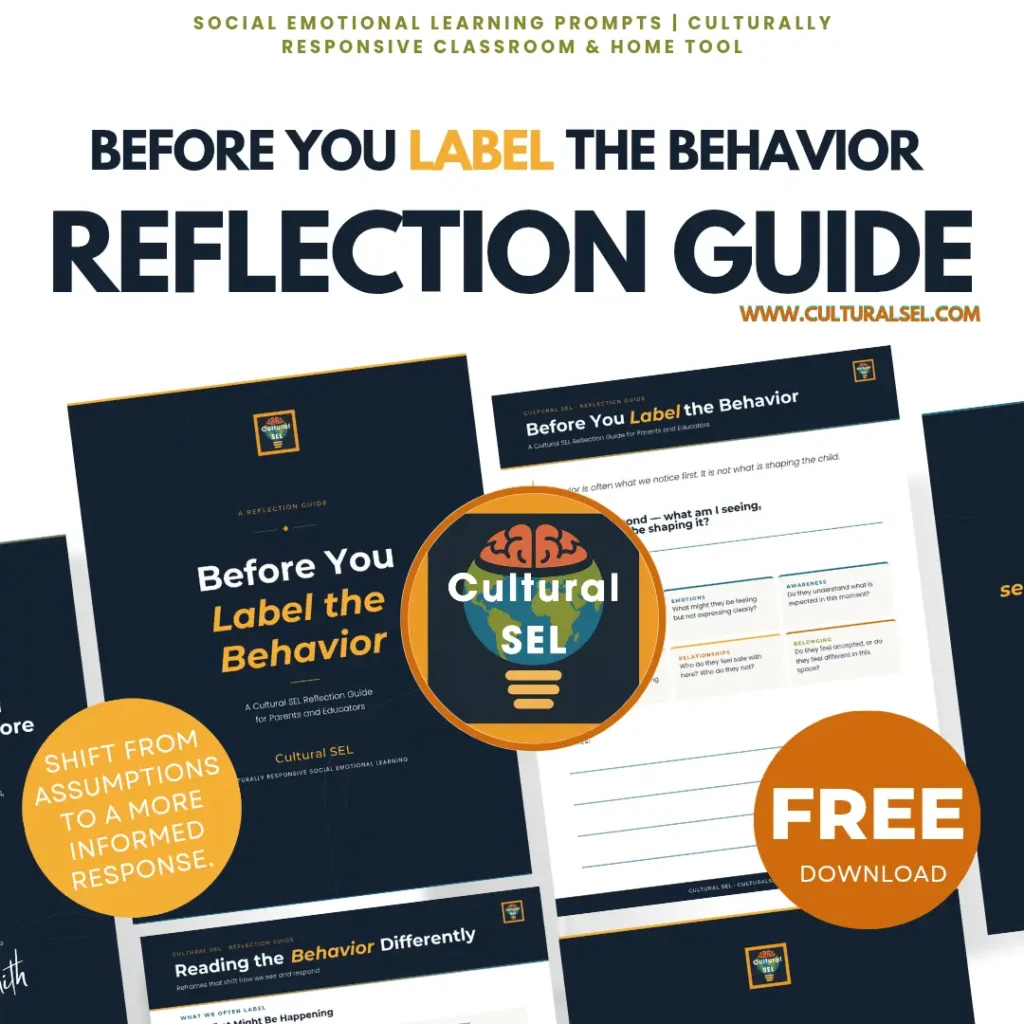
What if the behavior isn’t the whole story?
A free reflection guide that explores what may be influencing a child’s behavior before it is labeled, corrected, or misunderstood.
High-Achievement Family Cultures Often Come From Protection And Sacrifice
Many high-achievement family cultures begin with care. Parents may push education, discipline, and excellence because they want their children to have a safer life than they did.
That history matters. When a family has lived through poverty, racism, immigration stress, war, instability, or limited opportunity, achievement can feel protective. School may represent financial stability, respect, mobility, and a way out of struggle.
Parents may say:
- “Your grades matter because they open doors.”
- “We sacrificed too much for you to waste this chance.”
- “You have to work harder than others to get the same chance.”
These messages often come from both love and fear. A child may understand the sacrifice and still feel overwhelmed by the pressure.
I grew up hearing that to succeed, I had to work harder than others. In many families, that kind of message is meant to prepare children for reality.
As a child, though, preparation and pressure can start to sound the same. Now, as we raise multicultural children, I pay attention to how encouragement can turn into fear when emotional support is missing.
Anxiety Can Hide Behind Good Grades And Strong Behavior
Anxiety in high-achievement homes does not always look loud. It can hide behind strong grades, polished behavior, and constant effort.
Some children cope by becoming perfectionists. They panic over small mistakes. They study far beyond what is needed.
They avoid anything where success is not guaranteed. They may cry over a 95 because the missing five points feel like failure.
Other children hide stress through quiet achievement. They follow rules, complete work, and stay polite, so adults assume they are fine. Inside, they may feel tense, tired, and afraid of disappointing people.
This is why achievement alone does not tell the full story. A child can be praised, productive, and anxious at the same time.
The Centers for Disease Control and Prevention notes that anxiety in children can affect sleep, concentration, emotional regulation, and school participation.
Children experiencing pressure around achievement may continue performing well academically while still struggling emotionally.
Children May Learn That Mistakes Change How They Are Seen
In high-pressure environments, mistakes can begin to feel personal.
A low grade, missed goal, or public correction may feel like more than feedback. It may feel like proof that the child has disappointed the family.
That belief can shape behavior.
A child may:
- hide mistakes
- avoid asking for help
- over-apologize
- choose the safest path
- feel guilty during rest
- panic before tests or performances
- tie self-worth to results
This pattern often continues into adulthood. Many adults from high-achievement homes struggle to rest without guilt. They may overwork, over-prepare, and feel useful only when they are producing.
The issue is not laziness or lack of gratitude. The issue is that achievement has become tied to emotional safety.
Some children eventually stop needing constant outside pressure because the pressure becomes internal.
They begin constantly monitoring themselves, even when adults are not correcting them. Achievement becomes self-surveillance rather than healthy motivation.
When achievement becomes the main proof of worth, mistakes begin to feel like threats to belonging.
Schools Can Miss Anxiety When Students Keep Performing
Schools often notice grades, behavior, and completed work first. That means quiet high-performing students may be overlooked emotionally.
A student may look responsible and mature while carrying constant worry. They may never disrupt class, yet feel anxious before every presentation, test, or graded assignment.
Fear of failure can also change classroom participation. A child may stop raising their hand because being wrong in public feels too risky.
Another may avoid difficult work because the challenge feels unsafe unless success is guaranteed.
I notice this often in school spaces and family conversations. Some children appear responsible on the surface while carrying heavy pressure beneath the surface.
Adults usually respond first to visible behavior. Anxiety in high-achievement environments often stays hidden behind compliance, achievement, and self-control.
Cultural Expectations Shape How Pressure Is Communicated
Pressure does not sound the same in every family.
In some homes, it sounds direct:
- “Do better.”
- “That is not good enough.”
- “Look at what your cousin achieved.”
In other homes, it may come through silence, teasing, short praise, or disappointment that is felt more than spoken.
Different families also define success differently. For one family, success may mean financial security.
For another, it may mean a respected career, college admission, family honor, spiritual discipline, athletic excellence, or public recognition.
Children often carry several expectations at once. They may try to be a strong student at school, a respectful child at home, a good reflection of the family in the community, and a polished version of themselves online.
That pressure can become heavy when no one helps them name it.
Families Can Keep High Standards Without Making Fear The Driver
Families do not have to abandon discipline, responsibility, or ambition to reduce anxiety. The goal is to keep the values while changing the emotional tone around them.
Children need to know that mistakes do not change their worth.
Helpful language can sound like:
- “What did you learn from this?”
- “How are you feeling about it?”
- “One result does not define you.”
- “You can rest before everything is perfect.”
- “We can correct the mistake without attacking who you are.”
Parents can still expect effort. Teachers can still give feedback. Coaches can still challenge children. The difference is that correction should not make a child feel unsafe, unwanted, or ashamed.
Rest also matters. Children need sleep, play, quiet time, and recovery. Rest is not the opposite of discipline. Rest gives children the capacity to keep learning without running on fear.
Cultural SEL Helps Adults Look Beyond Performance
Cultural SEL helps adults ask better questions about achievement and anxiety.
Instead of only asking, “Is this child performing well?” adults can ask:
- What does success mean in this child’s family?
- What pressure is attached to achievement?
- What emotions are being hidden behind good behavior?
- How does this child show stress when they cannot say it out loud?
- Does this child feel valued outside of performance?
These questions help adults see the child more clearly. A high-achieving child may still need emotional support.
A disciplined child may still need rest. A successful child may still need help separating identity from results.
These questions come up often for parents, educators, counselors, and adults reflecting on their own upbringing inside high-pressure environments.
Common Questions About Anxiety In High Achievement Family Cultures
Why do high-achievement family cultures create anxiety?
High-achievement family cultures can create anxiety when children feel that success protects their belonging, approval, or family pride. When mistakes feel emotionally costly, children may begin to fear failure rather than learn from it.
In some homes, achievement also carries family sacrifice, reputation, or survival meaning. That can make normal setbacks feel much heavier emotionally, especially for children who fear disappointing the people they love.
What does anxiety look like in high-achieving children?
Anxiety may look like perfectionism, overworking, irritability, trouble sleeping, panic around mistakes, fear of disappointing adults, or shutting down after feedback. Some children look calm because they have learned to hide stress.
Anxiety does not always appear as disruptive behavior. Many high-achieving children become quieter, more perfectionistic, and more self-critical instead of acting out openly.
Can high expectations and emotional support exist together?
Yes. Children can have structure, accountability, and high expectations while also feeling safe, loved, and supported. The difference is how adults respond when children struggle.
Children usually handle challenges better when they know mistakes will bring guidance and support instead of shame, fear, or humiliation.
Why do some children tie their worth to achievement?
Children may tie worth to achievement when praise, attention, or approval mostly come after success. Repeated comparison, public pressure, and fear of disappointing adults can make performance feel like the price of connection.
How can parents reduce achievement pressure without lowering standards?
Parents can reduce pressure by separating mistakes from identity, allowing rest, asking about feelings, praising effort and character, and correcting behavior without shame. High standards work better when children do not have to earn emotional safety.
Some children learn to manage pressure before they learn how to talk about what the pressure is doing to them.
High-achievement family cultures can build discipline, focus, and opportunity.
They can also create anxiety when children begin to believe that success is the main way to stay valued, safe, or accepted.
The goal is not to remove ambition. The goal is to make sure children know their worth does not disappear when they struggle.
Some children are not afraid of hard work. They are afraid of what failure might change about how they are seen, valued, or understood.
That is where families, educators, and communities can respond with more clarity and care.
CONTINUE EXPLORING CULTURAL SEL
Explore free Cultural SEL guides, culturally responsive SEL tools, and practical resources for understanding how cultural environments, identity, belonging, relationships, and lived experiences connect with children’s social and emotional development.
📌 Save or share this post with someone who is raising, teaching, or guiding children.

Hi, I’m Faith, the creator of Cultural SEL
I create practical tools and resources that support children’s social and emotional development and help parents, caregivers, educators, and community professionals look beyond behavior labels.
My work focuses on how cultural environments, identity, belonging, relationships, and lived experiences shape what children experience and how adults interpret and respond.
Read more about Faith and Cultural SEL: https://culturalsel.com/about
Join the Cultural SEL community: https://culturalsel.com/fb