Why Some Children Get Labeled While Others Are Understood (Children Behavior Labeling in School)
Two children can break the same classroom norm and leave with different stories attached to them. One gets called “confident.” The other gets called “disruptive.”
Children behavior labeling in school often depends on how adults interpret behavior, not just what a child does.
The same action can be seen as confidence in one child and disruption in another. These patterns shape how children are treated, how they participate, and how they see themselves in school.
Much of children behavior labeling in school starts with adult interpretation, not behavior alone. That matters because labels shape how children are corrected, included, and remembered.
This becomes clearer when you look at how schools read the same behavior in different children.
FREE DOWNLOAD · REFLECTION GUIDE
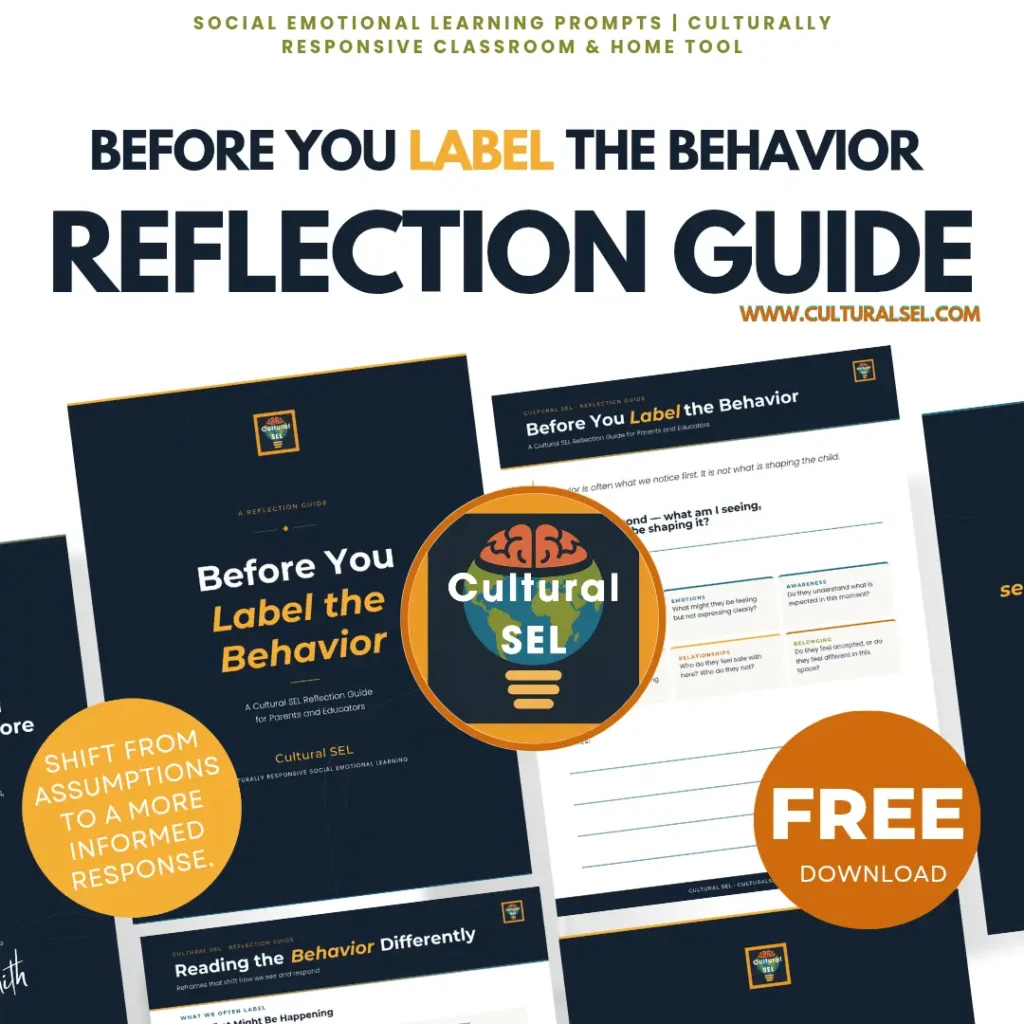
What if the behavior isn’t the whole story?
A free reflection guide that explores what may be influencing a child’s behavior before it is labeled, corrected, or misunderstood.
The Same Behavior Gets Different Labels In School
Children are rarely labeled by actions alone. Adults add meaning to what they see, and that meaning can shift from child to child.
A talkative student might be seen as confident, social, and eager to join in.
Another talkative student might be seen as distracting or hard to manage. The behavior looks similar, yet the response changes.
The same thing happens with quiet children. One child is called respectful and focused. Another is called withdrawn or disengaged. In both cases, adults move from description to judgment in seconds.
That jump matters. Once a child gets a label, adults often start watching for proof that the label fits. Then classroom decisions follow that pattern.
A child who is seen positively may get more chances to speak, lead, or recover from mistakes. A child with a negative label may get corrected faster and trusted less.
When adults describe behavior before they judge it, they make fairer choices.
How Interpretation And Culture Shape Behavior Labels
School behavior labels grow from adult expectations, and those expectations come from rules, habits, and social norms. Because of that, the same action can carry very different meanings.
A quiet child may be called shy in one room and respectful in another. A loud child may be praised as confident or corrected as disruptive.
A student who avoids eye contact may be seen as rude, even though eye contact shows disrespect in some families and cultures.
A child who speaks directly may sound assertive to one adult and disrespectful to another.
Communication style also matters. Some children grow up in homes where overlapping speech shows connection and interest.
School may expect strict turn-taking. Some children learn indirect language as a form of respect. School may reward direct answers instead.
These differences are easy to miss when one communication style is treated as the default.
I have seen this growing up between cultures and now raising my children. What feels normal in one setting can be corrected in another. I now help parents and educators pause and ask what a behavior means before deciding what to call it.
Once adults see behavior through that wider lens, many labels lose their grip.
Why Some Children Are Misinterpreted More Than Others
Schools do not give every child the same amount of grace. Some children get more room to make mistakes, explain themselves, or try again. Others are corrected quickly and watched more closely.
That gap shows up in small moments. One child speaks with energy and gets called a leader. Another uses the same tone and gets warned.
One student asks a direct question and is seen as thoughtful. Another is told to stop challenging the teacher.
These are not one-time moments. They repeat. They become patterns. Adults may not notice the pattern because each moment seems minor on its own. Yet the child feels it. Families often feel it too.
When responses stay uneven, the school message becomes clear. Some children are understood. Others have to work harder to be read fairly.
How Behavior Labeling Affects Confidence And Identity
Labels shape treatment, and treatment shapes self-belief. That is why behavior language matters so much in school.
A child called “disruptive” often gets more correction and less trust. That child may stop raising a hand, stop sharing ideas, or start bracing for the next warning.
Meanwhile, a child called “confident” often gets encouragement, leadership chances, and more room to speak.
These differences affect classroom participation, teacher relationships, and peer interaction. Classmates notice who gets praised and who gets redirected.
Children notice it even faster. They start to read the room and adjust themselves.
Repeated labels also sink deeper. A child may begin to believe, “I’m the problem,” or “Teachers always think the worst of me.” Some children withdraw.
Others overcorrect and become anxious about every small mistake. Academic confidence can drop, even when skill is there. Teacher relationships can strain, even when the child wants to connect.
When this happens year after year, the label starts shaping the student’s school identity.
Children Behavior Labeling In School Often Ignores Context
Behavior without context is easy to misread. Context includes culture, communication style, stress level, classroom setup, and the demands of the moment.
A child may speak over others because that is normal at home. Another may stay silent because they are observing before joining. A student may seem abrupt because they are confused and trying to keep up.
When adults slow down and ask what surrounds the behavior, their response gets clearer. They can still teach expectations, but they do it with better understanding.
What Adults Can Check Before Labeling Student Behavior
Describe The Behavior Before Assigning A Label
Start with what you can observe. “Talking while others are speaking” is clearer than “disruptive.” A description keeps the focus on the action, so adults can respond to what happened without turning it into a fixed trait.
Ask What The Behavior Might Mean In Context
Behavior carries meaning. Before naming it, pause and ask, “Is this learned at home? Is this a sign of respect in another setting? Is this confusion, comfort, or stress?” That short pause can change the whole response.
Compare Your Expectation With The Child’s Norm
Adults should know what they expect in the moment. Then they should ask whether that expectation is shared across cultures, homes, and learning styles. Many school rules feel neutral, yet they often reflect one way of speaking and interacting.
Check Consistency Across Students
Bias often shows up in uneven reactions. Ask, “Would I respond the same way if another child did this?” That question helps adults catch patterns before those patterns harden.
Choose A Response That Teaches Instead Of Labels
Children need guidance, and they also need dignity. A skill-based response keeps both in view. For example, “Let’s take turns speaking so everyone is heard” teaches the expectation without attaching identity-based language to the child.
Common Behavior Labels And More Accurate Reframes
This quick guide can help adults shift from judgment to clearer observation.
| Common Label | More Accurate Description |
|---|---|
| Disruptive | Speaks while others are speaking |
| Disrespectful | Does not make eye contact during instruction |
| Too loud | Expresses ideas with high energy |
| Not engaged | Observing before participating |
| Defiant | Questioning or seeking clarity |
Reframing does not remove expectations. It improves understanding before correction, which leads to fairer teaching.
Clear description leads to fair correction. Labels often lead to repeated misinterpretation.
Why Do Some Children Get Labeled More Than Others In School?
Children get labeled differently because adults interpret behavior through expectations, prior experiences, and school norms. These interpretations are not applied evenly, which leads to patterns in how children are treated.
Why Is The Same Behavior Treated Differently In School?
Because adults interpret behavior through expectations, prior beliefs, and school norms, not through actions alone.
How Does Culture Affect How Behavior Is Labeled?
Culture shapes eye contact, tone, turn-taking, and directness. When school norms differ from home norms, adults may misread the behavior.
Do Labels Affect How Children See Themselves?
Yes. Repeated labels can change confidence, class participation, and a child’s sense of who they are in school.
Why Are Some Children Corrected More Quickly Than Others?
Some children get more flexibility, while others are monitored more closely. That creates uneven discipline and uneven trust.
Can Labeling Impact Classroom Participation?
Yes. Children who expect judgment often speak less, take fewer risks, and pull back from classroom relationships.
What Is The Difference Between Labeling And Understanding Behavior?
Labeling gives quick judgment. Understanding looks at context, intent, and what skill the child may need next.
How Do Labeling Patterns Develop?
Adults repeat similar interpretations, and those repeated responses shape how a child is treated across days, months, and school years.
Recognizing Behavior Labeling Patterns In School Classrooms
Misreading behavior can feel normal because it repeats so often. Patterns become easier to spot when adults compare how they respond to different children showing similar behaviors.
As a PTA member working closely with families and schools, I see how quickly patterns form.
When adults pause and look again, the same child can be understood differently. That shift changes how the child shows up in the classroom.
More accurate understanding leads to more consistent responses. It also builds stronger relationships and increases participation. When adults read behavior well, children experience school in a different way.
Children do not walk into school as labels. Adults often place those labels on them through interpretation, expectation, and context.
That is why understanding matters before judgment. When teachers, families, and school teams pause, compare patterns, and respond with clear language, children have a better chance to feel seen, supported, and safe in the classroom.
CONTINUE EXPLORING CULTURAL SEL
Explore free Cultural SEL guides, culturally responsive SEL tools, and practical resources for understanding how cultural environments, identity, belonging, relationships, and lived experiences connect with children’s social and emotional development.
📌 Save or share this post with someone who is raising, teaching, or guiding children.

Hi, I’m Faith, the creator of Cultural SEL
I create practical tools and resources that support children’s social and emotional development and help parents, caregivers, educators, and community professionals look beyond behavior labels.
My work focuses on how cultural environments, identity, belonging, relationships, and lived experiences shape what children experience and how adults interpret and respond.
Read more about Faith and Cultural SEL: https://culturalsel.com/about
Join the Cultural SEL community: https://culturalsel.com/fb