Culturally Responsive SEL vs Traditional SEL: Structural Differences That Matter
A student shuts down during group work. Another avoids eye contact when an adult speaks. A third talks back when corrected.
Are these SEL skill gaps, or are adults reading behavior through the wrong lens?
Traditional social emotional learning teaches skills like self-management, empathy, and relationship skills through shared competencies.
Culturally responsive SEL teaches those skills too, while also treating culture, identity, language, and community norms as part of how emotions, behavior, and relationships show up.
This comparison matters because SEL sits close to discipline, belonging, and academic access. If the structure is off, the results will be off.
This guide is for educators, counselors, SEL facilitators, librarians, and families who want SEL to fit real students, not an imagined average student.

What if the right book still misses the child in front of you?
80+ books selected for identity, belonging, and cultural awareness. Each category includes what adults often miss, so you know how to use them, not just which ones to choose.
What Traditional Social Emotional Learning Frameworks Emphasize
Traditional SEL frameworks focus on clarity and consistency across a school. That consistency helps adults work from a shared plan, especially when staff turnover is high.
CASEL-style core competencies
Many schools organize SEL around five areas: self-awareness, self-management, social awareness, relationship skills, and responsible decision-making.
Lessons map to these categories so teams can plan across grade levels. This supports pacing guides, shared rubrics, and common language.
Skill-based instruction
Traditional SEL treats emotional skills as teachable and measurable. Students practice naming feelings, using coping strategies, setting goals, and solving peer conflict.
SEL looks like other instruction. Adults model a skill, students practice, feedback follows.
Standardized language
Schools often choose common words for behavior and emotion such as calm, respectful, and responsible. Adults repeat these terms across classrooms and hallways.
Shared wording helps when a school wants consistent expectations.
Behavior tracking systems
Many programs connect SEL to points systems, behavior charts, or referral categories. Teams review trends and respond with interventions.
When used thoughtfully, tracking can surface patterns adults missed.
Why schools adopted traditional SEL
Schools adopted traditional SEL because it offered structure and ready-to-use materials. It aligned with goals many leaders already had: stronger classroom climate, fewer disruptions, clearer expectations.
Traditional SEL can work well when adults stay reflective and flexible.
Where Traditional SEL Frameworks Leave Cultural Gaps
Gaps appear when schools treat behavior norms as universal.
When “appropriate” is defined in only one way, students from nondominant cultures often absorb the consequences.
Respect defined through one lens
In some settings, respect means steady eye contact and a calm voice. In other settings, respect means lowered eyes, fewer words, and space for adults to speak first.
If a school defines respect narrowly, the same student can be labeled polite in one context and defiant in another.
I have sat in meetings where two adults described the same student in completely different ways based on what they believed respect looked like. Interpretation shapes outcome.
Regulation defined as stillness
A quiet, still body is often labeled regulated. Yet some students regulate through movement, humming, or whispering to a peer.
Without context, adults can mislabel coping strategies as disruption.
Behavior interpreted without context
A student who challenges an idea may value directness. A student who stays quiet may be exercising caution.
When adults do not ask what behavior means in a student’s home or community, difference can be mistaken for disrespect.
“Neutral” language that reflects dominant norms
Terms like appropriate, expected, and good attitude sound fair. In practice, they often reflect dominant cultural habits.
When this goes unchecked, SEL shifts toward compliance.
Participation style misreads
Some students think aloud. Others observe first, then contribute. Some process through storytelling or side comments.
If only one participation style earns praise, others are labeled off-task.
Discipline referrals shaped by perception
Referral decisions depend on interpretation. Tone, accent, body language, and prior assumptions shape outcomes.
Over time, these interpretations widen discipline gaps and weaken trust.
Emotional expression differences
Some families teach children to keep feelings private. Others encourage open expression.
When SEL treats one emotional style as healthier, students can feel judged for how they were raised.
When adults define regulated and respectful without culture in mind, SEL can reinforce the discipline patterns schools are trying to change.
What Culturally Responsive SEL Adds to the Framework
Culturally responsive SEL keeps skill goals in place. It changes the foundation underneath them.
Identity, language, and community are treated as part of emotional development.
Identity as part of self-awareness
Students build self-awareness through race, language, family roles, gender, faith, and community history.
When identity is included, students learn to name emotions without distancing themselves from who they are. They also gain language for stress tied to bias or exclusion.
Language differences in emotion naming
Not every language maps neatly onto English feeling words. Even within English, families use different labels for the same internal state.
Culturally responsive SEL makes space for home language and code-switching. Teachers can ask, “What word does your family use for that feeling?”
Family expectations and school expectations
Family rules about adult-child talk, sibling responsibility, and independence vary.
Culturally responsive SEL treats families as partners. Goals are discussed, not imposed. Progress conversations include context.
Belonging as a regulation factor
Belonging shapes attention, risk-taking, and coping. When students feel watched or singled out, their nervous system reacts.
Culturally responsive SEL treats safety and belonging as inputs, not rewards.
Context before correction
Adults pause before correcting. They look for the need under the behavior and respond in ways that protect dignity.
Boundaries remain clear. The delivery changes.
Implementation Differences in Real Classrooms
These shifts show up in routines, training, and communication.
Staff training shifts
Traditional SEL training often focuses on lesson delivery and management strategies.
Culturally responsive SEL adds bias awareness, cultural humility, and reflective practice. Staff need support for difficult moments, including when colleagues mislabel students.
Behavior log reframing
Traditional logs record what happened and what consequence followed.
A culturally responsive log also captures context. It may include triggers, adult responses, student voice, and environmental factors.
Teams begin asking not only “What did the student do?” but also “What happened around the student?”
Family communication changes
Instead of sending home behavior scripts, schools use two-way communication.
Quick calls, translated notes, or short surveys create space for family voice. The goal is clarity without judgment.
Participation style flexibility
Teachers widen what engaged looks like. Students may show thinking through drawing, movement, partner talk, or storytelling.
Rubrics reflect multiple participation paths so students are not penalized for cultural style.
Reflection protocol for conflict
A short reflection routine protects time and dignity.
- Name the moment in neutral language.
- Ask the student what was happening for them.
- Share the impact on learning or peers.
- Co-plan one repair action and one strategy for next time.
- Close by reinforcing the relationship.
Consistency builds safety.
Accountability Differences That Matter
SEL creates data. It creates labels. It shapes stories about students.
That makes accountability essential.
Who gets labeled
If the same students are repeatedly tagged as defiant or disruptive, the issue may be systemic, not individual.
Teams should track patterns in labeling, not only frequency of behavior.
Who feels safe
Do students trust adults with personal stories. Do they expect fairness. Do they believe mistakes will not follow them.
If safety varies by group, SEL will not land evenly.
Who feels visible
Students need to see their communities reflected in examples, books, and language. Names should be pronounced correctly. Home language should be respected.
Without visibility, students perform SEL rather than internalize it.
Who is corrected most often
Track correction frequency. A student who hears stop all day will not experience SEL as supportive.
Adult-to-student interaction patterns matter.
Quarterly SEL Accountability Checks
| What to Review | What to Disaggregate | What to Look For | What to Do Next |
|---|---|---|---|
| Office referrals | Race, disability status, language, gender | Repeat referrals for subjective behaviors such as defiance or disruption | Clarify definitions, add context notes, coach adult responses |
| Classroom removals | Teacher, time of day, setting | Certain rooms or transitions driving removals | Adjust routines, add support during hot spots |
| Positive contacts home | Teacher, student group | Some families only hear from school for problems | Set goals for positive outreach, offer translation |
| SEL surveys or screenings | Student group, grade | Low belonging or low trust in adults | Co-plan changes with students and families |
If outcomes differ by group, the system needs attention.
How Families Can Recognize the Difference
Families often notice the structure before they know the term.
Clues appear in communication, discipline patterns, and how staff define respect.
Questions families can ask
- How do you define respect in class. Can you give examples.
- What happens before a referral.
- How do you include our family’s language and values.
- What data do you review for fairness.
Concrete answers matter more than polished statements.
Signs of alignment
Staff ask about your child’s strengths. Teachers offer multiple ways to participate. Conflicts include repair, not only consequence.
Communication includes space for your voice.
Signs of blind spots
Frequent correction for tone, attitude, or body language. Family input treated as resistance. A child who feels singled out even when grades look strong.
Patterns deserve follow-up.
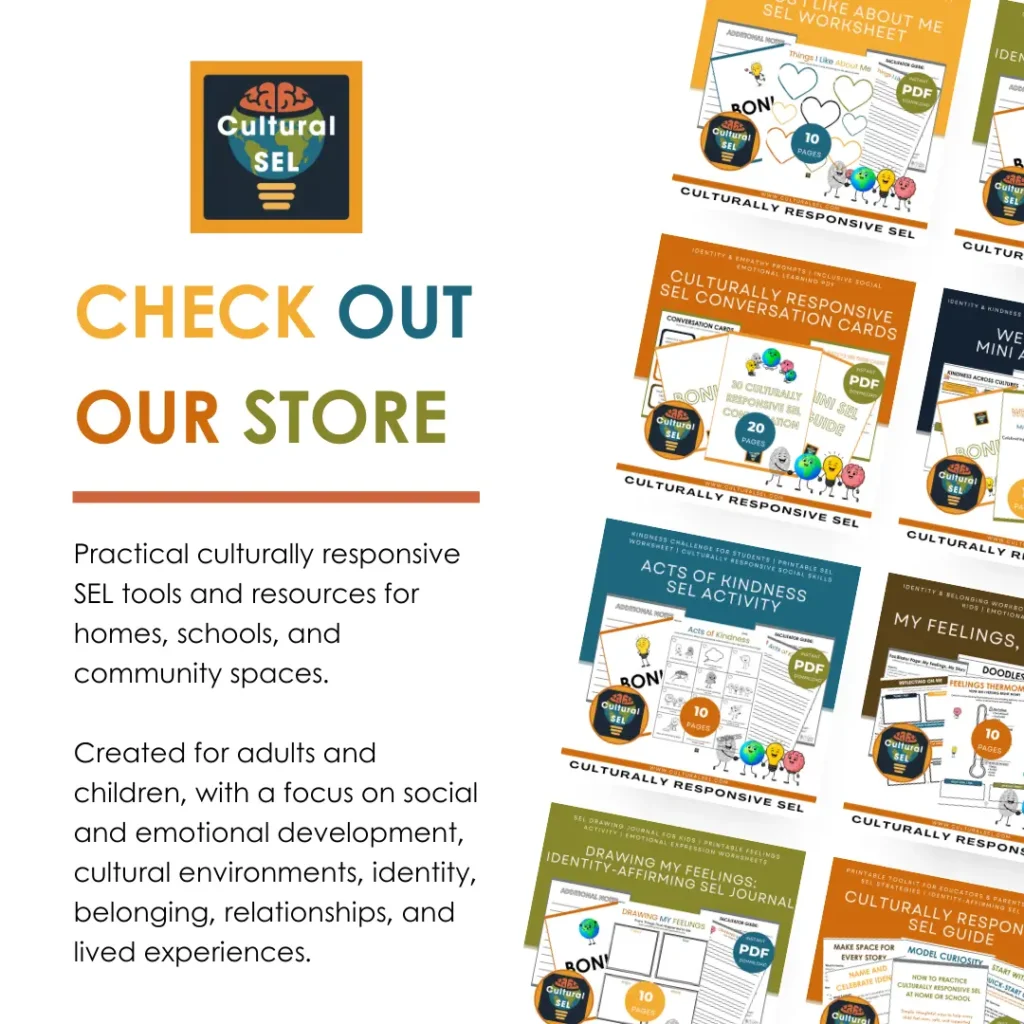
Shop Our Culturally Responsive SEL Resources
Digital Cultural SEL resources for parents, caregivers, educators, community professionals, and children.
Explore practical tools, guides, reflection resources, and activities focused on social and emotional development, cultural environments, identity, belonging, relationships, lived experiences, and behavior.
Common Questions About Culturally Responsive SEL vs Traditional SEL
Is culturally responsive SEL a separate program
It can be, but many schools adapt their existing framework. The shift shows up in training, materials, and accountability.
Does culturally responsive SEL lower expectations
No. Expectations remain clear. The difference lies in interpretation, context, and dignity.
Where should a school start
Start small. Clarify behavior definitions. Add context to logs. Practice one shared reflection protocol.
Culturally responsive SEL does not change the skills. It changes the lens through which those skills are taught, measured, and corrected.
Schools do not experience SEL through posters. They experience it through routines, adult decisions, and what happens after conflict.
Traditional SEL builds shared skills. Culturally responsive SEL asks whether systems interpret students fairly across identity and culture.
Systems change when adults decide to examine interpretation honestly.
I have seen how quickly interpretation becomes policy, and how quickly labels follow students when patterns go unchecked.
Choose one structural adjustment this month. Review your data and student feedback after six weeks. Notice what shifts when belonging becomes a measurable responsibility.
CONTINUE EXPLORING CULTURAL SEL
Explore free Cultural SEL guides, culturally responsive SEL tools, and practical resources for understanding how cultural environments, identity, belonging, relationships, and lived experiences connect with children’s social and emotional development.
📌 Save or share this post with someone who is raising, teaching, or guiding children.

Hi, I’m Faith, the creator of Cultural SEL
I create practical tools and resources that support children’s social and emotional development and help parents, caregivers, educators, and community professionals look beyond behavior labels.
My work focuses on how cultural environments, identity, belonging, relationships, and lived experiences shape what children experience and how adults interpret and respond.
Read more about Faith and Cultural SEL: https://culturalsel.com/about
Join the Cultural SEL community: https://culturalsel.com/fb


