Avoiding a Diagnosis Won’t Protect Your Child From a Label
THIS POST MAY CONTAIN AFFILIATE LINKS. THIS MEANS WE MAY RECEIVE A COMMISSION FROM QUALIFYING PURCHASES YOU MAKE THROUGH OUR LINKS. KINDLY READ OUR DISCLOSURE NOTICE FOR MORE INFORMATION.
A parent sits across from a school team, and the paperwork is on the table. Someone says the word out loud. Autism. Attention-deficit hyperactivity disorder, ADHD.
A learning disability. The parent hesitates, not because they cannot see their child struggling, but because they have watched that word get used against a child in their family, their community, or their culture, in a way that did more harm than good. Avoiding a diagnosis feels like the safer choice in that moment.
FREE DOWNLOAD · REFLECTION GUIDE
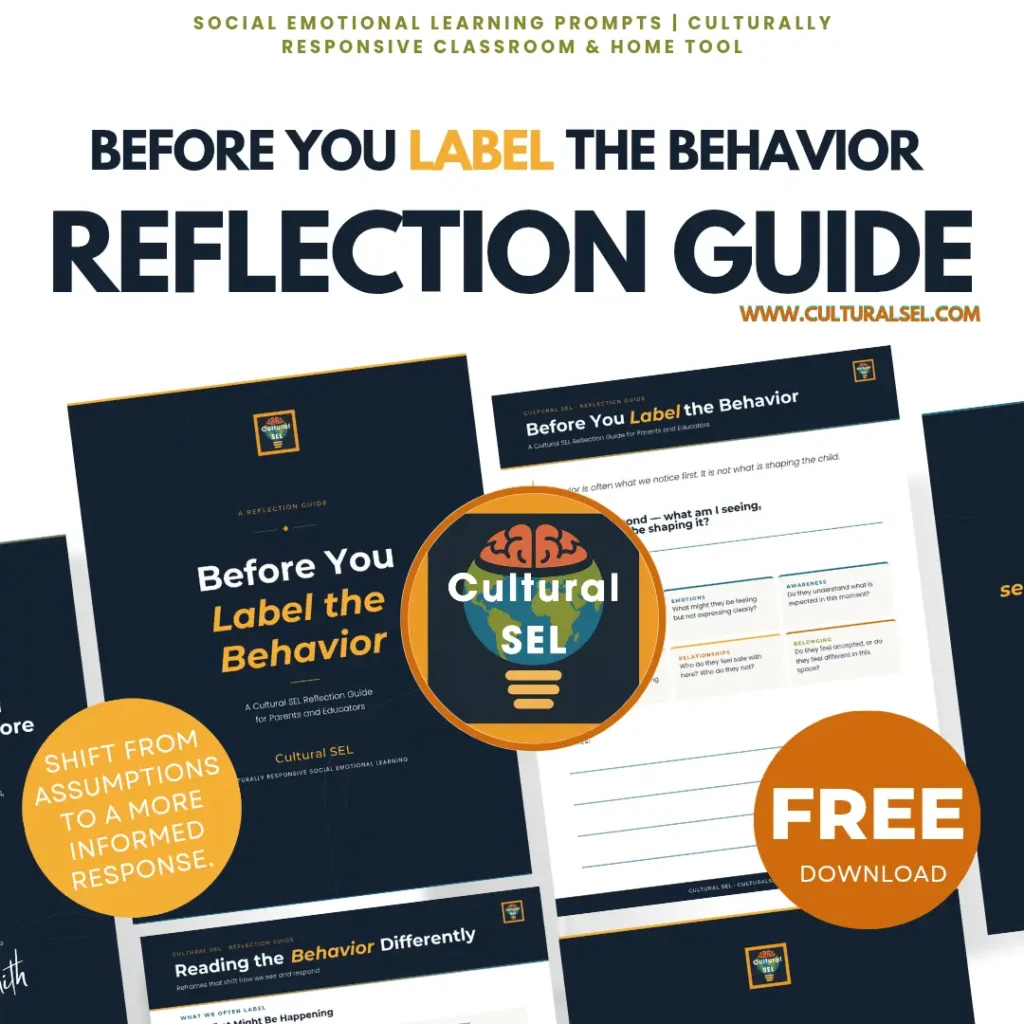
What if the behavior isn’t the whole story?
A free reflection guide that explores what may be influencing a child’s behavior before it is labeled, corrected, or misunderstood.
Avoiding a Diagnosis Does Not Stop Your Child From Being Labeled
Refusing to put a name on a child’s struggle does not stop the child from being labeled. It just changes which label they get.
Without the diagnosis, a child does not get called “a kid who needs support.” They get called lazy. Difficult. Hard to work with. Not paying attention.
Those informal labels form the same way any behavior label forms in school, through adult interpretation, not through the child’s actual needs.
These labels come with no services attached. No accommodations. No plan. No paper trail if the school gets it wrong.
A diagnosis brings a label that comes with protection attached. Cultural SEL looks closely at that gap, between the fear of the label and the cost of going without one.
Why Families Hesitate To Get A Diagnosis
This fear comes from what happens once a child enters a system that decides which label they get and why.
Race is one place where that system has been tracked closely enough to show a clear pattern.
School identification does not move in one direction. Research tracking disability identification in U.S. schools has found that Black students are identified faster and more often for categories like emotional disturbance and intellectual disability, categories that come with stigma and often lead toward discipline instead of support.
One common diagnosis in that group is oppositional defiant disorder, ODD, a pattern of anger, arguing, and defiance toward adults in authority.
At the same time, the same students are identified less often for categories like specific learning disability or speech and language impairment, the categories that come with the most academic support and the least stigma.
The U.S. Department of Education requires states to track this pattern every year under federal disproportionality monitoring.
The fear a parent feels walking into that meeting comes from pattern recognition. The system has, in documented ways, been more willing to hand out the label that limits a child than the label that helps one.
Diagnosis Avoidance Is Not Only About Race
Even though I was schooled in the German school system, I write from inside the American school system because that is where I am raising our children now.
This is not only a story about race in American schools. Families everywhere have a different relationship with institutions asking for information about their child.
Research on immigrant families shows the same pattern across ethnicities and countries of origin.
A family’s trust in the system, their comfort with the language being used, and their history with documentation and authority all shape whether they walk through the door for an evaluation at all.
Some families walk in expecting a door to open. Others walk in expecting a door to close on them later.
At a parent summit, I heard the split. Some parents saw a diagnosis as protection, the thing that gets their kid support.
Others saw it as a weapon, something used against families like theirs before, so they avoided it even when their child needed it.
Both groups were talking about the same paperwork, reacting to two different histories.
Shop Our Culturally Responsive SEL Resources
Digital Cultural SEL resources for parents, caregivers, educators, community professionals, and children.
Explore practical tools, guides, reflection resources, and activities focused on social and emotional development, cultural environments, identity, belonging, relationships, lived experiences, and behavior.
What To Ask Before You Accept A Label
Advocacy means knowing what to ask before the process decides for you.
Bring these questions into the meeting. Two terms come up often in these conversations: a 504 plan, which gives a child access like extra time or a different seat, and an IEP, short for Individualized Education Program, which provides direct special education services and goals.
- Which category are you proposing for my child, and why that one instead of another? A real answer names specific behaviors, work samples, or test results tied to that category. A dodge sounds like “this is just what we typically see with kids like this,” with nothing behind it.
- What happens if I decline the evaluation? What does my child lose access to? A real answer lists the exact accommodations or services tied to that specific category, not a general reassurance that things will be fine either way. If the answer stays vague after you ask twice, put the question in writing and ask for a written response.
- What is the difference between what a 504 gives my child and what an IEP gives my child? This is also covered in Disability, Emotional Regulation, and Cultural Understanding in Social-Emotional Learning. Ask a follow-up too: if a 504 stops being enough, what is the process for moving to an IEP, and who makes that call.
- Can you explain your reasoning in plain language, without the acronyms? A real answer walks through the actual evidence, attendance records, teacher notes, a specific assessment, not the same term repeated in a different sentence. If the explanation only restates the label, ask what observation led to it.
- What does the data say about students like mine in this specific category? Schools are required to track this. Ask for your own district’s numbers on this specific category, not a general statement that bias does not happen there.
- What gets written down if we disagree today, and how do we revisit this later? A category is not permanent. Ask what triggers a review, and get the timeline in writing before you leave the room.
You do not need to accept a label, or fear it, to ask why this one is being placed in front of you instead of another.
What Your Child Loses While Adults Decide
Most parents already know better than to trust the system blindly. But the choice is not only the parent’s to make.
Schools decide which categories to offer, and decide how quickly, and the data already shows schools do not offer those categories at the same rate to every group of students.
A child can go without support because a parent hesitates, because the school never offered the category that would have helped, or because a parent accepts whatever category is offered without knowing there was another one to ask about.
A label without a 504 or an IEP attached to it still follows a child, just as a character flaw instead of a diagnosis.
That happens whether a parent declines the evaluation or a school proposes the wrong category to begin with.
Either way, the child goes without the accommodations and services that could have helped.
FAQ: Avoiding a Diagnosis for Your Child
What is the difference between a 504 plan and an IEP?
A 504 plan gives a child access, things like extra time or preferential seating. An IEP provides special education services and academic goals, and is used when a child needs more direct instruction and support, not only access.
Why do some families avoid getting a diagnosis for their child?
Many families have seen labels used against people like them before, through school discipline, stigma, or lowered expectations. That history makes the decision to get a label feel risky, even when the child needs support.
Does refusing an evaluation protect my child from being labeled?
No. A child without a diagnosis still gets labeled. The label just becomes informal, unprotected, and often about character instead of need.
Can I ask the school to explain why they are proposing one category instead of another?
Yes. You can ask which category is being proposed, why that one, and what the data shows for children in that category. You are allowed to ask before you agree to anything.
CONTINUE EXPLORING CULTURAL SEL
Explore free Cultural SEL guides, culturally responsive SEL tools, and practical resources for understanding how cultural environments, identity, belonging, relationships, and lived experiences connect with children’s social and emotional development.
📌 Save or share this post with someone who is raising, teaching, or guiding children.

Hi, I’m Faith, the creator of Cultural SEL
I create practical tools and resources that support children’s social and emotional development and help parents, caregivers, educators, and community professionals look beyond behavior labels.
My work focuses on how cultural environments, identity, belonging, relationships, and lived experiences shape what children experience and how adults interpret and respond.
Read more about Faith and Cultural SEL: https://culturalsel.com/about
Join the Cultural SEL community: https://culturalsel.com/fb