How Culture Shapes Body Safety, Puberty, and Boundary Conversations With Children
Many adults already know the facts about puberty and body safety. They understand that children need accurate information, that body parts have correct names, and that children should know what safe and unsafe touch means.
Those conversations still feel difficult in many families. Family rules, religion, modesty norms, language, gender expectations, and personal history all shape what feels appropriate to discuss, when to discuss it, and who is expected to lead it.
Body safety, as used here, means helping children understand that their body belongs to them, what private parts are, what touch is acceptable, and how to ask for help.
Boundaries are the limits children can set around touch, privacy, and permission. Both are social and emotional skills, not just health topics, because they shape how children understand themselves, relate to others, and navigate different environments.
Family rules, religion, modesty norms, gender expectations, language, and personal history all shape what feels normal, rude, scary, or off-limits when these topics come up.
Once that cultural layer is visible, adults can respond with more intention.
FREE DOWNLOAD · REFLECTION GUIDE
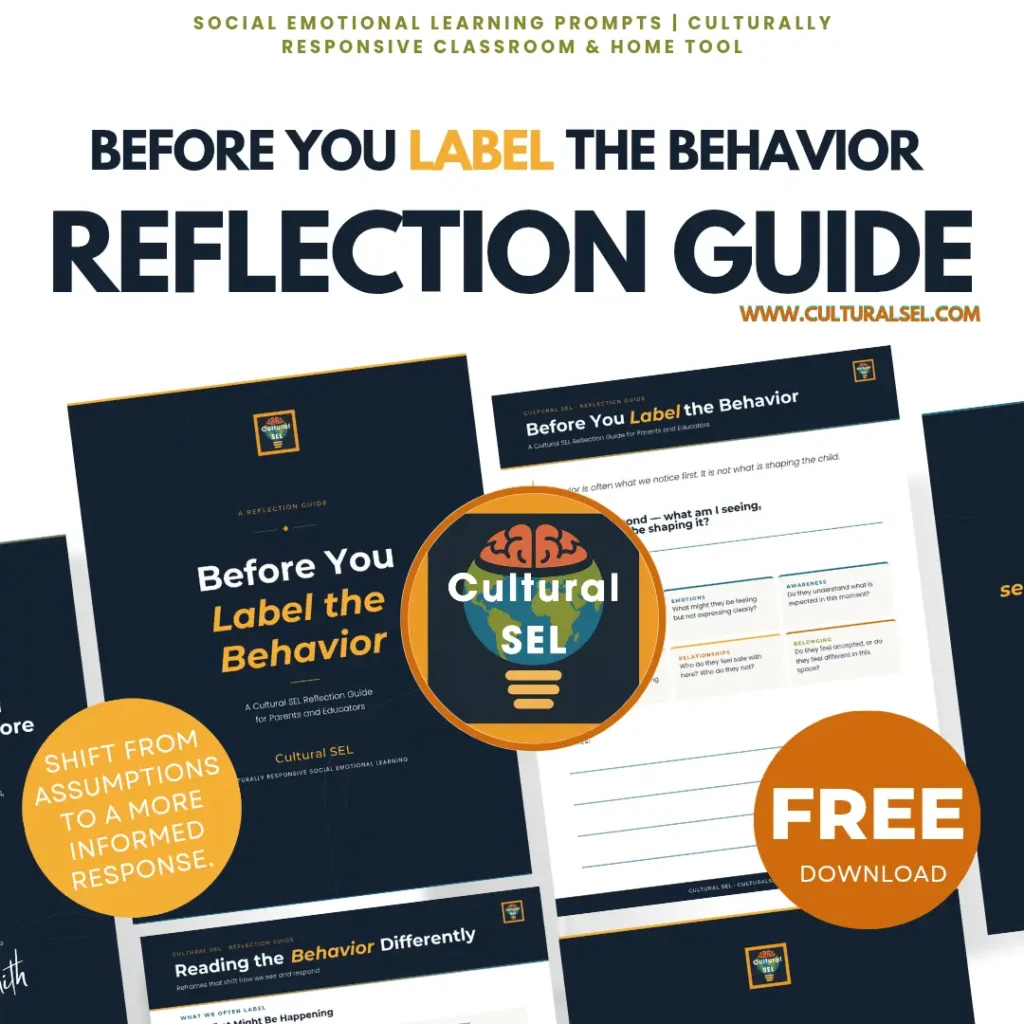
What if the behavior isn’t the whole story?
A free reflection guide that explores what may be influencing a child’s behavior before it is labeled, corrected, or misunderstood.
How Culture Influences Body Safety and Puberty Conversations
Culture shapes what gets discussed, what gets avoided, who is allowed to say it, and when. These patterns show up before any formal conversation happens.
How Privacy and Modesty Norms Shape What Gets Said
In some homes, nudity around small children is ordinary, but direct talk about puberty feels awkward.
In others, bodies are covered early, and questions are answered plainly. Some families speak openly at home but expect more reserve in public. Others keep the entire topic private across every setting.
That difference matters because a child’s need for information does not disappear when adults feel uncomfortable with the subject.
What varies is the cultural frame around the conversation, not the child’s need for it.
How Religious and Generational Beliefs Affect When These Talks Happen
Religious beliefs, family honor, gender roles, and generational habits shape when these conversations happen and how they sound.
Some families wait until a first period or voice change. Some separate boys’ and girls’ talks entirely. Some leave it to schools, aunties, uncles, or older siblings.
Children often learn the family’s attitude toward these topics before they learn any facts.
They pick up what causes tension, what gets whispered, and what shuts a conversation down long before anyone explains what puberty is.
How Childhood Experiences Shape Adult Responses
Adults often approach these conversations through the lens of their own experiences, even when they believe they are making a free choice.
How Growing Up Without These Conversations Affects Adults Now
Many adults learned about puberty through rumors, jokes, or panic. Nobody named body parts clearly.
Nobody explained why bodies change. Friends filled gaps with wrong information, and shame settled in early without anyone naming it as such.
Years later, a child asks why they need deodorant or what the pads in the bathroom cabinet are for, and the old discomfort returns.
The adult hesitates not because they lack the facts, but because their history with the topic still shapes their response.
Growing up between Ghanaian and German influences, I noticed early how differently the same topic could be handled depending on where I was.
Some subjects were approached directly in one setting and treated as too delicate in another.
Silence carried different meanings depending on context. Becoming a parent sharpened that observation.
What looked like protection in one setting sometimes turned out to be avoidance. Children can feel that difference even when adults cannot yet name it.
Why Children Need Accurate Information Earlier Than Before
Children encounter information about bodies, puberty, and sex earlier than most adults expect, and they are not waiting for a formal conversation.
How Children Encounter Body and Puberty Information Before Adults Realize
Children hear things on school buses, see bodies in the media, search for answers online, and absorb information from older peers without a filter for context.
Friends and social platforms fill gaps quickly, and much of that information is wrong, distorted, or framed for shock.
Curiosity also starts earlier than adults often anticipate. A child notices shaving, period products, pregnancy, locker room talk, or a sibling’s changing body.
Once they have heard or seen something, you cannot rewind it. You can only help them sort it out.
That sorting goes better when a trusted adult is part of it. How children express curiosity and what questions they feel safe asking is also shaped by emotional expression norms in the home.
Cultural SEL’s post on emotional expression across cultures explains how those norms develop and what they mean for children’s access to adult support.
Why Trusted Adults Should Be the First Source
Children do better when a trusted adult is the first place they bring questions about bodies and boundaries.
Why Repeated Small Conversations Build More Trust Than One Big Talk
This rarely happens in a single comprehensive talk. It develops through small exchanges that are calm, honest, and appropriate to the child’s age.
A five-year-old does not need the same answer as a ten-year-old, but both need a clear one.
Consistency across multiple small conversations tells children that the subject is not off-limits and that you are someone they can return to.
Silence Redirects Children to Other Sources
When adults stay quiet, children still go looking. They ask peers, watch videos, pick up partial or distorted language, or decide the topic must be shameful because no one will touch it.
Once that pattern is in place, the trusted adult is no longer the first filter on new information.
That is why openness matters more than perfect wording. A clear, brief answer now keeps the door open for harder questions later.
How Body Safety and Boundaries Connect to Social and Emotional Development
Body safety is not only about preventing harm. It also builds social and emotional skills children use in relationships, classrooms, and community spaces every day.
Boundaries Teach Respect and Self-Advocacy
When children learn about personal space, private parts, and permission, they learn that people have limits and that their own limits are worth stating.
The phrases that come from body safety practice are also relationship skills.
“I do not want a hug.”
“Please stop.”
“I need help.”
Children who can name unsafe situations are more likely to seek help. Children who have practiced saying no are less likely to freeze when something feels wrong.
That self-advocacy does not develop from one conversation. It develops when adults consistently honor the limits children express and give them language to do so.
For a broader look at how this connects to family culture, see Cultural SEL’s post on culturally responsive parenting and emotional expression.
Consent Starts in Ordinary Moments
Consent does not begin in adolescence. It starts with simple daily interactions.
“Do you want help with your hair?”
“Can I carry you?”
“Ask before touching the baby.”
These moments teach children that choices matter, that other people’s bodies have limits too, and that asking is a sign of respect, not weakness.
Emotional Safety Shapes What Children Will Ask
Children need to feel safe asking questions, safe admitting confusion, and safe seeking help.
When they expect to be laughed at, punished, or dismissed, they stop asking. That silence does not mean the questions went away. It means the child decided you were not the right person to ask.
Emotional safety allows children to learn without shame. It tells them that questions are welcome and that trusted adults can help them make sense of what they are experiencing.
In a culturally responsive framework, this matters even more because a child’s sense of safety around these topics is shaped by identity, language, family rules, and the environments they move through.
When Body Safety Expectations Differ Across Environments
Children move between settings with different expectations around bodies, privacy, and permission.
Home may have one set of expectations. School may have another. A grandparent may expect something different than a parent.
Online spaces may introduce ideas that do not match any of the above. A child taught not to question adults in one setting may be encouraged to speak up in another.
A child raised with one understanding of physical affection may encounter very different norms at school or in a community space.
This creates real confusion, especially for younger children who are still learning which rules apply where and why.
Helping children understand that different environments have different expectations gives them the language to describe what they are experiencing.
It also creates opportunities to name which safety rules stay constant regardless of the setting. Those rules need to be said clearly, not assumed.
Children are not being inconsistent when they adjust to different expectations. They are responding to the environment they are in.
A child may speak differently with grandparents than with classmates, follow different rules at home than at school, and show different levels of comfort discussing personal topics depending on the adults around them.
Understanding that adaptation helps adults respond to children more accurately instead of assuming confusion, disrespect, or defiance.
How Cultural Self-Awareness Improves These Conversations
Before answering a child, it helps to know what is already speaking inside you.
How to Recognize the Cultural Messages You Carry About Bodies
What messages did you absorb about modesty, obedience, gender, privacy, and silence around bodies?
Many adults parent and teach through those messages without ever examining them.
They say “we do not talk about that” before they have thought about why, or they delay a conversation until it no longer feels necessary, when in fact the child has already found another source.
Once those inherited messages are visible, adults can make clearer choices about what they want to pass on and what they want to handle differently.
Holding Values Without Adding Shame
Families can keep their values and still give children what they need. You can value privacy and still teach correct body terms.
You can hold religious beliefs and still answer a child’s question directly. You can prefer modesty and still explain what puberty involves before it begins.
This matters especially for children moving between home, school, community, and online spaces where the rules are not consistent.
Children need a clear internal framework. Adults provide that by being honest about what they believe and clear about what safety requires, regardless of the setting.
Common Challenges Parents Face With These Conversations and What Helps
Even adults who understand why these conversations matter run into the same obstacles across families and cultures.
| Challenge | Why It Happens | What Helps |
|---|---|---|
| Feeling unprepared | Adults did not receive clear language themselves growing up | Start with one honest sentence, then invite the next question |
| Not knowing when to begin | Adults wait for a single right moment that never arrives | Start when the child shows curiosity, then build gradually |
| Conflicting views at home | Parents, elders, or faith traditions do not align | Agree on shared priorities first: safety, respect, and accurate information |
| Worrying about giving too much information | Adults fear taking away innocence | Answer the question the child actually asked, not the larger lesson |
| Questions at awkward times | Children ask when something catches their attention | Give a short answer in the moment and return to it later |
Most of these challenges ease once adults stop waiting for perfect timing and perfect wording. A brief, calm response builds more trust than a prepared speech delivered after a long delay.
Practical Ways to Start Body Safety and Puberty Conversations
Starting does not require a speech. It requires consistent habits across ordinary moments.
Use everyday openings. A pregnancy announcement, the deodorant aisle, a scene in a show, or a question from a younger sibling can all naturally lead to a short, calm exchange.
Keep answers simple and direct. “Bodies change in puberty” is enough for a first answer. The follow-up question tells you how much more the child is ready for.
Use correct names for body parts. Clear language reduces confusion and gives children the words they need to accurately describe discomfort or ask for help.
Teach safety without fear. The goal is awareness, not anxiety. Most people are trustworthy. Children still need to know the difference between safe and unsafe situations and to know they can come to you.
Welcome questions without judgment. If a child asks something loudly in a public place, answer briefly and say you will talk more later. Following through matters.
Return to the topic. Repetition tells children the conversation is still open and that they can bring up new questions as they come up.
Body Safety Conversations in Multicultural Families
These conversations can become more complex in multicultural homes. One parent may prefer direct language.
The other may want more privacy around the topic. Grandparents may expect silence.
Children notice all of it, particularly in immigrant, mixed-cultural, or multilingual households where expectations shift depending on who is in the room.
The most useful starting point is shared family values. Most adults agree on the basics: safety, respect, honesty, and dignity.
Start from that common ground. Then explain to children that different families handle these topics differently, and that your family’s approach is based on those shared values.
Children can hold more than one cultural perspective at once when adults give them the language and context to do so.
Communication style carries weight here, too. Some cultures value directness. Others approach sensitive topics indirectly or through example.
Children typically need more clarity than adults assume. When in doubt, a direct, calm sentence is more useful than a hint they may not recognize.
How to Build a Family Culture Where These Conversations Can Happen
A family culture where body safety conversations are possible is not built in one talk.
It is built through repeated small signals that questions are welcome, that confusion is not shameful, and that adults will not react with embarrassment or punishment when children bring something forward.
That tone creates a foundation for future relationships and conversations.
Children who can name how they feel, say what they need, and state a limit clearly are better prepared to navigate friendships, peer relationships, and eventually adult life.
They grow into people who know their bodies have value and that other people’s bodies do, too. Those are social and emotional skills. Culture shapes how they are learned.
What to Reflect On Before the Next Conversation
Culture shapes these conversations before the first question is ever asked. Childhood experience shapes adult reactions in the moment.
Children need clear, age-appropriate information, and the trust that makes it possible to ask for it is built across many small exchanges over time.
Start with one reflection tonight:
What message about bodies and boundaries did I inherit, and what message do I want my child to hear from me instead?
That question does not need a complete answer before you begin. It just needs to be asked.
CONTINUE EXPLORING CULTURAL SEL
Explore free Cultural SEL guides, culturally responsive SEL tools, and practical resources for understanding how cultural environments, identity, belonging, relationships, and lived experiences connect with children’s social and emotional development.
📌 Save or share this post with someone who is raising, teaching, or guiding children.

Hi, I’m Faith, the creator of Cultural SEL
I create practical tools and resources that support children’s social and emotional development and help parents, caregivers, educators, and community professionals look beyond behavior labels.
My work focuses on how cultural environments, identity, belonging, relationships, and lived experiences shape what children experience and how adults interpret and respond.
Read more about Faith and Cultural SEL: https://culturalsel.com/about
Join the Cultural SEL community: https://culturalsel.com/fb