Disability, Emotional Regulation, and Cultural Understanding in Social-Emotional Learning
A student melts down during group work. Another never joins, even when they want to.
A family seems to “disagree” with supports that the school thinks are basic. If you teach or lead SEL, these moments can feel personal, confusing, and urgent.
This post connects three areas that are often taught separately: disability inclusion, emotional regulation, and cultural understanding in social-emotional learning.
You’ll get clear ways to plan lessons, respond to behavior, and partner with families without guessing what’s “really going on.”
You don’t need perfect words. You need practical moves that protect dignity and help kids build skills.
FREE DOWNLOAD · REFLECTION GUIDE
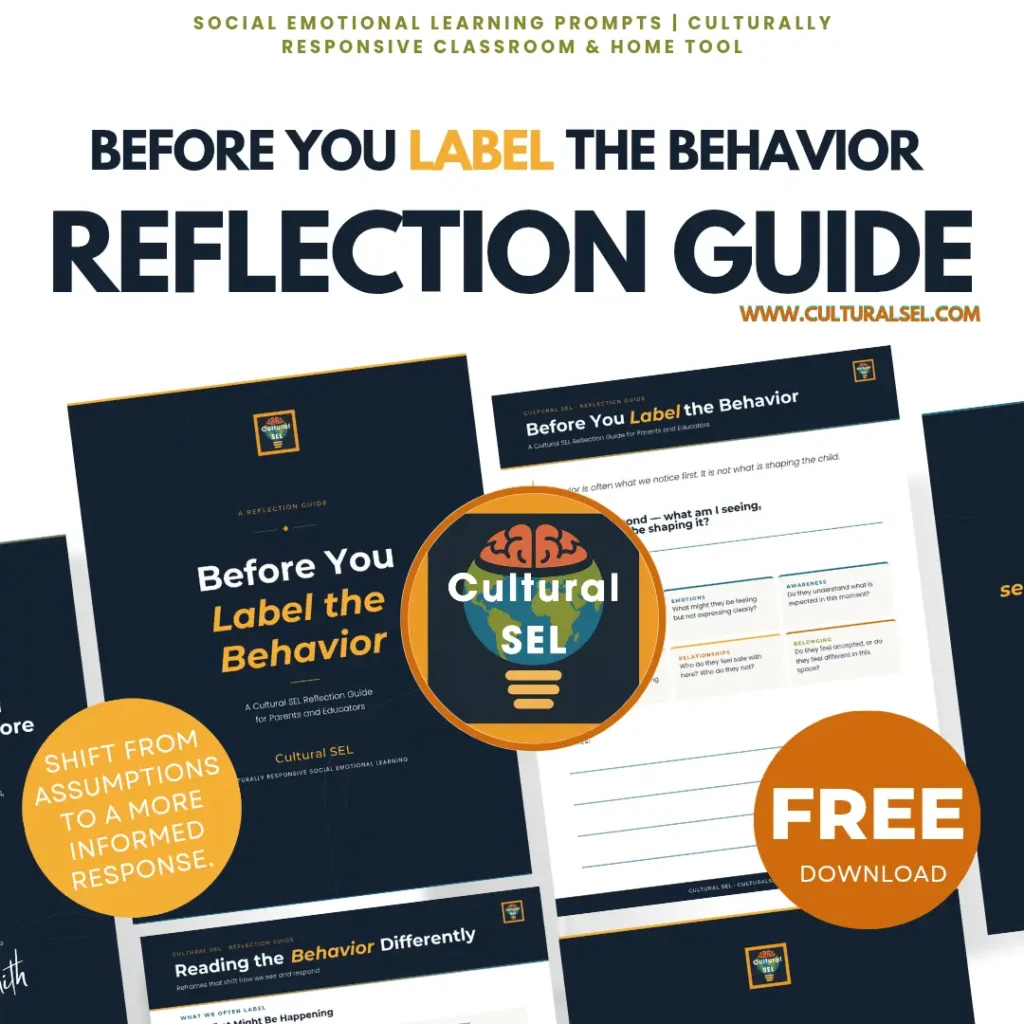
What if the behavior isn’t the whole story?
A free reflection guide that explores what may be influencing a child’s behavior before it is labeled, corrected, or misunderstood.
Social-Emotional Learning Includes Diverse Development Paths
SEL works best when it assumes learners develop skills on different timelines. That includes students with disabilities, students learning in a second or additional language, and students with trauma histories.
When SEL lessons rely on one “right” way to talk, sit, write, or share, some students lose access before the lesson even starts.
Ableism is prejudice, discrimination, or assumptions that treat nondisabled ways of functioning as the expected or preferred standard.
It can affect children with apparent and non-apparent disabilities.
When a disability is not immediately visible, adults may be especially likely to interpret a child’s communication, movement, regulation, participation, or need for support as defiance, refusal, disengagement, or another behavior problem before recognizing that disability may be part of the context.
A simple planning shift helps: teach one skill, then offer multiple ways to show it.
For example, a lesson on identifying feelings can include speaking, pointing to a visual, writing, or using a device. Children are still working on the same skill, but they may participate in different ways.
Access and Participation Supports in Everyday Social-Emotional Learning
Access is not only ramps and wide doorways. It also means access to participation, voice, and time.
I’ve seen a student with sensory needs get disciplined for covering their ears when the room was too loud to stay regulated, and when we added headphones and a quiet signal, the student stayed in the lesson and responded without shutting down.
- Extra processing time helps students who freeze under pressure.
- Visual supports help students who struggle to name emotions quickly.
- Predictable routines help students who worry about surprises.
- Offering a choice of response formats helps students with fine-motor or speech needs.
Example: During a class meeting, a teacher offers three ways to share. Students can talk, hold up an emotion card, or write a one-sentence response. A student with a speech disability participates every time, without being singled out.
Emotional Disabilities Affect Emotional Regulation and Behavior Responses
Some students have emotional disabilities (or disability-related needs) that affect mood, impulse control, and stress tolerance.
In SEL, these students may understand a strategy but still struggle to use it in the moment. That gap often looks like “refusing,” “arguing,” or “overreacting.”
Skill building still matters, but the teaching has to be more direct and more practiced. Short practice, repeated often, beats a long lesson once a month.
Teach Regulation as a Routine, Not a Rescue
Build regulation practice into calm parts of the day. Then, when a student escalates, you can cue the routine instead of inventing a new plan.
Try a simple sequence:
- Name the body signal (“Your hands are tight.”)
- Name the feeling (offer two options)
- Choose one tool (two choices only)
- Return plan (“Then we do the first two problems together.”)
Example: A student shouts when they lose a game. The adult says, “I hear yelling. Pick one: five wall pushes or a water break.”
After the break, they practice a short script: “I’m mad, I need a redo.” Over time, the student learns a replacement response that keeps them included.
When a child can’t regulate yet, the adult’s calm voice and clear choices act as the “training wheels” for regulation.
Physical Disabilities Influence Classroom Participation and Independence Skills
Physical disabilities can affect stamina, movement, writing, and access to materials.
In SEL activities, barriers appear quickly: sitting on the carpet, moving to partner spots, writing long reflections, or using small tools.
If the barrier stays in place, the student may appear “disengaged” while working twice as hard just to participate.
SEL can support independence, but it should not confuse independence with doing everything alone. Many students build independence through the right supports.
Plan Participation Without Making a Student Ask
A good rule: if a student has to request access repeatedly, the plan is not working yet.
Consider these supports during SEL:
- Seating options that keep the student in the group, not apart from it
- Materials within reach, or assigned classroom helpers for passing items
- Alternatives to hand-writing (speech-to-text, sentence starters, drawing, checkboxes)
- Extra time for transitions, with a clear signal before the group moves
Example: In a lesson on conflict resolution, students role-play. A student using a wheelchair can’t move into the center quickly.
The teacher assigns roles from seats and uses a “talking object” that gets passed. The student leads the script from their spot, and peers adjust naturally.
Here’s a quick way to match common barriers with SEL-friendly supports:
| Need That May Show Up in SEL | What It Can Look Like | Support That Keeps the Goal Intact |
|---|---|---|
| Fine-motor limits | Avoids writing reflections | Choice: dictate, draw, or use sentence frames |
| Mobility or stamina | Arrives late to circles | Pre-set spot, early transition cue, peer runner |
| Fatigue or pain | Shuts down mid-activity | Shorter task, break card, chunked directions |
| Assistive tech use | Slower responses | Wait time, preview questions, partner note-taker |
The takeaway: you can keep expectations high while changing the format.
Mental Health Conditions Affect Attention, Stress Response, and Learning Readiness
Mental health conditions in children and teens can affect sleep, attention, motivation, and stress response.
Some students appear “checked out.” Others become perfectionistic and panic when tasks feel unclear. SEL can help, but only when it respects a student’s readiness.
A student can’t reflect well when their nervous system is on alert. Start with safety and predictability, then teach the skill.
Small Supports That Reduce Stress Fast
Many supports cost nothing and help many students. They also reduce shame because they look like normal classroom routines.
- Brief check-ins (private when possible)
- Clear start and end points (“First we list, then we choose one.”)
- Advanced notice before sharing or partner work
- Calm-down spaces with a return plan, not a time-out vibe
Example: A student with anxiety refuses presentations. The teacher offers a three-step ladder: record audio, present to one trusted adult, then present to a small group.
Each step includes the same SEL skill: noticing worry, using a coping tool, and reflecting afterward. Progress becomes visible and steady.
Cultural Beliefs Influence How Disability and Support Needs Are Interpreted
Culture shapes how families name disability, how they view behavior, and when they seek outside support. Some families trust schools deeply.
Others have reasons to be cautious. In some communities, disability talk feels private. In others, extended family plays a central role in decisions.
These differences can create misreadings. A school may see “non-compliance.” A family may see respect, protection, or fear of labeling.
Build Shared Meaning Before You Build a Plan
Start with curiosity and clarity. Use plain language. Avoid acronyms unless you explain them. Ask what families notice at home and what helps.
Helpful prompts:
- “What do you call this at home?”
- “When do you see your child most calm?”
- “What worries you about support at school?”
- “Who should be part of decisions?”
Example: A caregiver avoids the word “disability” and declines counseling. Through an interpreter, the school learns the family fears stigma in their community.
The team reframes the plan as skill support, shares what will and won’t go on records, and offers a meeting with a trusted community liaison. The student receives help without the family feeling pushed.
Behavior Expectations and Safety Structures Support All Learners
SEL lessons don’t replace behavior systems. Students need clear expectations, steady routines, and safe responses when things go wrong.
That matters even more when disability affects impulse control, sensory needs, or communication.
Behavior expectations work best when they are teachable and observable. “Be respectful” is vague. “Use a quiet voice during independent work” is teachable.
Make Safety Plans Clear, Simple, and Practiced
A strong structure answers three questions:
- What do we do before a problem starts?
- What do we do during escalation to keep everyone safe?
- What do we do after to repair and learn?
Example: A student becomes aggressive during transitions. The team changes the schedule, adds a two-minute warning, and teaches a hallway routine with practice runs.
During escalation, adults use fewer words and increase space. Afterward, the student completes a short repair: a note, a reset plan, and a quick practice of the replacement skill.
A predictable response reduces power struggles because students stop testing where the line is.
Family and School Collaboration Strengthens Emotional Skill Development
SEL works when adults use the same language across settings. That doesn’t mean families should copy school routines.
It means the school should share simple tools, listen to what works at home, and agree on a few shared goals.
Collaboration also protects students from mixed messages. If school focuses on “use your words” but home values quiet respect, a student may feel trapped. Shared goals can honor both.
Keep Collaboration Concrete and Time-Respectful
Families are busy. Meetings can feel intimidating. Make communication short, clear, and action-based.
One helpful pattern:
- Share one strength you see.
- Name one challenge in plain language.
- Offer two support options.
- Ask what feels realistic at home.
Example: A student tears up papers when frustrated. The school teaches “help” signals and a two-choice break routine.
The family shares that music calms the child. The teacher adds a two-minute headphone option during tough tasks.
The student uses the same “help” signal at home during homework. Progress shows up within weeks.
Inclusive Social-Emotional Learning Builds Long-Term Belonging and Confidence
Inclusive SEL changes peer culture. Students learn to notice needs without teasing, to offer help without pity, and to accept differences without making them a spectacle.
Belonging grows from daily moments: who gets picked, who gets listened to, who gets leadership roles.
This matters beyond school. In early 2026, disability employment rates stayed near record highs (38.1% employment-to-population ratio in February 2026), based on monthly data from the U.S. Bureau of Labor Statistics.
That progress connects to many factors, including access and skills. Social-emotional skills like self-advocacy, emotion management, and communication support long-term participation in work and community life.
Make Belonging Visible in Your SEL Routines
Inclusion shows up in what you normalize.
- Use stories and examples that include disability as part of life.
- Teach peers how to offer support (ask first, respect “no,” don’t grab devices).
- Rotate classroom jobs so students with disabilities lead, not only receive help.
- Practice self-advocacy scripts (“I need more time,” “Please face me when you speak.”)
Example: During a lesson on empathy, a student explains how loud noise affects them.
The class practices a quiet signal and agrees on headphone-friendly times. The student gains control, and peers gain a real-world empathy skill.
FAQ: Disability, Emotional Regulation, and Culturally Responsive SEL
What is culturally responsive social-emotional learning?
Culturally responsive SEL teaches skills while respecting students’ identities, languages, and family values. It includes materials students recognize, avoids “one right way” to show emotion, and builds partnerships with families.
What is ableism in social-emotional learning?
Ableism in social-emotional learning is when nondisabled ways of communicating, moving, regulating emotions, participating, or showing independence are treated as the expected standard. It can affect how disabled children are interpreted, which behaviors are corrected, and whether adults change the environment or expect the child to adapt to it.
How do I teach emotional regulation to kids with disabilities?
Teach one tool at a time, practice it during calm moments, and use visual cues. Keep choices limited during stress. Track what helps each student return to learning, then repeat that routine.
What is the difference between an IEP and a 504 plan?
An IEP (Individualized Education Program) provides special education services and goals. A 504 plan provides accommodations for access. Schools decide eligibility through a formal process, and families are part of the team.
How should schools respond to disability-related behavior without shame?
Use clear expectations, describe what you see, and offer a next step the student can do. After the moment passes, teach the missing skill and plan for the next trigger. Public call-outs and sarcasm often increase stress and repeat behavior.
How can I talk with families about disability when cultural beliefs differ?
Start with what the family observes and values. Use plain language, offer interpreters, and ask permission before using labels. Agree on shared goals, then pick supports that match those goals.
“Disability in SEL is not a barrier to learning, but a call to teach differently so every child can participate and be understood.”
Disability inclusion in SEL works when support is planned, not improvised. Emotional regulation grows through practice, co-regulation, and clear routines.
Cultural understanding improves when schools ask, listen, and explain without pressure.
Pick one routine from this post and use it for two weeks. Write down what changes, even small ones.
Inclusive, culturally responsive SEL builds belonging through daily decisions, and students notice every one.
CONTINUE EXPLORING CULTURAL SEL
Explore free Cultural SEL guides, culturally responsive SEL tools, and practical resources for understanding how cultural environments, identity, belonging, relationships, and lived experiences connect with children’s social and emotional development.
📌 Save or share this post with someone who is raising, teaching, or guiding children.

Hi, I’m Faith, the creator of Cultural SEL
I create practical tools and resources that support children’s social and emotional development and help parents, caregivers, educators, and community professionals look beyond behavior labels.
My work focuses on how cultural environments, identity, belonging, relationships, and lived experiences shape what children experience and how adults interpret and respond.
Read more about Faith and Cultural SEL: https://culturalsel.com/about
Join the Cultural SEL community: https://culturalsel.com/fb