Why Representation Doesn’t Equal Understanding of Race and Culture
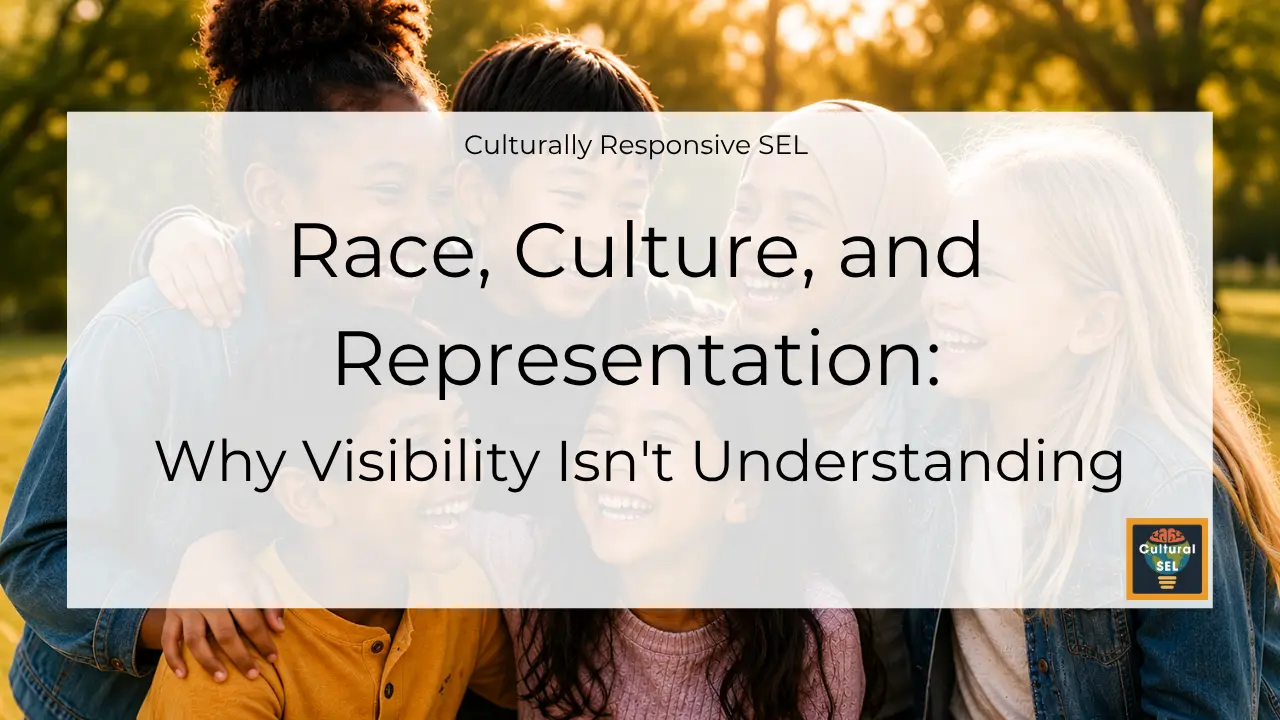
Children notice who appears in books, classroom materials, leadership positions, movies, and community spaces. They also notice who does not.
That pattern of absence became hard to ignore. And for many adults raising, teaching, or guiding children, working to change it felt like the right response.
More diverse books on shelves. More diverse characters on screen. More attention paid to whose stories were being told.
What often gets overlooked is that race, culture, and representation are not the same thing. Race describes how people are socially categorized.
Culture describes how people communicate, celebrate, understand family, and make sense of daily life.
Representation describes who is visible in books, media, leadership, and public spaces. Those three things overlap, but they do not substitute for each other.
When adults treat them as though they do, a familiar appearance becomes a substitute for actual understanding.
A child can see someone who looks like them and still feel misunderstood. Adults can increase representation in every space they touch and still be operating from assumptions.
FREE DOWNLOAD · REFLECTION GUIDE

What if the behavior isn’t the whole story?
A free reflection guide that explores what may be influencing a child’s behavior before it is labeled, corrected, or misunderstood.
Why Representation Became Such a Big Conversation
Representation became a major conversation because people noticed what was missing.
Children noticed when no one in a book shared their background, family structure, name, or experience.
Families noticed when leadership rarely reflected the communities being served. Communities noticed when certain stories appeared repeatedly while others remained invisible.
Representation became a response to those absences. When a child sees a character, teacher, or family that reflects part of their identity, a space can feel more welcoming and accessible. That is not a small thing.
Representation is about creating conditions in which people can imagine themselves within a space. It answers the question: Is there room here for someone like me?
Visibility matters, but people also want to know whether they will be understood once they enter that space.
The Difference Between Race, Culture, and Representation
Race, culture, and representation are often discussed as though they describe the same thing: They do not.
Race is a social category tied to visible traits and historical patterns of classification.
It shapes how people are perceived by others, how institutions have treated groups over time, and how people are positioned socially.
It does not tell us about a person’s family, language, traditions, beliefs, or lived experiences.
Culture is different. Culture includes how people celebrate, communicate, understand family, express emotions, observe faith, define respect, and make sense of daily life.
It is shaped over time through families, communities, faith spaces, and lived environments.
Two people may share a racial identity and grow up with entirely different cultural practices, languages, and expectations.
Representation is about visibility. It answers: who appears? Whose image shows up in books, media, leadership, classrooms, and public life?
| Term | What It Describes | What It Cannot Tell You |
|---|---|---|
| Race | How people are socially grouped, often through visible traits and historical categories | A person’s language, traditions, values, family experiences, or beliefs |
| Culture | Shared customs, communication styles, traditions, values, and ways of understanding the world | The complete story of an individual |
| Representation | Who is visible in media, books, leadership, schools, and public spaces | Whether those individuals are understood accurately |
Race, culture, and representation overlap, but they do not substitute for each other. When adults treat them as though they do, one category gets used to make assumptions about another.
A shared racial identity becomes an assumption of shared experience. A familiar appearance becomes a substitute for actual information.
That is where understanding begins to break down.
Why Visibility Doesn’t Create Understanding
Two children can share a racial identity and grow up in entirely different worlds.
One may be raised in a household where three languages are spoken, where extended family is part of daily life, and where faith shapes the structure of the week.
Another may be raised in a small town where the family is the only one of their background, and cultural preservation happens quietly at home, away from public spaces.
A Latino child raised in a bilingual household, navigating different expectations at home and at school, is developing a skill set that the adults around them may never fully see.
Another may have moved across countries multiple times, never quite settling into one community’s expectations. Another may have been adopted into a family with a different cultural background entirely.
Those differences show up in how children communicate with adults. They shape how children respond to authority, build friendships, participate in groups, express emotions, and understand their role in a room.
None of those things is visible at first glance. Understanding requires information that appearance cannot provide.
Adults only learn that information through observation, conversation, and a willingness to let what they hear change what they assumed.
Without that process, people fill in the missing information with their own expectations. A child who communicates differently gets read as disrespectful.
A child who responds differently to authority is labeled defiant. A child adapting across cultural environments is called inconsistent.
The appearance was familiar. The interpretation was still wrong.
Same Race, Different Cultural Experience
I grew up Ghanaian in Germany. When I moved to the United States, I expected that being surrounded by more people who looked like me would mean more familiarity.
Some things felt familiar. Many did not, because the cultural experiences that shaped me were different from what people assumed.
I was still shaped by growing up in Germany. I had moved between two sets of cultural expectations for most of my life.
When people here talked about race, they were drawing from a history I had not grown up inside.
When they used cultural references I was expected to recognize, some landed, and some didn’t.
When I responded to situations in ways shaped by my Ghanaian background or my German environment, that context was not always understood by the people around me.
People could see that I was Black. They could not see what had shaped me.
Some assumed immediate shared understanding. Some were surprised when my experience was very different from what they expected. A few took the time to ask questions rather than assuming.
That difference, between someone who assumed and someone who stayed curious, changed the direction of many interactions.
Representation put me in spaces that felt more welcoming. It did not automatically make those spaces understand me. Understanding required much more.
Sharing a Race Doesn’t Mean Sharing a Story
What I experienced is not unique to my situation.
An Asian child from Seoul and an Asian child from Fiji may have different traditions, family expectations, languages, and relationships to their cultural heritage.
A Latino child from Puerto Rico and a Latino child from Peru may have different experiences of identity, immigration, and belonging.
A Black child raised in Lagos and a Black child raised in Jamaica carry different language patterns, family expectations, and cultural frameworks, even if an adult sees them as the same.
A White child raised in rural Appalachia and a White child raised in Warsaw bring entirely different cultural histories into the room.
An Indigenous child from one tribal nation carries different traditions, governance structures, and community relationships than an Indigenous child from another.
One was raised in a household where formal respect toward elders shapes every interaction. Another was raised in an environment where directness was a sign of confidence.
Both may share a racial identity. Their ways of moving through the world are not interchangeable.
Race may create an initial point of connection, but it does not explain the language, traditions, expectations, and experiences that shape a person’s life.
Every Community Holds Cultural Diversity
People often talk about communities as though everyone inside them shares the same story.
Culture is not a single story, and neither is any community within it. Every culture contains subcultures, smaller groups shaped by region, ethnicity, language, faith, and history, each with its own distinct practices and ways of organizing life.
Even within the same family, siblings may experience their shared culture differently depending on age, birth order, schooling, friendships, and how much of the family’s history was passed down to them.
This is true inside Black communities, Latino communities, Asian communities, Indigenous communities, and European communities alike.
The label names a group. It does not tell you what any individual inside that group actually carries.
Christian communities include diverse denominations, worship practices, theologies, and cultural expressions of faith.
Military families share certain patterns of experience while differing in deployment history, location, family structure, and how often they have moved.
This matters because when adults assume everyone inside a group thinks the same way, they stop gathering information.
They rely on a picture of the group instead of paying attention to the person in front of them.
The assumption is never just a harmless shortcut. It actively replaces curiosity.
Once an adult decides they already understand a person, they stop gathering information. The picture of the group fills in for the child who is actually standing there.
Where These Assumptions Show Up Every Day
In schools, assumptions about shared cultural experience often go unnamed but shape everything.
A student may be expected to understand social references that are unfamiliar to them.
A family may be grouped with other families based on appearance, only to be surprised when their actual priorities and communication styles differ from what the school expected.
A student’s communication style may get read as disrespect when it is simply a different but functional way of engaging with adults.
A child who is quiet in class may be seen as disengaged when they are operating inside a cultural expectation that listening is active participation.
In many East Asian and Southeast Asian households, attentive silence is a sign of respect, not absence. An adult who does not know that will misread what they are seeing.
In friendships, children are sometimes pushed together because adults assume shared appearance will automatically create a connection.
Sometimes it does. Sometimes, two children who look similar have less in common than adults expect, and the forced pairing creates more discomfort than a sense of belonging.
In faith communities and neighborhood organizations, people may be welcomed as members of a group while important parts of their story remain unknown. They are included in the room but not yet understood inside it.
None of these situations requires bad intent. They happen when adults treat familiar patterns as complete information.
Shop Our Culturally Responsive SEL Resources
Digital Cultural SEL resources for parents, caregivers, educators, community professionals, and children.
Explore practical tools, guides, reflection resources, and activities focused on social and emotional development, cultural environments, identity, belonging, relationships, lived experiences, and behavior.
Representation Can Open the Door, Assumptions Can Shut It
Representation can make someone feel welcome.
A child sees a character that shares part of their identity and thinks there is room for them here.
An adult notices that the space includes people who look like them and feels more willing to participate.
A family sees their traditions mentioned in a school activity and feels recognized rather than invisible.
The problem begins when adults treat that moment of recognition as the end of the conversation.
Once something appears familiar, questions can stop. Listening becomes less intentional. Adults begin responding to what they expect rather than what they are actually seeing.
A child who does not behave as the adult anticipated is interpreted through the assumption rather than through observation.
Representation opened the door. The assumption closed what was supposed to happen next.
Visibility Does Not Automatically Change Interpretation
A classroom can become more diverse while students continue to be misunderstood.
A workplace can become more representative while people continue to make assumptions about one another’s experiences.
A curriculum can include more diverse authors while still interpreting children’s behavior through a single cultural lens.
The issue is interpretation. When adults assume that shared appearance means shared experience, interpretation becomes less accurate.
The information available about a child gets replaced by a picture of a group.
That picture influences responses to behavior, communication, participation, emotional expression, and relationships.
This is the interpretation gap. Adults believe they understand what is happening in front of them. They are actually responding to what they assumed would happen.
Increasing visibility does not close that gap. Adults close it by slowing down the process of interpretation.
By treating behavior as communication rather than evidence of character. By asking what they do not know before responding based on what they assume.
How Cultural SEL Goes Beyond Representation
Cultural SEL starts where representation stops.
It asks adults to look beyond what is immediately visible and consider the factors that actually shape a child’s experience.
Culture. Family history. Language. Migration. Faith. Environment. Community relationships. Those factors do not stay constant.
They shift depending on where a child is, who they are with, and what that environment expects of them.
A child may communicate one way at home and another way at school, not because something is wrong, but because they are navigating two different sets of expectations.
Understanding that requires adults to ask questions they may not have considered before.
Instead of asking only what is happening, adults who work from a Cultural SEL framework also ask what information they might be missing.
What experiences may be shaping this child’s response? What expectations is this child navigating that I may not be able to see? What assumptions am I bringing into this interpretation?
Those questions change what adults notice. They change what gets named, what gets understood, and what kind of response a child receives.
Representation remains part of that work. Children need to see themselves reflected in the environments around them.
What they also need are adults who are willing to keep learning who they are beyond what is visible.
Why Children Need Both Visibility and Cultural Understanding
Most people want both visibility and understanding.
They are related, but they are not the same thing. A person can be visible in a space and still feel unknown. A child can appear in the curriculum and still feel misinterpreted by the adult teaching it.
Children notice the difference between an adult who assumes and an adult who stays curious.
They notice when someone responds to what they expected rather than what was actually happening. They notice when a question gets asked that takes their actual experience seriously.
That difference influences whether a child feels understood, whether they trust the adults around them, and whether a space feels safe enough to be honest in.
It shapes whether a space ever becomes a place where a child can be fully themselves.
Common Questions About Race, Culture, and Representation
Why is representation important?
Representation helps people see themselves reflected in books, media, leadership, schools, and public life. Visibility can influence whether someone feels there is room for them in a space. That recognition matters. It is the beginning of inclusion, not the whole of it.
What is the difference between race and culture?
Race is a social category tied to visible traits and historical classifications. Culture includes traditions, values, communication styles, customs, family practices, and shared ways of understanding the world. Two people can share a racial identity while carrying very different cultural experiences.
What is cultural representation?
Cultural representation refers to how cultures appear in media, schools, leadership, books, public discussions, and community spaces. It addresses whose stories are told and how.
Can two children from the same racial background have different cultural experiences?
Yes. Children may grow up in different countries, communities, languages, faith traditions, family structures, and educational environments. Those differences shape how they communicate, understand relationships, and move through the world.
Does representation automatically create belonging?
Representation can help people feel visible and welcome. Belonging deepens when people are also understood, respected, and known. Those things develop over time through relationship, not through presence alone.
Why do people from the same racial group have different experiences?
Language, migration history, faith tradition, family structure, community influences, regional history, and individual life circumstances all shape how people experience the world. Race is one part of identity. It does not determine the whole of a person’s experience.
What does Cultural SEL add to conversations about representation?
Cultural SEL encourages adults to look beyond visibility and consider the cultural, contextual, and environmental factors that shape a child’s experience. It gives adults a framework for interpreting and responding to the child in front of them, rather than a picture of the group they assume that child belongs to.
How to Move From Representation to Understanding
Reading this is already a different kind of noticing. Most adults were never taught to ask what a child’s behavior is actually communicating across cultural and environmental contexts.
They were taught to respond to what they saw. This post is asking something harder than that.
The next step is not a program or a checklist. It is a pause.
Before responding to a child, ask what you do not yet know about them. What expectations is this child navigating that are not visible in this room?
What might their behavior be communicating that your default interpretation is not picking up? What cultural context are you missing that would change how you see this moment?
That pause is where a culturally informed lens begins. Not in a training. Not in a policy. In the space between what you see and how you respond.
Children who are on the receiving end of adults who have developed that pause experience something different.
Not just fewer misreadings. They experience being accurately known within the spaces they move through every day.
That is what representation was always pointing toward. And it is what cultural understanding actually delivers.
CONTINUE EXPLORING CULTURAL SEL
Explore free Cultural SEL guides, culturally responsive SEL tools, and practical resources for understanding how cultural environments, identity, belonging, relationships, and lived experiences connect with children’s social and emotional development.
📌 Save or share this post with someone who is raising, teaching, or guiding children.

Hi, I’m Faith, the creator of Cultural SEL
I create practical tools and resources that support children’s social and emotional development and help parents, caregivers, educators, and community professionals look beyond behavior labels.
My work focuses on how cultural environments, identity, belonging, relationships, and lived experiences shape what children experience and how adults interpret and respond.
Read more about Faith and Cultural SEL: https://culturalsel.com/about
Join the Cultural SEL community: https://culturalsel.com/fb