Culturally Responsive Teaching Starts With What the Educator Brings to the Room
Culturally responsive teaching is most often framed as a practice educators direct toward students.
Educators are trained to notice what students bring into the room: language, family structure, communication style, and background. The adjustment flows in that direction.
What that framing doesn’t address is where the teacher’s own expectations formed. The tone registers as respectful.
The pace that feels normal. The amount of emotional display that reads as appropriate for a classroom.
Those standards were shaped years before any training, inside a specific household and community, by the adults and cultural environments that raised the teacher long before the job existed.
Throughout this post, the teacher refers to any adult in a consistent interpretive role with children: classroom teachers, school counselors, advisors, coaches, and others in similar positions. The formation described in this post belongs to all of them.
FREE DOWNLOAD · REFLECTION GUIDE
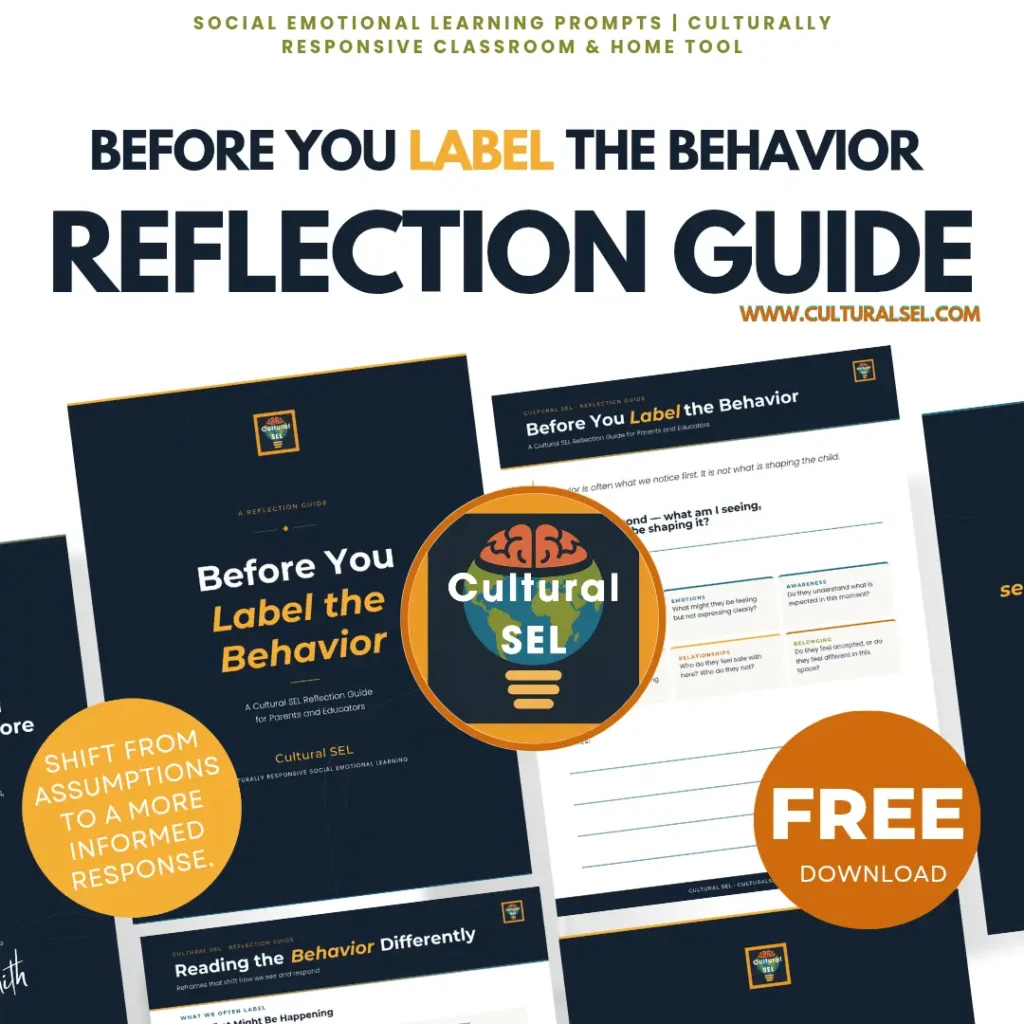
What if the behavior isn’t the whole story?
A free reflection guide that explores what may be influencing a child’s behavior before it is labeled, corrected, or misunderstood.
Most Training Points Outward, Never Inward
OECD TALIS survey data show that nearly half of teachers across education systems report a moderate or high need for professional development specifically for multicultural classrooms.
That professional development, when it happens, focuses almost entirely on interpreting students: their language needs, behavior patterns, and family context.
That focus addresses a real gap. What it leaves untouched is the teacher’s own interpretive starting point.
A teacher can learn ten frameworks for understanding student behavior and still apply every one through an unexamined personal default.
The frameworks adjust what gets noticed. They don’t surface where the noticing habit came from.
A Teacher’s Own Background Sets a Default Before the Lesson Starts
Every teacher grew up inside a specific set of rules about directness, authority, and emotional restraint.
A teacher raised in a African, Caribbean, Asian, or Latin American household grew up within a different set of norms around those same areas than the defaults most teacher training programs were built around.
Those rules are formed within a family and a community. They don’t dissolve when a teacher steps in front of a room.
An educator whose household treated quiet, indirect responses as a sign of respect for authority may interpret a student’s hesitant answer as a sign of uncertainty.
A teacher whose household treated animated, overlapping speech as normal engagement may interpret a soft-spoken, measured student as disengaged.
A teacher whose household maintained formal address toward adults may interpret a student’s casual tone with authority figures as disrespectful rather than as a different norm around familiarity.
None of these defaults is wrong on its own. They become a problem when a teacher mistakes a personal default for a neutral standard and starts correcting students for failing to match it.
What PTA Leadership and Community Work Revealed About Adult Interpretation
Years in PTA leadership and community spaces put me inside the rooms where adults decide how to interpret a child’s behavior.
I watched well-meaning adults reach for the explanation that felt familiar to them, not necessarily the one that fit the child in front of them.
That pattern was easy to name in others. It took longer to catch in myself. I noticed it in the moments when I assumed a certain kind of directness or restraint was called for, because that was what my own upbringing had instilled in me.
What I help adults recognize now is that examining a child’s environment and behavior without first examining the lens doing the looking gets the order backward.
What Self-Examination Actually Requires
Generic advice to “reflect on your bias” doesn’t give a teacher anywhere to start. A more specific set of questions does.
- What did I learn growing up about how to address someone in authority?
- What tone of voice was treated as disrespectful in my own home, and by whom?
- What was I taught to do with strong emotion in front of other people?
- Who corrected me as a child, and what did that correction sound like?
Those answers are the foundation for what a teacher notices first, corrects fastest, and treats as normal without examining them.
Knowing them changes what the teacher brings to the moment of interpretation.
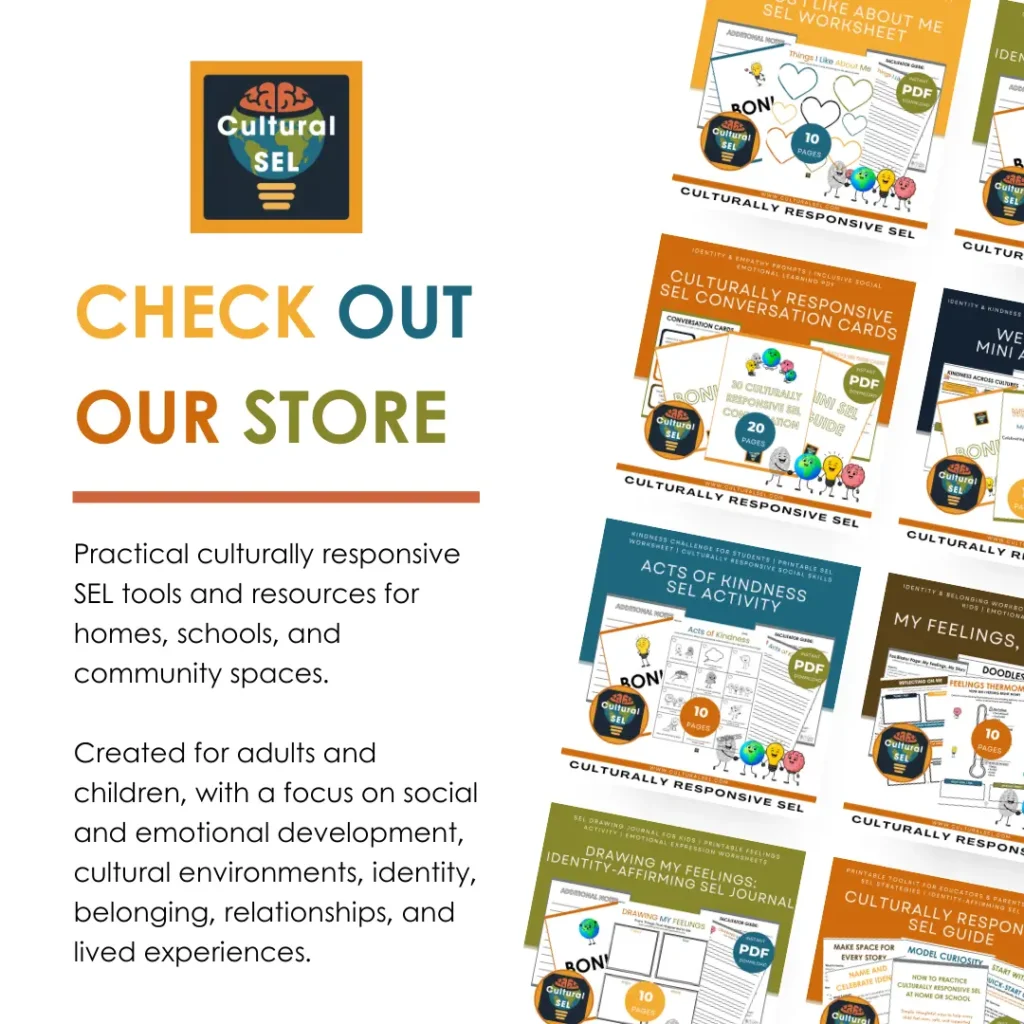
Shop Our Culturally Responsive SEL Resources
Digital Cultural SEL resources for parents, caregivers, educators, community professionals, and children.
Explore practical tools, guides, reflection resources, and activities focused on social and emotional development, cultural environments, identity, belonging, relationships, lived experiences, and behavior.
The Same Default Shows Up Outside the Classroom
This isn’t only a classroom dynamic. The same untouched default shapes how a parent interprets a child’s tone at the dinner table, or how a coach interprets a kid’s silence after a mistake.
Culturally responsive parenting addresses the same formation from the family side.
Once a teacher starts examining what their own background has trained them to treat as normal, the next step is to apply that same scrutiny to how they interpret a specific child’s behavior, a dynamic explored further in the ways cultural identity shapes student behavior.
Teacher Self-Examination Is the Starting Point for Accurate Interpretation
Every teacher starts from a specific cultural position. Culturally responsive teaching is more accurate when teachers know from which position they are starting, rather than treating a personal default as a neutral standard against which all students should be measured.
Within culturally responsive social-emotional learning, self-knowledge is part of what makes adult interpretation more reliable.
Knowing the formation behind the lens is what separates interpretation shaped by observation from interpretation shaped by habit.
Questions About Culturally Responsive Teaching and Teacher Identity
What is culturally responsive teaching?
Culturally responsive teaching connects classroom practice, relationship-building, and interpretation of student behavior to the cultural identities, lived experiences, and community contexts students bring with them. It recognizes that learning does not happen outside of culture, and that the adults in a room shape what feels safe, normal, and expected for students, whether or not that shaping is named.
Does culturally responsive teaching apply outside the classroom?
Yes. The interpretive habits this post describes belong to any adult in a consistent role with children: school counselors, advisors, coaches, youth program leaders, and others. The formation behind their defaults, what they were taught about authority, emotional expression, and communication, shapes every interaction with a child, regardless of setting.
How is professional development for culturally responsive teaching typically structured?
Most professional development for culturally responsive teaching focuses on student demographics, cultural awareness frameworks, and instructional adjustment strategies. It builds knowledge about the students in the room. It rarely includes structured reflection on the teacher’s own cultural formation, which is where the interpretive default that applies all other learning actually lives.
What is the connection between teacher self-awareness and student belonging?
When a teacher’s interpretive default goes unexamined, students whose communication styles, emotional expressions, or behavioral patterns differ from that default are more likely to be corrected, misinterpreted, or labeled. When a teacher understands where their own expectations are formed, interpretation becomes more accurate, correction becomes more precise, and students are more likely to feel seen rather than managed.
CONTINUE EXPLORING CULTURAL SEL
Explore free Cultural SEL guides, culturally responsive SEL tools, and practical resources for understanding how cultural environments, identity, belonging, relationships, and lived experiences connect with children’s social and emotional development.
📌 Save or share this post with someone who is raising, teaching, or guiding children.

Hi, I’m Faith, the creator of Cultural SEL
I create practical tools and resources that support children’s social and emotional development and help parents, caregivers, educators, and community professionals look beyond behavior labels.
My work focuses on how cultural environments, identity, belonging, relationships, and lived experiences shape what children experience and how adults interpret and respond.
Read more about Faith and Cultural SEL: https://culturalsel.com/about
Join the Cultural SEL community: https://culturalsel.com/fb