Equality vs Equity in Social Emotional Learning
“I treat all my people the same.” Most of us have heard it. Teachers say it. Parents say it. Coaches, youth leaders, and faith community adults say it.
What they mean is: the same rules, the same response, the same standard for everyone. Consistency matters. Fairness matters. The problem is that sameness and fairness are not the same thing.
In equality and equity in social emotional learning, that distinction changes what adults do when a child is struggling to meet an expectation.
SEL asks children to notice feelings, manage stress, repair harm, and problem-solve. Those skills do not develop on the same schedule for every child, nor under the same conditions.
Picture two children in the same conflict. Both raise their voices. Then the responses split. One takes a breath, steps back, and returns to the task.
The other escalates, shuts down, or walks away. Equity applies in both directions.
The child who struggled and the child who self-regulated both need a response that sees what actually happened. If the adult response is identical, what each child actually needs gets missed.
This post uses classroom examples throughout because schools are where equality vs equity in SEL is most often debated and most clearly visible.
The principle applies wherever adults are making decisions about how to respond to children.
FREE DOWNLOAD · REFLECTION GUIDE
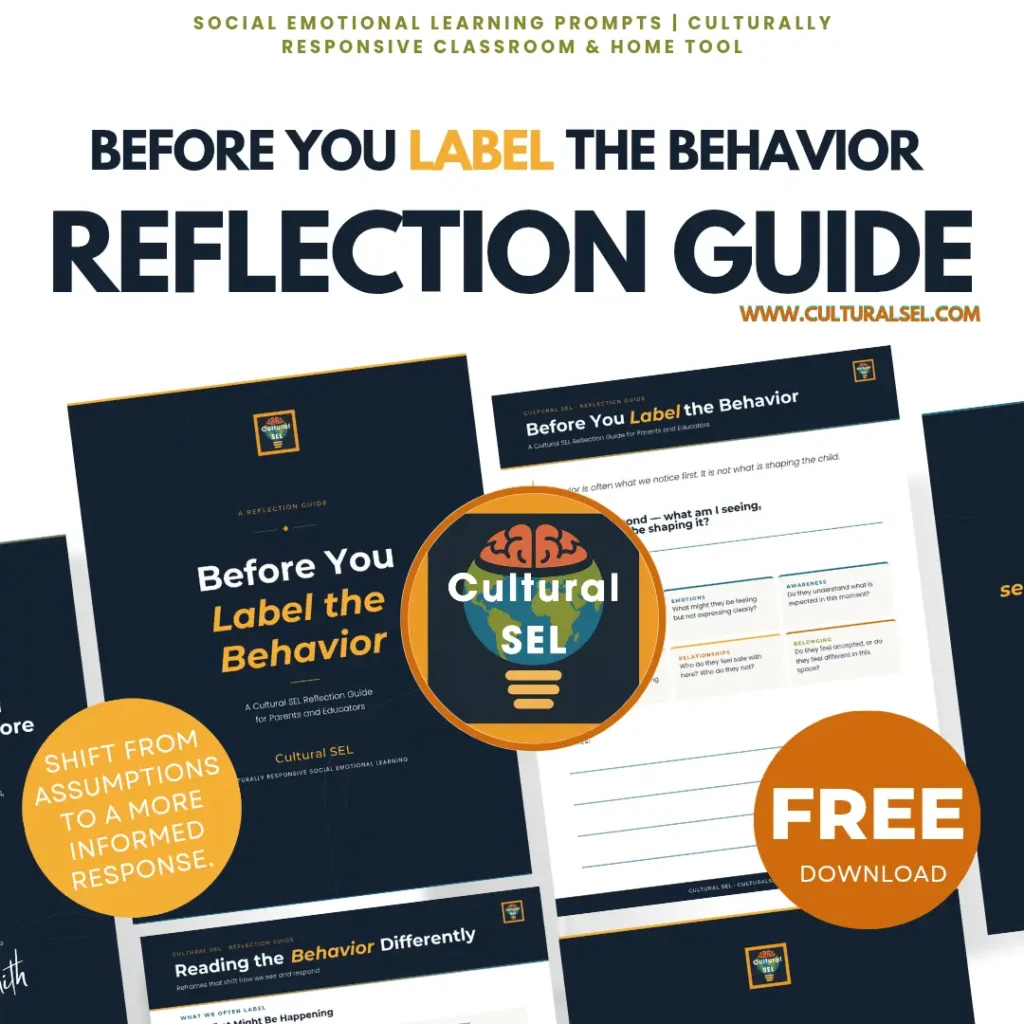
What if the behavior isn’t the whole story?
A free reflection guide that explores what may be influencing a child’s behavior before it is labeled, corrected, or misunderstood.
Fair Classroom Expectations And Emotional Regulation Support
Fair expectations in SEL start with a simple promise. The classroom stays safe, and everyone has a path back to learning.
Safety rules should be consistent across students because predictability lowers stress for everyone. Still, consistent rules do not mean identical support.
Emotion regulation is a learnable skill, and many students need direct teaching.
Research on social-emotional learning continues to show that regulation skills improve when adults teach them directly and practice them with students.
When adults respond only with consequences, students may comply in the moment, yet they do not build the tools to handle the next conflict.
Regulation support fits best when it shows up early and often. For example, a teacher can model what “reset” looks like during calm moments.
Then, during conflict, the teacher can prompt the routine with a short cue that the student already knows.
Developing self-management skills in daily school routines gives a fuller picture of how those routines are built and practiced.
Short, targeted regulatory support saves time later by preventing repeated escalations.
When expectations stay steady, and support matches skill readiness, students experience fairness as something they can feel, not just something adults say.
Equality and Equity In Social Emotional Learning Shape Behavior Expectations
Equality in SEL means the same rules, the same response, and the same lesson for everyone. Equity means shared expectations, with teaching pathways adjusted so students can reach those expectations.
Classrooms need consistent standards for safety and respect. Equity does not change that. Equity changes how students learn the skills behind those standards, especially when stress, disability, trauma exposure, or language differences affect regulation.
Equity keeps the bar in place and adds the scaffolds that help students reach it.
A simple example works in most grade levels. All students are expected to use respectful language. Some students can do that after one reminder.
Others need sentence frames posted at eye level, a practiced pause phrase, or a calm-down routine before they can speak without harm.
The expectation stays the same. The support changes because skill readiness differs.
| Classroom Need | Equality Response | Equity Support |
|---|---|---|
| Respectful language during conflict | Same reminder to all students | Same rule plus sentence starters, visuals, or coached practice |
| Calm body expectation | Same consequence for movement or pacing | Same expectation plus movement breaks or a structured reset routine |
| Reflection after harm | Same written reflection for everyone | Same reflection goal with options such as audio response, guided conference, or translated prompts |
Why Treating All Students The Same Can Increase Behavior Stigma
When adult responses do not align with regulation readiness, behavior is often misread. That is where stigma grows.
A student who argues back may be labeled defiant. A student who freezes may be called lazy. A student who cries quickly may be seen as dramatic.
These labels can follow students even when the behavior reflects stress, a skill gap, or a communication difference.
Stigma also affects belonging. Once a student expects adults to see them as the problem, participation often drops.
Healthy academic risk-taking becomes harder. Group work and classroom discussions may feel unsafe.
Families feel this impact as well. Emotional expression rules differ across cultures and households.
Direct speech may be interpreted as disrespect. Quiet endurance may hide distress until shutdown occurs. Without careful listening, school-home trust can weaken quickly.
I have watched this pattern show up in school meetings where a child’s behavior was the only data point on the table.
The overwhelm, the environment, the mismatch between home expectations and classroom expectations, none of it was in the room.
What the adults were responding to was the surface, not the situation. How adult emotional responses shape classroom escalation explains what happens on the adult side of that dynamic.
This classroom example shows the dynamic directly. During group work, a student puts their head down and stops responding.
If this is treated only as refusal, the student may lose points or be removed from the group.
The overwhelm that triggered the shutdown remains. Next time, the student shuts down sooner because the outcome feels predictable.
Stigma grows most when compliance is expected without direct teaching of regulation skills.
Equity-centered SEL interrupts that cycle by asking what skill is missing and what support would allow safe practice.
Emotional Regulation Skill Differences Affect Student Behavior
Emotion regulation is developmental. Students vary in emotional awareness, vocabulary for feelings, coping tools, and recovery time. These differences show up most clearly under pressure.
Some students can name feelings with precision. Others rely on broad labels such as “mad” or “fine.” Some notice escalation early.
Others recognize it only after reaching a peak. Disability can affect impulse control, sensory processing, or communication.
Stress exposure can keep the body in alert mode. Culture shapes which emotions feel safe to express.
The same feeling may appear in very different forms. One student verbalizes frustration and asks for help.
Another withdraws, fidgets, or goes silent. Both may be communicating distress. If adults respond only to surface behavior, one student receives support while the other receives discipline.
Emotional regulation expectations across disability and culture looks specifically at how disability and cultural beliefs shape what regulation looks like in school.
SEL instruction works best when it expands options. Teachers can walk students through the first three steps for frustration: name the feeling, choose a reset tool, and ask for what you need.
Students practice these steps in low-stakes situations and apply them in actual conflicts.
Those skills are not fixed traits. When adults treat regulation as teachable, the response to a child struggling in the moment shifts from consequence to instruction.
Fair Classroom Support Without Lowering Behavior Standards
Fairness becomes clearer when the goal and the method are separated. The goal stays consistent.
No aggression. No threats. Respectful language. Repair after harm. The method can flex through modeling, prompts, guided practice, and structured reset options.
Predictable systems help reduce the perception of special treatment. A calm-down station can be introduced to the whole class, practiced during morning meetings, and used with clear expectations. One student at a time. Timed reset. Return with a plan.
How To Keep Standards High While Adjusting Support
- Define non-negotiables for safety, such as hitting, threats, or unsafe objects.
- Teach regulation routines before problems occur. Model breathing, pacing, and help-seeking during calm moments.
- Offer a short structured reset before consequences escalate.
- Coach the repair step after calm returns.
- Track patterns across time, task type, peer triggers, and sensory factors.
Example in action. A student raises their voice during partner work.
The teacher uses the shared cue, points to a sentence starter card, and offers a brief reset. If yelling continues, the consequence still follows. The student had a clear pathway to meet the expectation.
Standards remain firm. Support remains responsive.
Shop Our Culturally Responsive SEL Resources
Digital Cultural SEL resources for parents, caregivers, educators, community professionals, and children.
Explore practical tools, guides, reflection resources, and activities focused on social and emotional development, cultural environments, identity, belonging, relationships, lived experiences, and behavior.
Cultural Expectations Influence Emotional Regulation And Participation
Emotional expression and expectations for self-control are shaped by family and community norms.
School norms often reflect one dominant cultural frame for tone, volume, and emotional expression, and students whose families hold different norms get interpreted through that frame without anyone naming the mismatch.
In many households, children are taught to listen, be still, and speak when addressed. That is not passivity.
That is respect, shaped by a specific cultural understanding of what attentive behavior looks like. In other households, emotional restraint in public settings holds the same meaning but looks different in practice.
In others still, expressive communication and passionate speech are normal, expected, and relational.
The same child moving between those home norms and a quiet, hand-raising classroom may look inconsistent to an adult who only sees the school version.
Many of us have navigated more than one set of cultural rules at the same time. I grew up navigating a Ghanaian household and a German school environment at the same time.
The rules were different in each space, and neither was wrong. What was missing was any adult acknowledgment that I was moving between them.
That navigation was invisible to the people around me, which meant my behavior in one space got interpreted without the context of the other.
Greetings and forms of address show the same pattern. A child who greets an adult with a handshake, a bow, or a formal title is showing respect.
A child who greets casually is showing familiarity. Both may be expressing respect. An adult who responds to one with warmth and the other with correction is applying one cultural standard to two different expressions of the same value.
Participation judgments run the same risk. Soft speech may be labeled unprepared. Passionate, direct speech may be labeled disruptive.
Cultural awareness shows up in practical classroom moves. Offer multiple participation formats. Teach classroom norms directly rather than assuming students arrived knowing them.
Invite students to describe what respect looks like at home. Notice patterns in who receives consequences and who receives support. These steps build trust and reduce misinterpretation.
When adults slow down and gather context first, children get responses that reflect who they actually are, not just what the adult expected to see.
Cultural discipline expectations and the interpretation of behavior goes deeper into how discipline norms vary across communities and what that means for adults responding to children.
This does not require guessing a student’s culture. It requires the adult to hold open the possibility that the behavior in front of them is being shaped by a context they have not seen yet.
The Fairness Assumption Lives Beyond the Classroom
A parent with two children applies it at home. One child processes conflict by going quiet. The other talks through every feeling immediately.
Treating both the same in a tense moment, same tone, same expectation, same timeline, does not produce the same result.
One child gets what they need. The other gets a consequence that skips the part where they actually learn something.
A youth sports coach applies it on the field. One player shuts down after a mistake and needs a moment to hear feedback.
Another bounces back quickly and wants to know what to fix right away. The standard for both is the same: stay in the game, respond to coaching, and treat teammates with respect. How the coach gets each player there looks different because the players are different.
A faith community leader applies it in youth programming. A child who comes from a home with high emotional expressiveness may participate loudly.
A child from a home that values quiet listening may seem disengaged. Both may be fully present.
The adult who reads expressiveness as engagement and quiet as absence is applying one cultural standard to two children with different norms.
In each of these settings, equity asks the same question the classroom does. What does this child need in order to meet the expectation that applies to everyone? The answer changes by child. The expectation does not.
Questions Adults Ask About Equality and Equity in SEL
What is the difference between equality and equity in SEL?
Equality provides the same lesson or response to every student. Equity maintains shared expectations while adjusting how students are taught and supported so they can reach those expectations.
Why does equity matter in social-emotional learning?
SEL depends on skill readiness. Expecting the same performance without teaching the skills behind it increases mislabeling and discipline disparities, particularly for students whose regulation patterns are shaped by culture, language, disability, or stress exposure.
What does an equitable SEL classroom look like?
Clear expectations that stay consistent. Predictable routines. Multiple pathways to meet the same standard. Adults who reflect on how they interpret behavior before responding to it.
Can schools use equality and equity together?
Yes. Equal access to SEL instruction, meaning every student receives it, can exist alongside targeted support for students who need additional skill-building.
How does equity affect discipline outcomes?
When adults teach regulation skills directly and adjust support based on readiness rather than expecting uniform compliance, repeated incidents decrease because students have tools to use, not only consequences to avoid.
What This Comes Down to for Educators and Families
Treating children the same can appear fair, especially when an adult is managing a group and needs consistency to hold.
What sameness can miss is whether every child has the tools, the context, and the support needed to actually meet the expectation being set.
Equity in SEL does not lower the bar. It asks who has been given what they need to reach it. In a classroom, that might start with teaching one shared regulation routine to the whole group, something every child learns together.
At home, it might start with noticing that two children need different entry points into the same conversation.
In a faith or community setting, it might start with questioning whether the participation norms in the room match what every child in the room was taught.
The expectation stays. The path to it adjusts. That is the distinction.
CONTINUE EXPLORING CULTURAL SEL
Explore free Cultural SEL guides, culturally responsive SEL tools, and practical resources for understanding how cultural environments, identity, belonging, relationships, and lived experiences connect with children’s social and emotional development.
📌 Save or share this post with someone who is raising, teaching, or guiding children.

Hi, I’m Faith, the creator of Cultural SEL
I create practical tools and resources that support children’s social and emotional development and help parents, caregivers, educators, and community professionals look beyond behavior labels.
My work focuses on how cultural environments, identity, belonging, relationships, and lived experiences shape what children experience and how adults interpret and respond.
Read more about Faith and Cultural SEL: https://culturalsel.com/about
Join the Cultural SEL community: https://culturalsel.com/fb