How to Advocate for Your Child at School With a Language Barrier
Parents with a language barrier often leave school meetings without understanding everything that was said.
They nod, say thank you, and go home with questions they did not get to ask. The school sees a parent who agreed. The parent knows they did not follow.
To advocate for your child at school means to speak up about your child’s needs: asking questions, raising concerns, and asking for help.
A language barrier makes each of those harder, and you can still take part with the right support.
This guide shows parents how to ask for an interpreter, tell the school what is new to them, contact the right people when no one responds, and get involved. It also shows educators what a school can do so a parent can follow the meeting and be understood.
FREE DOWNLOAD · Conversation Prompts
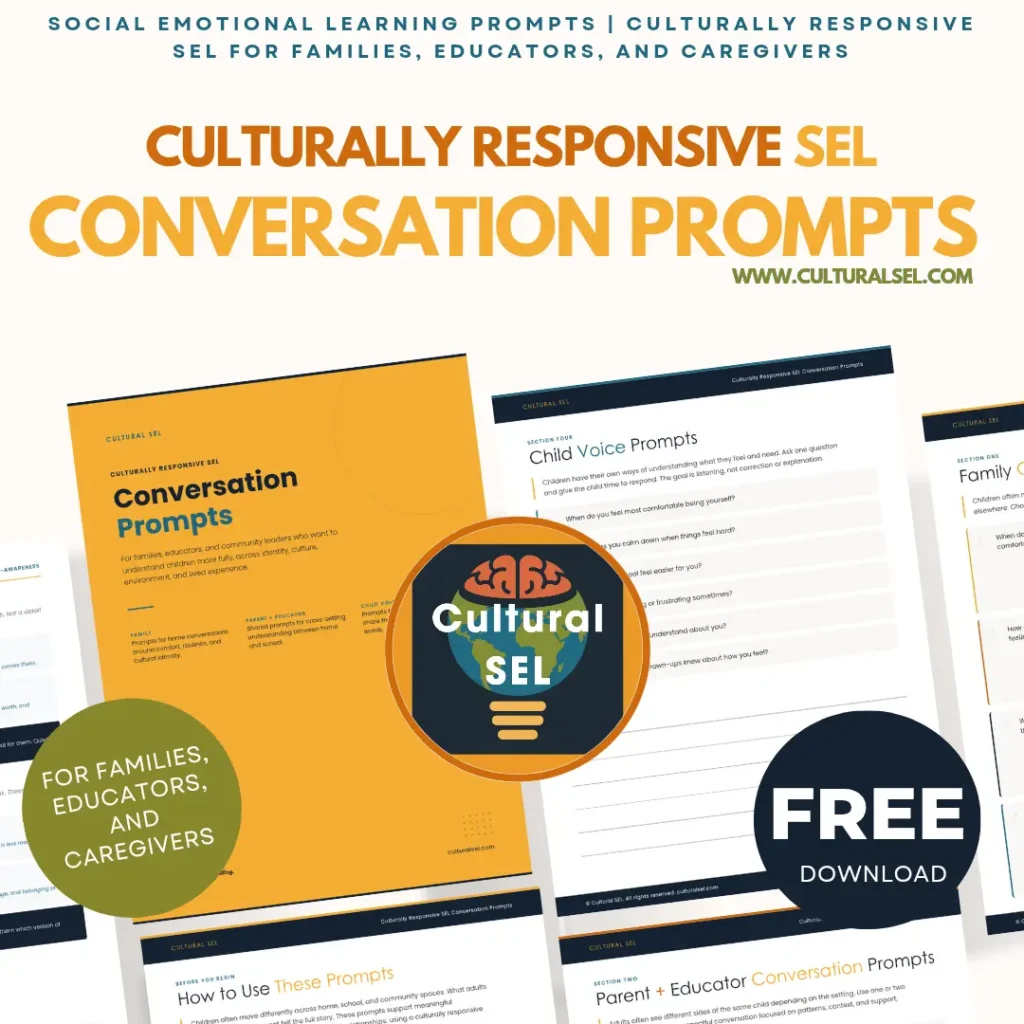
What if one conversation changed how you see the child in front of you?
A free resource that opens conversation across home, school, and community. For adults who want to understand children more fully, across identity, culture, environment, and lived experience.
What It Means to Advocate for Your Child at School With a Language Barrier
You know things about your child that school staff do not. You know how your child behaves at home, what worries them, and what they say about school. Teachers know things you may not.
They see how your child works in a group, how your child asks for help, and how your child acts with classmates during the day. You and the teacher each need what the other knows to understand your child.
Understood, a nonprofit parent resource, says advocating just means speaking up about your concerns.
It also says you can do it quietly and with just one person, such as your child’s teacher.
Queensland’s education department in Australia tells parents they don’t need to be proficient in English to help and support their child in school.
Advocating has three steps. You understand what is being said, you say what you think, and you get a response from someone who can act.
A parent who skips the first step cannot do the second, and a parent who gets no response cannot change anything. The sections below cover each step, then ways to get involved and what educators can do.
Ask for an Interpreter Before Any Important Meeting
An interpreter is a trained person who turns spoken words from one language into another during a conversation.
Ohio’s education department describes interpreters as professionals who listen to one person in one language and share that information with others in a different language.
A translator does the same work with written text, such as a letter or a report. Parent guides sometimes use “translator” for both jobs.
One Understood article about special education meetings is titled with “translator,” for example. If you are unsure which word your school uses, ask for “an interpreter or translator.”
When you can ask. Ohio says you can ask for an interpreter any time you need to talk to someone at your child’s school, including parent-teacher conferences, meetings with the school counselor, and meetings about special education services for children with disabilities.
Its guide gives the example of a family that speaks Somali talking with a teacher who speaks English.
Prince George’s County Public Schools in Maryland lists PTA (Parent-Teacher Association) meetings, back-to-school nights, home visits, and suspension conferences among the events where interpreters can help.
How to ask:
- Ask when the meeting is scheduled. Tell the person scheduling the meeting that you need an interpreter, and ask as early as possible so the school has time to find one.
- Name your language and write the request in an email or note. Keep a copy.
- If you do not know whom to ask, try the English language teacher, family liaison, school counselor, your child’s teacher, or the school office secretary.
- Ask the school to confirm that an interpreter will be at the meeting.
A request can be this short: “I would like an interpreter for our meeting on [date]. My language is [language]. Please confirm that one will be there.”
In New York City, the school system says parents have the right to receive information or communicate with a staff member at their school in their language.
Where the right comes from. Rules differ by country, and in the United States, they differ by state and district.
At the federal level, the Department of Education says Title VI of the Civil Rights Act of 1964, the federal law that bans discrimination based on race, color, or national origin in programs that receive federal money, requires schools to communicate important school information to parents who have limited English in languages they can understand.
In 2025, the Education Department rescinded a 2015 federal letter that explained how schools should do this, and school and state websites still link to the 2015 materials.
Chalkbeat, a nonprofit education newsroom, reports that rescinding the letter does not change the underlying laws.
An executive order cannot overturn an existing law, and state laws and district policies still apply.
Washington State’s education agency says that under state and federal law, parents are entitled to information about their child’s education in a language they understand.
If your child has an IEP (Individualized Education Program), the written plan for your child’s special education services, federal rules under IDEA (Individuals with Disabilities Education Act), the federal special education law, say the school must take whatever action is necessary so you understand the meeting, including arranging for an interpreter if your native language is not English.
In New York City, Chancellor’s Regulation A-663, the school system’s rule on translation and interpretation, gives parents the right to these services.
The city amended it in 2025 to cover more languages and to formalize the role of school-based Language Access Coordinators, the school staff who connect parents with language services.
Your Child Should Not Be the Interpreter
Washington State’s education agency says schools may not rely on or ask students, siblings, or other children to interpret for parents. The school must provide competent adult interpreters.
Ohio’s guide explains why: children who interpret for their parents may feel more stress or pressure, especially when the conversation includes terms or topics they do not know.
A 2016 conference paper by researchers at the University of Northampton in England notes there is general agreement that children should not be asked to translate when very serious or sensitive matters are being discussed.
The paper examines whether schools follow that agreement in meetings about special educational needs and school subject choices.
When a child interprets, they have to say the teacher’s words about themselves to their own parent, and the parent’s words back to the teacher. A trained interpreter does that job without placing the child in that position.
Tell the School Which Parts of Its System Are New to You
I did not go to school in the United States, so when I need more information from a teacher, I say that first. The teacher then explains the term, and we start with what I know and what I do not. Telling the teacher which parts are new to me helps them explain them.
Many parents are in the same position. Colorín Colorado, a bilingual education resource, says immigrant and refugee parents are typically unfamiliar with how school is done in the U.S. unless someone explains it.
In one Washington State district studied by University of Washington researchers, a mother who had moved from Uganda thought she needed to call the superintendent to ask which school supplies to buy.
A district staff member told her to contact the teacher, according to KNKX public radio. That mother needed to be told which question goes to which person, and the district told her.
Say which parts are new to you. Ask what a term means, ask who handles which kind of question, and ask the teacher to name the exact behavior or decision behind the term.
Advocates for Children of New York suggests asking, “Tell me more,” and “I think what I heard was… Am I right?” The same guide says to sign documents only after you understand them.
Our post on how to ask a school to define its terms shows how to ask for that detail, and our post on why to ask for the exact moment of concern explains what the answer tells you.
Contact the Teacher, Then the Principal, Then the District
If the teacher is not listening, go to the principal. If the principal is not listening, go to the district office and the superintendent, the person who leads the school district.
Keep asking until someone responds to your concern. The order of contacts and the names of the offices change by district.
- Start with the teacher. Austin Independent School District in Texas says that when a parent brings a classroom concern to the principal first, the principal will ask the parent to talk with the teacher first. Edmonton Public Schools in Alberta, Canada, says the principal will ask whether you have already spoken with your child’s teacher.
- Expect more than three levels. Austin’s page lists the teacher, then the principal or assistant principal, then the Associate Superintendent for Middle Schools. Edmonton lists the teacher; the principal or assistant principal; Division Support Services, which gives advice and mediation; and then the Superintendent of Schools or your trustee, a member of the school board.
- Write it down and keep asking. Advocates for Children of New York tells parents to send an email after a conversation to confirm what was said, save every letter and email, and keep asking and calling when a response is slow. The same guide says everyone has a supervisor, so if someone cannot answer your question, ask for the supervisor and keep going up until you get an answer. Understood suggests keeping a communication log of who you spoke to and when.
- If the problem is the language help itself, the same order applies, with one addition. Washington State’s education agency says a discussion with the school principal, the district’s language access coordinator, or the district’s civil rights coordinator, who handles complaints about discrimination, is often the best step. The same page says you can file a complaint with the state if that does not resolve it. Colorín Colorado tells families that if little or no language assistance is available, talk to your child’s principal or another administrator.
If your child’s safety is at risk, do not wait for the order. Go to the principal right away.
Shop Our Culturally Responsive SEL Resources
Digital Cultural SEL resources for parents, caregivers, educators, community professionals, and children.
Explore practical tools, guides, reflection resources, and activities focused on social and emotional development, cultural environments, identity, belonging, relationships, lived experiences, and behavior.

Ways to Get Involved at School Without Perfect English
Through PTA work and family engagement, I have seen that a family may know a side of their child that school rarely sees.
When the family cannot follow or attend the meeting, the school does not get that information. Getting involved, even in small ways, is how the school gets it.
A 2014 University of Washington study of districts in South King County, Washington found that PTA meetings can send unintended negative messages to immigrant families.
Researcher Ann Ishimaru described the conditions: meetings held only in English with no interpretation, run by formal rules, a focused on fundraising and paying to join can leave low-income immigrant parents feeling they have no place there.
She also said that when schools offer only traditional activities, such as joining the PTA or donating to a fundraiser, that tells parents there is only one way to interact with the school.
The same study describes two programs. Federal Way School District hosts workshops where parents speak in their own language while a district director listens to live interpretation through a headset.
Kent School District runs a nine-week evening class, led by parent facilitators in different languages, that teaches parents how to advocate for their child and build partnerships with teachers and staff.
Ways to start:
- Ask for an interpreter at PTA meetings and school events. Prince George’s County lists PTA meetings among the events its interpreters cover.
- Ask whether the school has a family liaison or a parent leadership program, as Federal Way does.
- Volunteer in roles that do not depend on spoken English. Alloprof, a Quebec education support organization, lists chaperoning field trips, repairing sports equipment or books, helping clean or decorate the school, and helping organize a fundraising event.
- Join other parents. Advocates for Children of New York says parent groups often understand how a system works and tells parents to work together.
How Language Gaps Get Mistaken for Disinterest
A parent who nods may not have understood. A parent who stays quiet may be waiting for an interpreter. Adults often take both as agreement or disinterest, and both are mistakes.
Cultural SEL gives adults a four-step pause called the Lens: notice, consider, interpret, and respond.
Applied to a parent, an educator notices what the parent did, considers what may be shaping it, such as the language of the meeting, the terms used, or earlier experiences with schools, interprets the nod or the silence as something to check, and responds by asking.
My parents raised us in Germany, and speaking up for us at school was not straightforward for them.
Language was part of it, and the terms schools used were another. A parent cannot speak up about something they have not been able to follow.
In school meetings now, I notice whether everyone can follow the terms being used, because that determines who gets to speak.
Parents who have felt dismissed by schools before may arrive at a meeting guarded. Our post on why some families distrust school support conversations explains where that comes from.
Accent is another factor. Our post on how language shapes behavior and learning names mistaking an accent for a lack of understanding as a common misinterpretation in students, and the same mistake can be made with parents.
What Educators Can Do So Parents Can Advocate
A parent can advocate only if the meeting is arranged so they can follow it.
- Ask each family which language works best, and check before assuming. Colorín Colorado tells teachers to learn families’ communication needs and avoid assuming English levels. At Wolfe Street Academy in Baltimore, staff saw more special education referrals for Spanish-speaking students even though the assessments were given in Spanish. They then learned that many of those students spoke Mixtec, an Indigenous language from Mexico, as a first language. Families had not mentioned it because of stigma around the language.
- Book the interpreter before the meeting, and include phone calls. The same Colorín Colorado article describes an Afghan father who spoke Pashto and very limited English. The school sent most information in English and Spanish, and he appreciated the teachers’ phone calls but could not understand what they said. The article advises requesting interpreters in advance for planned meetings and contacting the interpreter ahead of time to share documents and prepare for sensitive topics.
- Speak to the parent, not the interpreter. Colorín Colorado recommends training so that eye contact and communication stay focused on the parent. Ohio’s guide gives parents the matching advice: look at the person you are meeting, so each side can see the other’s gestures.
- Use trained interpreters, and book a phone or video interpreter if none can attend in person. Washington State’s education agency says bilingual staff and volunteers might not be skilled enough to interpret both ways in meetings, even when they speak both languages well. Ohio lists over-the-phone and video interpreters as options schools can use, and a meeting can be moved to a time when one is available. A parent may bring their own family member or friend if they choose, but the school should not make that choice for them.
- Name the exact behavior or decision behind each term. Words like “executive functioning” and “self-regulation” describe groups of behaviors, and a parent cannot respond to a group of behaviors. Our post on translating school terms into family language gives examples of how to do this.
How School Interpreter Rights Differ Across Countries
The right to an interpreter exists in many places, and each place sets its own rules.
- Victoria, Australia. The state education department’s policy, updated in January 2026, says schools must offer interpreting and translation services to parents and carers with limited or no English for key information about their child’s education, such as parent-teacher interviews. Parents can also use a free telephone interpreting service to call schools in their preferred language.
- Queensland, Australia. The state education department says that if you are more comfortable in your own language, you can ask a family member or friend to come with you to help you communicate, or ask the school for an interpreter. It says the interpreter service costs parents nothing.
- North Rhine-Westphalia, Germany. The state education ministry calls it a legally anchored responsibility to give all parents access to information and advice. Schools report their need to the local Integration Center, which runs a pool of lay language mediators. This is a different standard from the trained interpreters described elsewhere in this guide.
- Styria, Austria. The state runs a free interpreting service for compulsory schools covering parent-teacher conferences, parent evenings, and individual parent talks. School leadership or an authorized teacher books it, so a parent can ask the school to arrange it.
- Canton of Zurich, Switzerland. The canton’s education page says the school arranges interpretation when needed and that qualified intercultural interpreters support these conversations. It also says students are never asked to translate at parent meetings.
- Alberta, Canada. The Calgary Board of Education says families pay nothing for interpretation. Parents can ask by marking a box on the student registration form, asking school staff, or bringing their own interpreter.
- Washington State, United States. The state education agency says the right applies even if you speak some English or your child speaks or reads English.
Many parents do not know they can ask. In a 2015 survey of 175 New York City parents who did not feel comfortable speaking English at their child’s school, nearly a third did not know that schools are supposed to offer translation and interpretation, and more than a third said they felt somewhat or very uncomfortable asking for it.
This section covers the United States, Canada, Australia, Germany, Austria, and Switzerland, where we found school policies on interpreters for parents that we could check.
If your country is not on this list, we could not confirm the rule there. Ask the school office for the education department’s language access or interpreting policy, and for the name of the person who handles it.
Send your request in writing and keep a copy of the reply. If you want us to look for your country’s policy, send your country and the type of meeting through our contact page.
Common Questions About Advocating for Your Child With a Language Barrier
Can I ask for an interpreter if I speak some English?
Yes, in many places. Washington State’s education agency says parents have the right to language services even if they speak some English and even if their child speaks or reads English.
Does the school pay for the interpreter?
Where the sources say who pays, parents did not. Ohio says schools must provide interpreters and translation for free to families who request it. Queensland, Calgary, and Styria say their services are free. The NRW and Zurich pages do not say.
What if the interpreter is not good?
In special education meetings, the Federation for Children with Special Needs, a Massachusetts organization that supports families of children with disabilities, says a parent can stop the meeting and ask for another meeting with a qualified interpreter if the interpreter leaves out information or acts unprofessionally. Disability Rights Wisconsin says you can ask to stop the meeting and resume when a trained interpreter is available, and adds that staff may not know the interpretation is poor unless you tell them. Both guides are about special education meetings, so ask your school whether the same applies to other meetings.
What if the school says no interpreter is available?
Ask for a phone interpreter, ask to move the meeting to a time when an interpreter can attend, and email the request so there is a record. Ohio lists over-the-phone and video interpreters among the types of interpreters schools can use. If that does not work, follow the order of contacts above.
Should I go straight to the principal?
Many districts ask you to start with the teacher, and principals often ask whether you spoke with the teacher first. If your child’s safety is at risk, go to the principal right away.
Can the school ask a bilingual staff member or another parent to interpret?
Washington State’s education agency says staff need more than the ability to speak two languages because they might not be skilled enough to interpret both ways in meetings. Colorín Colorado says bilingual staff without formal training should not interpret in meetings. Ohio says schools may not rely on students, siblings, or untrained adults.
What to Do Before Your Next School Meeting
Before your next meeting, send the school one message with the date, your language, and a request for an interpreter.
Educators can check the next conference list for families who may need one and book interpreters before the first meeting.
CONTINUE EXPLORING CULTURAL SEL
Explore free Cultural SEL guides, culturally responsive SEL tools, and practical resources for understanding how cultural environments, identity, belonging, relationships, and lived experiences connect with children’s social and emotional development.
📌 Save or share this post with someone who is raising, teaching, or guiding children.

Hi, I’m Faith, the creator of Cultural SEL
I create practical tools and resources that support children’s social and emotional development and help parents, caregivers, educators, and community professionals look beyond behavior labels.
My work focuses on how cultural environments, identity, belonging, relationships, and lived experiences shape what children experience and how adults interpret and respond.
Read more about Faith and Cultural SEL: https://culturalsel.com/about
Join the Cultural SEL community: https://culturalsel.com/fb