How Schools Can Audit Their SEL Through a Cultural Lens

What does your school mean when it says students should “show respect” or “use self-control”? Those words sound clear, until you look at who gets written up for missing them.
An SEL audit through a cultural lens is a structured review of how social-emotional learning shows up in daily school life, and whether it lands fairly across student groups.
It looks at routines, language, and adult responses, then compares them to what students and families experience.
Many districts already run academic and safety audits. Applying the same structure to SEL strengthens consistency without lowering expectations.
This kind of audit does not target SEL for removal. It strengthens SEL by making it more accurate, more consistent, and more aligned with your community.
FREE DOWNLOAD · REFLECTION GUIDE
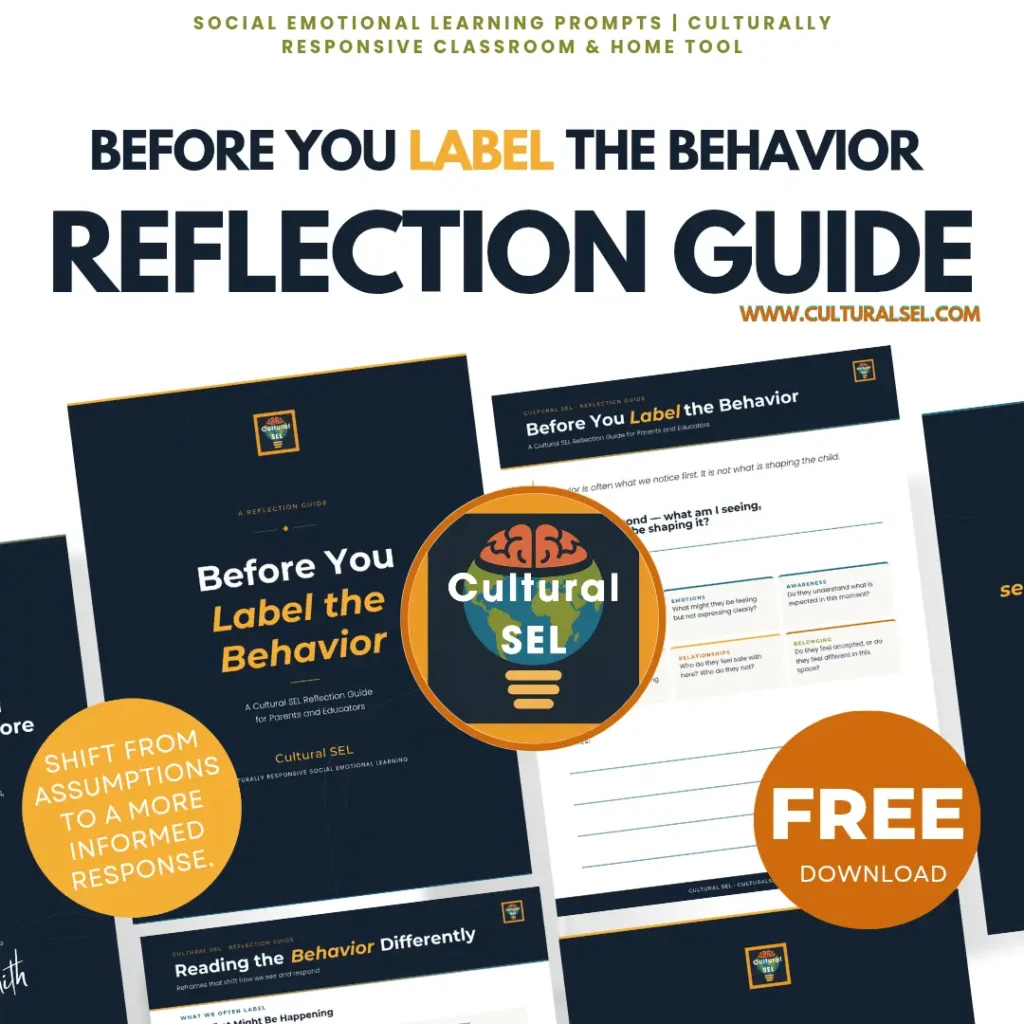
What if the behavior isn’t the whole story?
A free reflection guide that explores what may be influencing a child’s behavior before it is labeled, corrected, or misunderstood.
What an SEL Audit Through a Cultural Lens Actually Examines
An SEL audit through a cultural lens focuses on school processes you can observe and measure. It avoids guessing students’ intent. It also avoids broad claims like “this school values relationships” without evidence.
Start by listing where SEL gets graded, tracked, corrected, or rewarded. Then compare patterns by race, gender, disability status, language background, and grade level, based on what you legally collect.
Common audit sources include lesson plans, referral data, and family feedback. Also include hallway interactions and transitions, because that is where many “soft skills” get judged.
When language stays vague, patterns repeat year after year.
Behavior Referral Patterns
Look for repeat reasons and repeat students. Track location and time of day. Many patterns tie to supervision, crowding, or unclear routines.
Participation Tracking
Check who gets praised for “engagement.” Compare that to who gets marked off-task. Participation rules often hide cultural assumptions.
Language Used in Rubrics
Review SEL rubrics, report card comments, and “citizenship” scores. Flag words that require mind-reading, such as “chooses,” “cares,” or “tries.”
Who Receives Intervention
Note who gets pulled for SEL groups and who gets consequences. Then compare who gets adult mentoring, calm-down space access, or check-ins.
Family Feedback
Look at the feedback you already collect. If response rates are low, that is also a finding worth naming.
Reviewing Behavior Data for Cultural Patterns
Behavior data often reveals gaps between stated SEL goals and actual outcomes. The goal is not blame. The goal is to find where your system sends different messages to different students.
Begin with the past 12 to 24 months. Pull office referrals, classroom-managed logs, suspensions, and removals. Add notes on who wrote the referral and where it happened.
Then disaggregate. Look for gaps that repeat across teachers, teams, or settings.
Suspension and Referral Trends
Track rates, not just totals. A small group can drive a large share of removals. Also check for spikes during certain months, testing windows, or schedule changes.
Who Is Labeled “Disrespectful”
Review narratives for words like “back talk,” “attitude,” “defiant,” and “refused.” These labels often depend on adult interpretation.
Who Is Labeled “Disengaged”
“Disengaged” can mean many things, including language processing, anxiety, or cultural norms around speaking up. Compare this label with attendance, workload, and classroom conditions.
Interpretation Patterns
Compare referrals with direct quotes. If logs rarely include student words, adults may be filling in meaning.
If the behavior description would not hold up in a neutral review, the data will not guide fair decisions.
Auditing SEL Language in Report Cards and Behavior Logs
Schools often use the same SEL terms for every child. Families then receive reports that sound like judgment, not information. An SEL audit checks whether your language describes observable actions and clear next steps.
Collect a sample of report cards, behavior logs, and classroom comment banks. Include multiple grades and teachers. Then highlight phrases that sound positive, yet still vague.
In family engagement meetings, I have watched adults use the same word and mean different behaviors. The gap is rarely about intention. It is usually about definition.
When definitions are not shared, schools and families may believe they agree while correcting different actions.
Words That Lack Action Clarity
Terms like “mature,” “responsible,” and “kind” can matter, yet they need examples. Without examples, students cannot practice the skill.
Vague Terms Like “Appropriate”
“Appropriate” depends on the setting and the adult. If you keep the word, add the expectation. For example, “uses a calm voice during group work.”
Alignment With Family Language
Check whether translations match meaning, not just words. Also check if school terms match how families describe behavior at home.
Action-Based Rewording Examples
| Common SEL Wording | Problem | Action-Based Option |
|---|---|---|
| “Shows respect” | Depends on adult lens | Uses greeting, listens without interrupting, follows agreed class signals |
| “Has a bad attitude” | Labels personality | Used a raised voice, turned away, and stopped responding for 3 minutes |
| “Appropriate participation” | Unclear norm | Shares ideas in writing or aloud at least once per activity |
| “Needs self-control” | Too broad | When upset, takes a break, uses breathing, and returns within 5 minutes |
When language names actions, coaching gets easier and bias has less room to hide.
Evaluating Participation Expectations Across Cultures
Many SEL rubrics treat one style of communication as the correct style. Students then get scored down for differences that are normal in their home culture or community.
Use short classroom observations. Keep them low-inference. Write what you see and hear, then connect it to the expectation being graded.
Also review teacher prompts. A prompt like “Look at me when I am talking” sets a narrow rule. A prompt like “Show me you are listening” allows more than one way.
Calling Out vs Raising Hands
Some classrooms value quick back-and-forth talk. Others require waiting. If a student comes from a talk-rich setting, calling out may be participation.
Eye Contact Expectations
Eye contact norms vary widely. Some students show attention by facing forward and staying quiet. Others look away while processing.
Emotional Tone Norms
“Calm voice” expectations can become unfair when adults label emotion as disrespect. Teach volume and word choice, then avoid policing tone alone.
Group Work Communication Styles
In some cultures, group roles are fluid. In others, one person speaks for the group. When you grade collaboration, define what counts.
Examining Adult Emotional Regulation and Response Patterns
Students learn SEL from adults all day. That includes how adults correct, de-escalate, and repair.
During your SEL audit, watch adult responses under stress. Focus on patterns, not one-off moments. Use brief walkthroughs, peer observation, or video reflection with proper permissions and privacy safeguards.
This section pairs well with staff learning on adult regulation and trauma awareness. Keep the focus on skills adults can practice.
Tone During Correction
Track volume, speed, and distance. A sharp tone can trigger fear, even when the words sound polite.
Escalation Triggers
Look for predictable moments such as phones, hats, hallway bumping, and transition time. Then look for adult moves that increase tension, like repeating demands without offering choices.
Public vs Private Correction
Public correction carries social cost. Check whether some students get redirected quietly while others get called out.
Adult Modeling
Audit what adults do after a mistake. Do they name it, apologize, and repair? Students notice that more than posters on the wall.

Including Family Voice in the SEL Audit Process
Family voice turns an SEL audit from school evaluating students into community improving systems. It also helps schools avoid guessing what families value.
Start by making feedback safe. Families will not share much if they expect pushback, or if the only contact has been negative.
Keep questions concrete. Ask about school language, problem-solving steps, and how families prefer communication.
Structured Feedback Loops
Use short surveys with two or three open questions. Offer paper and phone options. Then report back what you heard and what changes you will test.
PTA Engagement
PTA groups, short for Parent Teacher Association, are family-school organizations that support communication and involvement.
They can help reach families who are already connected. Still, do not stop there. Add outreach for caregivers who do not attend evening events.
Listening Sessions
Host small group sessions with clear norms. Use a neutral facilitator when possible. Provide interpretation, child care, and food when you can.
Translating School Language
Translate SEL terms into plain language, then check the meaning with families. Many families understand the skill, yet reject school labels.
If families only hear from school when something goes wrong, SEL messages will not land the way you intend.
Turning SEL Audit Findings Into Action Steps
Audit results should lead to clear actions, owners, and timelines. Keep the plan short at first. Small changes with steady follow-through beat a long plan no one uses.
Use a simple cycle: name the pattern, pick one setting, test one change, and measure again.
Staff Reflection Protocols
Use low-inference prompts:
- What did I see?
- What did I assume?
- What else could be true?
Keep it short and routine.
Language Updates
Revise rubrics and comment banks with action-based wording. Train staff on using the new language consistently.
Professional Learning Focus
Pick one or two skills, such as de-escalation scripts or bias-aware referrals. Practice them with role-play and peer feedback.
Family Communication Shifts
Send home a one-page guide that outlines school SEL goals, examples of language, and how families can share concerns. Use the same terms across school and home.
Measurable Benchmarks
Choose measures you can track monthly, such as referral reasons, time out of class, or the percent of logs with objective descriptions.
Shop Our Culturally Responsive SEL Resources
Digital Cultural SEL resources for parents, caregivers, educators, community professionals, and children.
Explore practical tools, guides, reflection resources, and activities focused on social and emotional development, cultural environments, identity, belonging, relationships, lived experiences, and behavior.
How to Run a 30-Day SEL Audit Cycle
- Pick one focus area, for example “disrespect” referrals in grades 6 to 8.
- Pull a clean data set that includes referrals, narratives, location, staff, and student group.
- Review 20 to 30 entries and flag vague labels.
- Observe two settings linked to the pattern, such as hallway transitions or group work.
- Test one change for two weeks, such as a new correction script or updated rubric wording.
- Re-check the data and share results with staff and families in plain language.
FAQ: SEL Audit Through a Cultural Lens
What is an SEL audit in a school?
An SEL audit is a structured review of how SEL is taught, graded, and enforced. It uses evidence such as rubrics, referrals, observations, and feedback.
How do you make SEL more culturally responsive without lowering expectations?
Keep expectations high. Define them in observable terms. Teach and apply them consistently.
What data should schools use for a culturally responsive SEL audit?
Use referrals, suspensions, classroom behavior logs, report card comments, participation grades, intervention rosters, and family input. Add brief observations to connect numbers to real moments.
How often should schools audit SEL?
Many schools run a short cycle each quarter and a deeper review once a year. The best schedule is one your team can sustain.

“If expectations are not observable, they are not equitable.”
A strong SEL program shows up in actions, language, and daily adult choices. When schools run an SEL audit through a cultural lens, they get clearer about what students experience and where systems need tightening.
Families often notice patterns before schools do. An SEL audit creates space to name them without blame.
That work belongs to everyone, from classroom staff to administrators to families. Choose one pattern, measure it, and make one change this month.
What would change first if your school described behavior with facts and taught the next skill clearly?
CONTINUE EXPLORING CULTURAL SEL
Explore free Cultural SEL guides, culturally responsive SEL tools, and practical resources for understanding how cultural environments, identity, belonging, relationships, and lived experiences connect with children’s social and emotional development.
📌 Save or share this post with someone who is raising, teaching, or guiding children.

Hi, I’m Faith, the creator of Cultural SEL
I create practical tools and resources that support children’s social and emotional development and help parents, caregivers, educators, and community professionals look beyond behavior labels.
My work focuses on how cultural environments, identity, belonging, relationships, and lived experiences shape what children experience and how adults interpret and respond.
Read more about Faith and Cultural SEL: https://culturalsel.com/about
Join the Cultural SEL community: https://culturalsel.com/fb