Privacy vs Secrecy in Families: What Children Actually Learn
A lot of adults grew up hearing the same line: “What happens in this house stays in this house.” Some heard “don’t discuss house business,” “stay in a child’s place,” or “because I said so.”
As adults, they describe what that phrase meant to them very differently. Some learned family privacy. Others learned silence, fear, or careful self-editing.
That difference, privacy vs secrecy in families, is what shapes how children learn to trust, to ask for help, and to use their own voice.
FREE DOWNLOAD · REFLECTION GUIDE
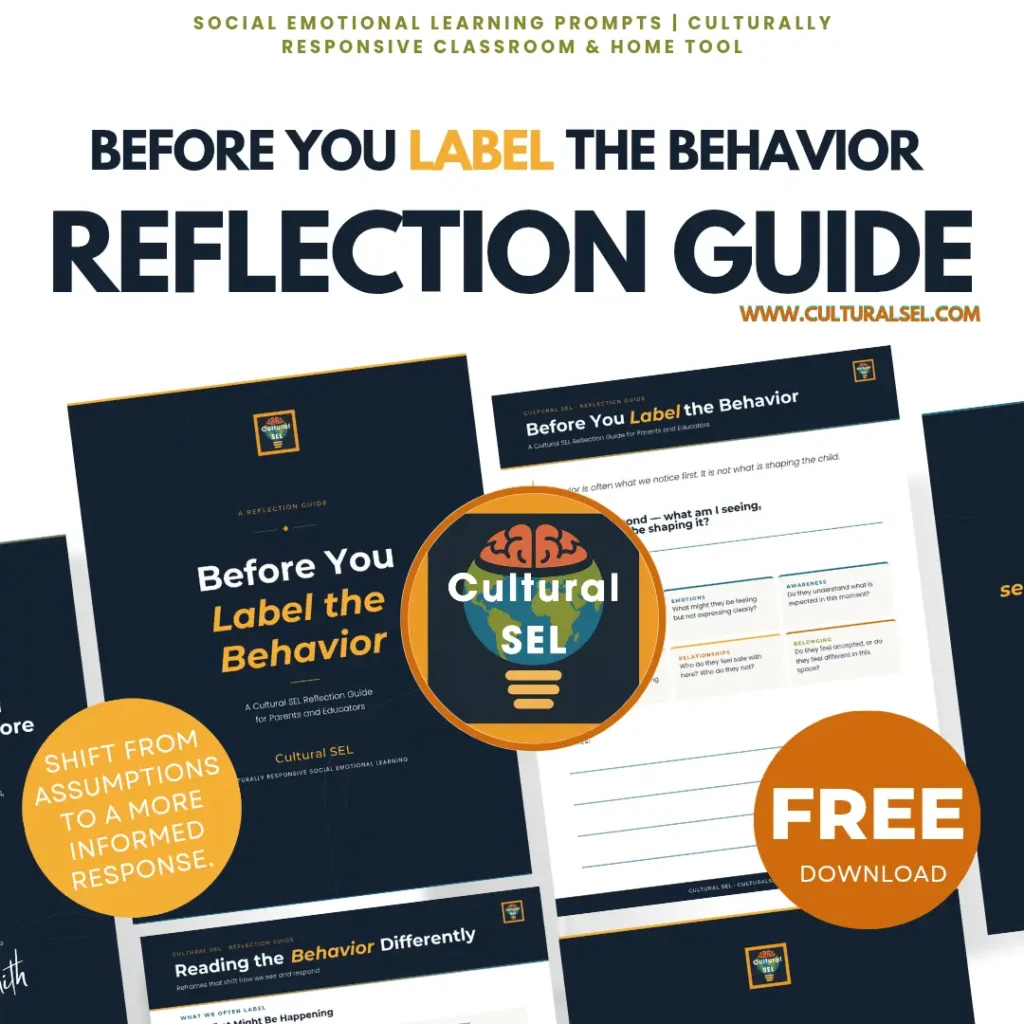
What if the behavior isn’t the whole story?
A free reflection guide that explores what may be influencing a child’s behavior before it is labeled, corrected, or misunderstood.
What “Keep It in the House” Usually Means
Most of the time, this message points to discretion. Family matters should stay private. Parents may mean, “Don’t tell everybody our business.”
That can be reasonable. A child does not need to share a parent’s medical issue, money stress, or a disagreement with classmates or strangers online.
But families do not all mean the same thing by it. One child hears, “We keep private things private.” Another hears, “Do not tell anyone if something is wrong.” The words may be the same, but one child grows up trusting that some things are private. Another grows up believing nothing they say is safe.
Why Children Interpret the Same Family Message Differently
Adults usually think about what they meant. Children remember what they felt.
Two children in the same home can hear the same rule and learn different lessons. One may hear protection. Another may hear warning. Age matters. Role in the family matters. So does tone.
A child who feels safe may hear, “Use judgment.” A child who gets shut down, blamed, or punished may hear, “Your truth is dangerous.” Even siblings can grow up with different versions of the same house rule.
Why Intent and Impact Are Not Always the Same
Many adults who repeated these phrases were trying to teach judgment, not silence. They wanted children to understand privacy, respect, and family boundaries.
The challenge is that children do not learn from intention alone. They learn from the environment around the message.
A phrase intended as protection can feel restrictive if questions are punished. A phrase intended as a matter of discretion can feel like secrecy if asking for help is discouraged.
Looking at impact does not mean assuming bad intent. It means paying attention to what children actually learned.
When Family Privacy Teaches Healthy Boundaries
Healthy privacy can teach good judgment. It can help children understand that not every personal detail belongs in public.
Learning That Not Everything Needs to Be Shared
Children need to know that some information is private. A family argument, a sibling’s diagnosis, or a parent’s job loss does not belong in casual conversation.
Young children often do not understand the difference between public and private information. They may casually tell teachers, neighbors, or strangers details adults never intended to share.
Part of growing up is learning audience awareness. Children benefit from understanding that honesty and privacy can exist together.
That lesson helps children separate honesty from oversharing. It also protects family trust.
Understanding Personal Boundaries
A child can learn that names, addresses, passwords, bodies, and private stories are not public property. They can also learn that other people’s information is not theirs to spread.
That is a real boundary lesson. It helps children think before they speak.
Respecting Family Privacy Without Fear
Healthy privacy does not come wrapped in threat. It sounds more like, “Grandpa’s health is private, so we don’t talk about it at school,” and less like, “Don’t ever tell anybody what happens here.”
One teaches discretion. The other teaches fear.
When Family Privacy Becomes Family Secrecy
Privacy turns into secrecy when a child cannot ask questions, get help, or speak honestly about harm.
Privacy protects personal information. Secrecy can leave a child alone with a problem.
The Difference Between Privacy and Secrecy
Privacy has room for explanation. A child can ask why something is private and still feel safe. Secrecy usually comes with pressure, shame, or punishment.
A private matter might be a parent’s divorce paperwork. A harmful secret might be violence, neglect, sexual abuse, addiction chaos, or threats a child is told to hide.
Why Children Need Safe Adults Outside the Home
Children need at least a few adults outside the house who can hear the truth. That may be a grandparent, teacher, coach, school counselor, doctor, clergy member, or neighbor.
When no outside adult is allowed in, a child has nowhere to take a real problem. The rule meant to protect the family ends up protecting whatever is wrong inside it.
When Silence Protects Problems Instead of People
Some homes use silence to control what other people think of the family. The child learns that how the family looks matters more than what actually happened.
If a child cannot say, “I’m scared,” or “Someone hurt me,” the rule has crossed a line. At that point, the silence is protecting the problem.
How Culture Shapes Privacy vs Secrecy in Families
The same sentence can mean different things across homes, communities, and countries.
In many cultures, what happens inside the home is kept separate from what gets said outside it, and that separation is often tied to respect, family standing, and protecting the people involved, not to hiding harm.
I grew up in a Ghanaian household in Germany, where this was true, and it gave me an early, specific example of how that separation works, and honestly, how it still does.
In my house, certain things, especially how discipline worked, were normal inside those walls but could be read as dysfunctional outside them.
What was kept inside wasn’t a problem to hide. It was a way of doing things that made sense in our home and risked being misread anywhere else.
That taught me the difference between privacy as protection and privacy as exposure control.
Now, sitting in PTA and family engagement meetings, I watch families navigate that same line, and I can usually tell which version of “keep it in the house” a child is living with by how they answer a simple question.
Immigrant and diaspora families may teach discretion for reasons outsiders miss. Gossip can affect marriage prospects, housing, jobs, immigration paperwork, or safety.
Families who have lived under scrutiny, racism, or government mistrust may guard information closely.
Within Black American communities, “what happens in this house stays in this house” carries its own weight, often tied to protecting family image in spaces that have historically judged Black families harshly.
The same sentence can mean “don’t embarrass us” in one home and “don’t give anyone a reason to call the police” in another.
These dynamics are evident in the ways diaspora children convey messages about identity and belonging from one generation to the next.
Shop Our Culturally Responsive SEL Resources
Digital Cultural SEL resources for parents, caregivers, educators, community professionals, and children.
Explore practical tools, guides, reflection resources, and activities focused on social and emotional development, cultural environments, identity, belonging, relationships, lived experiences, and behavior.
What Children Learn About Their Own Voice
This is where the message stays with people. Children learn what speaking does in their home.
When Children Learn Their Voice Matters
If adults say, “Some things stay private, but you can always tell the truth about safety,” a child learns that their voice has a place. They learn judgment, not fear.
When Children Learn to Watch What They Say
If every hard question gets called disrespectful, the child stops asking. They start rehearsing what they say before they say it, sorting which version of the truth will be allowed.
When Children Learn to Stay Quiet
Some children stop asking for help. Others get good at acting fine. They may defend the family in public and feel confused in private.
When Children Learn to Speak Thoughtfully
There is a healthy version of restraint. A child can learn that timing, audience, and honesty all matter. They can tell a counselor, aunt, or teacher something serious without turning private pain into public talk.
Different Houses, Different Rules Teach Adaptation Too
Children also learn that every space has its own rules.
A child may be loud with cousins, formal with grandparents, guarded at school, and quiet at a place of worship.
Adults sometimes call that inconsistent. Often, it is an adaptation, part of a larger pattern in how children’s social behavior shifts across different environments.
Problems usually appear when children are expected to adapt everywhere, with no place where they can relax and be fully themselves.
How Childhood Privacy Rules Show Up in Adulthood
Research on family secrets has found that childhood secrecy continues to shape how adult children understand family relationships, communication, and their own roles within them.
Old house rules do not always stay in childhood. They often show up in adult relationships, work, parenting, and help-seeking.
Difficulty Asking for Help
Adults who learned “keep it in the house” may wait too long to ask for help. They may handle stress on their own until things get worse.
Struggles With Trust
Some adults grow up unsure who is safe with the truth. They may have learned that sharing information leads to judgment, punishment, or betrayal.
Others become highly selective about who has access to their personal life. The childhood lesson can continue to shape relationships long after the original rule is gone.
Fear of Vulnerability
For some people, telling someone outside the family what is really going on feels like betraying the family itself, even when nothing they’re sharing is harmful.
Keeping Problems Hidden
Money trouble, a strained marriage, grief, and health concerns may stay buried longer than they should. The old rule keeps running.
Strong Personal Boundaries
Not every outcome is negative. Some adults develop excellent judgment about what to share, what to protect, and who has earned access to their private life.
Teaching Privacy and Safety at the Same Time
Children can learn discretion without learning silence.
Keep the message plain. “We do not share every family detail with everyone.”
Then add the part many children need to hear out loud: “If someone hurts you, scares you, touches you in a wrong way, or tells you to keep a hurting secret, you can tell.”
Name who they can tell. Do not leave that vague. Give real people and places, inside and outside the home. Practice examples.
- “Our bills are private.”
- “A fight that made you feel unsafe is tellable.”
- “Your cousin’s medical issue is private.”
- “An adult asking you to lie is tellable.”
Private is allowed. Unsafe is tellable.
Questions Adults Can Ask About Family Messages
- What did I mean when I repeated that rule?
- What lesson did the child actually receive?
- How would my child know when it is okay to ask for help?
- Which adults outside this home can hear the truth?
- What does my child learn about their voice here?
What This Means for the Child in Front of You
The phrase itself is only part of the story. Children remember what it taught them about privacy, loyalty, safety, and their own voice.
Some learned discretion. Some learned silence. Some learned how to move carefully between different spaces.
That distinction sits at the center of what Cultural SEL is built to help adults see: not just a child’s behavior, but the experience underneath it.
Pick one family phrase you heard often growing up. Ask what it taught you, and what a child near you may be learning from it now.
Frequently Asked Questions About Privacy vs Secrecy in Families
Is it healthy to teach children about family privacy?
Yes, when privacy means discretion and respect. It stops being healthy when it blocks honesty, help-seeking, or safety.
What is the difference between privacy and secrecy?
Privacy protects personal information. Secrecy hides something a child may need help with, especially when fear or punishment is involved.
Can family secrets affect children in adulthood?
Yes. They can shape trust, vulnerability, conflict habits, and how easily a person asks for help. They can also lead to strong personal boundaries.
How can parents teach boundaries without teaching silence?
Use clear examples. Tell children what stays private, what must be shared for safety, and exactly who they can tell.
Why do siblings remember family rules differently?
They may have had different ages, roles, treatment, and levels of safety in the same home. The shared rule was filtered through different lives.
What should children do if something unsafe happens at home?
Tell a trusted adult right away. That could be a relative, teacher, coach, doctor, school counselor, clergy member, local child protection service, or emergency service if there is immediate danger.
CONTINUE EXPLORING CULTURAL SEL
Explore free Cultural SEL guides, culturally responsive SEL tools, and practical resources for understanding how cultural environments, identity, belonging, relationships, and lived experiences connect with children’s social and emotional development.
📌 Save or share this post with someone who is raising, teaching, or guiding children.

Hi, I’m Faith, the creator of Cultural SEL
I create practical tools and resources that support children’s social and emotional development and help parents, caregivers, educators, and community professionals look beyond behavior labels.
My work focuses on how cultural environments, identity, belonging, relationships, and lived experiences shape what children experience and how adults interpret and respond.
Read more about Faith and Cultural SEL: https://culturalsel.com/about
Join the Cultural SEL community: https://culturalsel.com/fb