Connection Before Correction in Culturally Responsive SEL
Behavior keeps repeating, even after reminders.
Some students shut down the moment you address them.
Families leave conferences feeling blamed.
Staff feel rushed, so correction becomes the fastest tool, even when it makes things worse.
Connection before correction means building safety first. Then you address behavior after the student is calm.
In culturally responsive SEL, that connection must honor identity, language, family norms, and lived experience.
The goal stays the same. Students learn skills and meet expectations. The path changes because students experience respect in different ways.
This guide gives a clear plan: what to say in the moment, what to do after calm returns, and common missteps that quietly break trust.
FREE DOWNLOAD · REFLECTION GUIDE
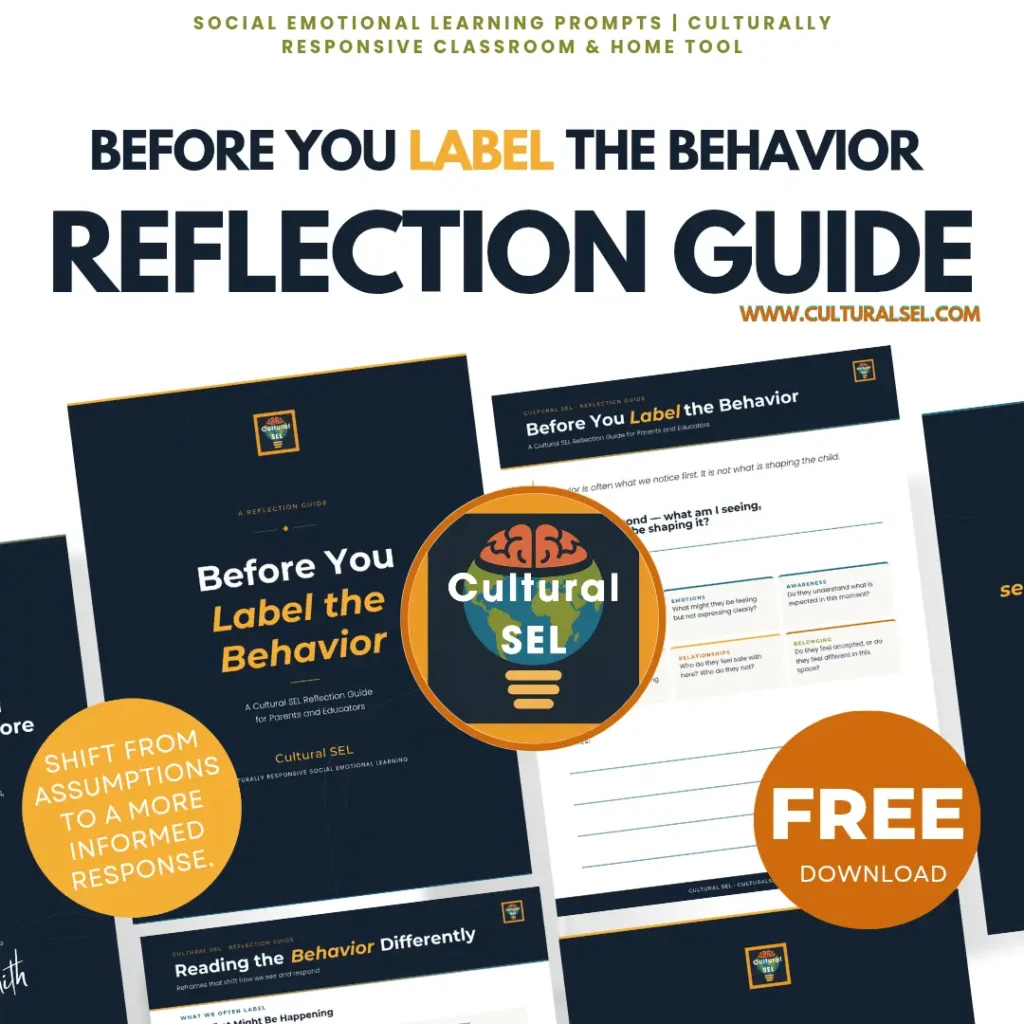
What if the behavior isn’t the whole story?
A free reflection guide that explores what may be influencing a child’s behavior before it is labeled, corrected, or misunderstood.
What Connection Before Correction Means in Culturally Responsive SEL
Connection does not mean removing consequences or lowering expectations. It means helping a student calm down enough to think clearly before correction.
When a student feels threatened, correction sounds like danger. Even polite words can feel like an attack. The child protects themselves. They argue. They laugh it off. They leave. Or they go silent.
Here is the simple brain reason: When stress rises, the amygdala activates. The prefrontal cortex slows down. That is the part of the brain needed for self-control and problem-solving.
A long lecture during an outburst cannot land.
When a student is overwhelmed, they cannot process feedback. Calm comes first because a student cannot use self-control or problem-solving skills while overwhelmed.
In school conferences, I’ve seen how quickly a child shuts down after being corrected in front of a group.
In one instance, a child was publicly called out for interrupting. The child crossed their arms and refused to speak for the rest of the meeting.
Later, when the adult spoke to the child privately and asked what happened, the child explained they felt embarrassed.
The rule about not interrupting stayed the same. The conversation moved to a private setting.
Culturally responsive SEL adds another layer. Students are always asking themselves one quiet question: Is it safe to be myself here?
If adults misread cultural communication styles, students may experience correction as criticism of who they are, not just feedback about behavior.
Connect Now, Correct Later in Culturally Responsive SEL
Connect now means you focus on regulation before instruction.
Correcting later means you return to the expectation once the student can actually process it.
Here’s what that looks like in real time.
A student snaps, “Leave me alone,” and pushes materials off the desk.
In that moment, jumping straight to discipline usually escalates things. Instead, the adult lowers their voice and says,
“I’m here. You’re not in trouble for having big feelings. We’ll talk when you’re ready.”
No lecture. No debate. Just a quick pause.
After a short break, when the student is calmer, the adult circles back. The expectation is still clear. Materials cannot be thrown. Words cannot be used that way. The behavior is addressed.
Correction still happens.
It just happens when the student can hear it.
Why Culture Changes How Students Experience Correction
Respect does not look the same in every family.
Adults sometimes misread behavior because they assume one “right” way to show respect. These differences show up across many communities and families.
What you might see:
A student answers without using titles like “sir” or “ma’am”
What it can mean: Home norms that value direct speech
What you might see:
A child waits to be invited into conversation
What it can mean: Respect for authority or turn-taking
What you might see:
Family members speak for the child in meetings
What it can mean: Collective decision-making at home
What you might see:
A student reacts strongly to public correction
What it can mean: Saving face matters deeply in their community
Bias also plays a role. Some students receive more patience. Others are corrected faster for the same behavior.
Over time, these patterns shape how students see themselves. If correction feels constant or harsher than it does for others, students may stop trying to explain. They may begin to expect misunderstanding.
Noticing these patterns is about awareness. When adults reflect on who they correct first and how they describe behavior, they reduce unnecessary escalation.
Noticing these patterns is not about blame. It protects students. It also protects adults from escalating conflicts they never intended to create.
I’ve seen how quickly adults assume intent instead of asking questions. In one conversation, a parent explained that in their home, children wait to be invited into adult discussion — the “speak when spoken to” rule many of us grew up hearing.
The teacher interpreted silence as avoidance. Once that difference was named, expectations became clearer on both sides.
A Connect-First Script for Managing Student Behavior in the Moment
You do not need perfect wording. A lower voice and fewer words often matter more than the exact sentence.
Connection begins with co-regulation. When your tone rises, theirs often rises too. When you slow your tone, pace, and body language, the student receives fewer signals of urgency or threat. They are more likely to slow down as well.
Keep it brief. Avoid demanding eye contact. Avoid insisting they “fix their face.” Avoid requiring instant compliance. A student cannot regulate on command.
Here is a five-step routine you can use in under two minutes.
- Reduce the audience. Move to a quieter spot or shift attention away from the student. Public attention increases stress.
- Pause before responding. Take one slow breath. Lower your voice slightly and keep your first sentence short.
- Name what you see without blame. “Your hands are tight.” “Your voice got loud.”
- Ask one simple question. “What happened?” “Walk me through what happened.”
- Offer a choice. “Do you want a short break or a quiet corner?”
Add: “We will talk about what happened when you’re ready.”
This approach is for emotional escalation, not physical fights or immediate harm.
Using PACE in Connection Before Correction
PACE describes how you respond so the moment does not escalate further.
Playfulness when it fits, not sarcasm.
Acceptance of the feeling, not the behavior.
Curiosity without interrogation.
Empathy that says, “I’m staying nearby.”
Accepting the feeling does not mean excusing the behavior. It means separating emotion from action so the child can calm down without losing the boundary.
Public correction often escalates. Eye-rolling, sarcasm, or calling out behavior in front of others puts the child on display.
Once a student feels exposed, they are more likely to defend themselves than to reflect.
How to Correct Student Behavior After Regulation
Once the student is calm, move from emotion to accountability.
Start with clarity.
State what happened in plain language.
“This is what I saw.”
“This is what was said.”
Then give space for the student’s perspective.
After that, name the expectation.
“In this space, we do not throw materials.”
“In this classroom, we speak without insults.”
Now build the skill.
Ask, “What can you do next time when you feel that heat rising?”
If they do not know, give options.
End by resetting the relationship.
“We’re moving forward.”
Correction is not a speech. It is a short sequence: name it, own it, plan it, move on.
A Simple Repair Conversation After Student Misbehavior
Use this structure.
- Reconnect. “I’m glad you came back.”
- Reflect. “What happened from your view?”
- Name the expectation. “In this space, we speak respectfully.”
- Plan for next time. “What can you do when you feel that heat rising?”
- Reaffirm the relationship. “We’re good. We’re moving forward.”
If families are involved, focus on partnership rather than blame. Share what happened, describe the plan for next time, and invite their input.
When families feel included instead of judged, they are more likely to collaborate and reinforce the plan at home.
Common Questions About Connection Before Correction
Does This Mean No Consequences?
No. Consequences still happen. The difference is timing. Correction works better after a child can think clearly. The expectation stays the same. The delivery changes.
What If I Do Not Have Time to Connect?
Connection does not require a long conversation. A name spoken calmly. A short pause before responding. A brief check-in later in the day. Small moments reduce repeated conflicts.
What About Serious Behavior?
If there is physical danger, address that immediately. Once the situation is stable, return to accountability and repair. Safety and connection are not opposites.
What If a Student Rejects Connection?
Do not force it. Say, “I’ll check back in five minutes.” Then return when you said you would. Consistency builds trust more than intensity.
How Do I Stay Culturally Responsive If I Am Not From the Same Culture?
You do not need to share a background to show respect. Ask how communication works at home. Notice patterns in who gets corrected first. Adjust where needed.
Why Connection Before Correction Strengthens Culturally Responsive SEL
Connection does not weaken expectations. It makes them clearer.
Students are more likely to accept correction when they feel respected. They are more likely to take responsibility when they are not defending themselves.
This is not about avoiding discipline. It is about improving how discipline works.
Build safety first.
Then address the behavior.
Then teach the skill.
If you want to start small, choose one sentence you will use consistently this week:
- “I’m here.”
- “We’ll talk when you’re ready.”
Then watch what changes in the room. Notice how often the arguing stops when your first response is firm and brief instead of confrontational.
Connection does not remove accountability.
It makes accountability more effective.
CONTINUE EXPLORING CULTURAL SEL
Explore free Cultural SEL guides, culturally responsive SEL tools, and practical resources for understanding how cultural environments, identity, belonging, relationships, and lived experiences connect with children’s social and emotional development.
📌 Save or share this post with someone who is raising, teaching, or guiding children.

Hi, I’m Faith, the creator of Cultural SEL
I create practical tools and resources that support children’s social and emotional development and help parents, caregivers, educators, and community professionals look beyond behavior labels.
My work focuses on how cultural environments, identity, belonging, relationships, and lived experiences shape what children experience and how adults interpret and respond.
Read more about Faith and Cultural SEL: https://culturalsel.com/about
Join the Cultural SEL community: https://culturalsel.com/fb